If anyone is using my E8 to H4 folding matrix in their research, this post provides a bit of context from the original form (2012-2014) as it was improved to the current form. Drop me an email if you are using my work or have questions, or find errors, etc.
See here (Baez), here (Castro-Perelman), here (Schmidt), here (Ruen on WP E8 Polytope D4-E6 “Mox” projections) for properly cited examples.

I am working with a few who are using my work on cryptography, quantum computing, and computation optimization, but they have yet to post or publish results.
Of course, many authors may or may not be aware of their use of my prior art (so it goes without citation) e.g. here (Nielsen) using the fine structure constant α-n as a hyper-dimensional geometric nD scaling factor for the fundamental constants, such as my definition of a new Unit of Measure (UoM) distinct from Natural Units from 1998-2001).
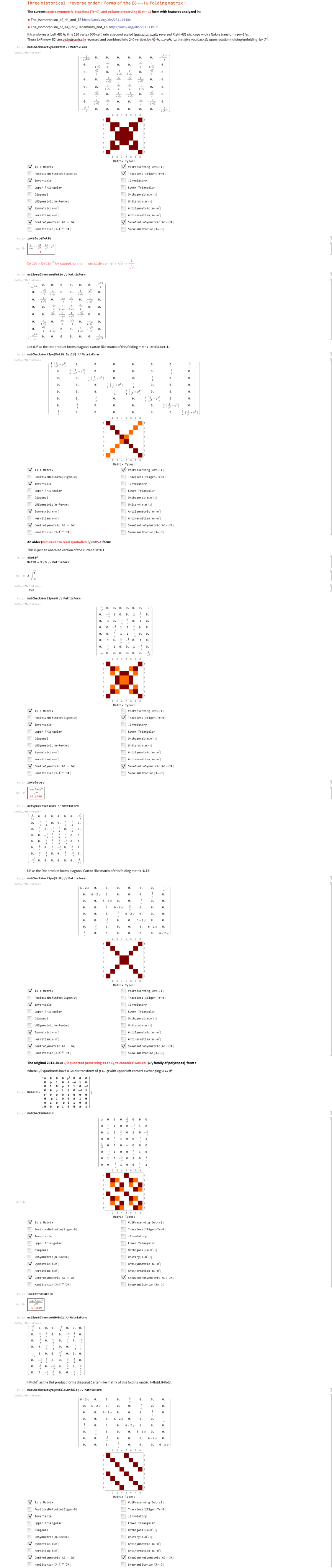
The image below is also available as a Mathematica notebook (NB) or PDF. Click the PNG image for the SVG version.
The first part reviews the current Hermitian, centrosymmetric, traceless (Tr=0), and volume preserving (Det = 1) form of the folding matrix (U).
The last part reviews the traceless Hermitian unitary matrix (uU) of determinant 1 (i.e. A7=SU(8)) with characteristic polynomial |coefficients| of the 5th row of the Pascal triangle (1,4,6,4,1}. This matrix has the same characteristic polynomial as that of the 3-Qubit Hadamard matrix. Both are related to QM Hadamard, CNOT and SWAP gates and Pauli matrices from which it, cmU, and U are constructed.
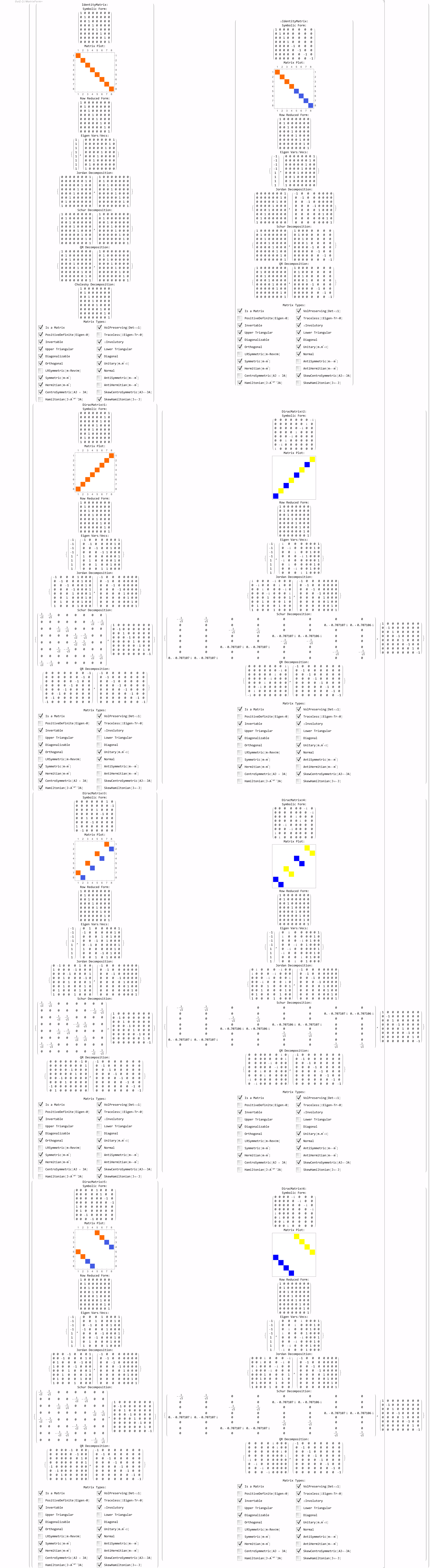
Below that is another matrix analysis of the 6 8×8 Dirac matrices (i.e. DiracMatrix[#, Dimension -> 6]&/@Range@6) with the Identity and +/- Traceless Identity matrices prepended. These have similar properties to uU with the addition of being (skew)Hamiltonian matrices.
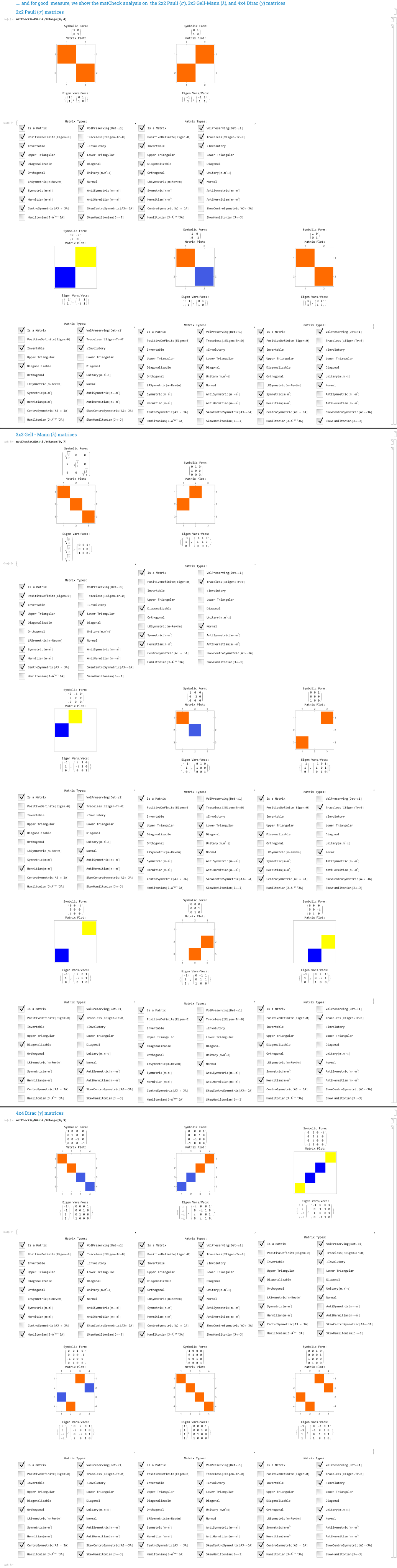
Now for good measure, we show the matrix characteristics of the 2×2 Pauli, 3×3 Gell-Mann, and 4×4 Dirac matrices:
And finally, we analyze the 8×8 Dimension 6 n=4 Dirac Matrices:
