Please refer to the Baez blog post here.
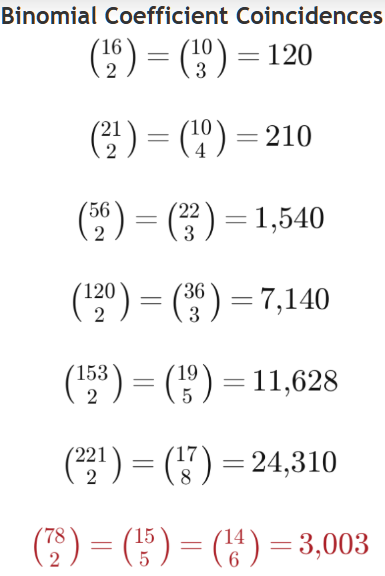
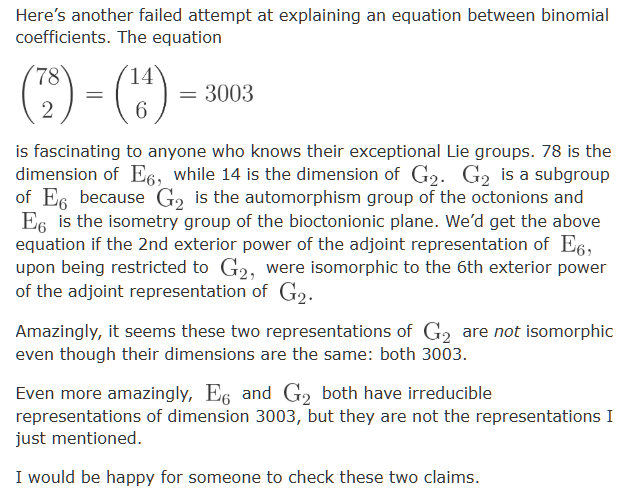
My first reaction is to question whether the “isomorphism of the irreducible representations (of the given orbit dimension)” is or is not over-constraining the binomial’s numerical pattern match.
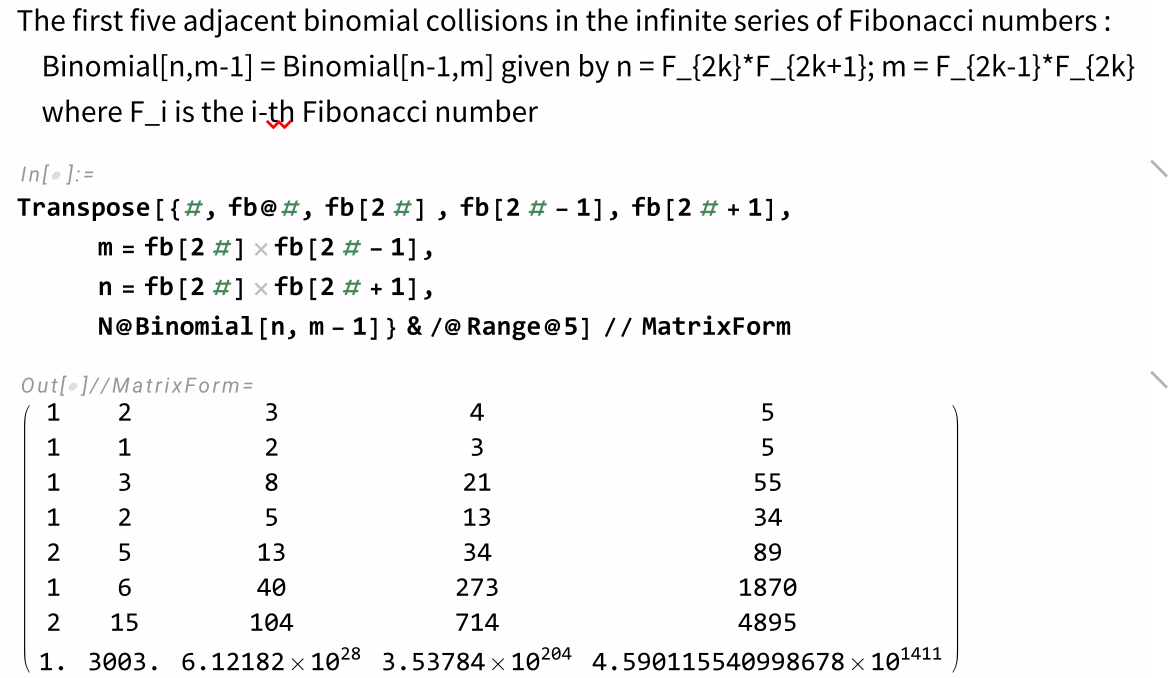
G2 has 3 and E6 has 8 representations of orbit dimension 3003 (each shown below). I found a possible alternate path via Λ SU(4) = ΛSO(6) with the Binomial[15,5]=3003. Yet, these groups don’t have natural orbits of 3003 as E6 and G2 do. The two adjacent binomials in this 3003 triplet of collisions, namely Binomial[14,6] and Binomial[15,5], are part of the known infinite series of solutions with k=2 for binomial(n,m-1) = binomial(n-1,m) given by n = F_{2k}*F_{2k+1}; m = F_{2k-1}*F_{2k} where F_i is the i-th Fibonacci number.
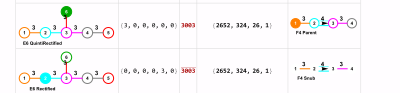
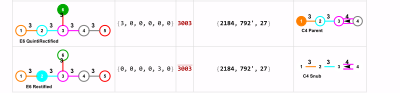
Below are the related maximal subgroups for G2 and E6. The first column shows the G2 or E6 Coxeter-Dynkin diagram. The second column is the Weyl orbit. The third column is the identified maximal subgroup elements in the 3003 rep. The fourth column shows the maximal subgroup content and the fifth column shows its Coxeter-Dynkin diagrams.
Please forgive (ignore) my use of filled instead of ringed nodes. The relevant information is the subgroup content in the third column.









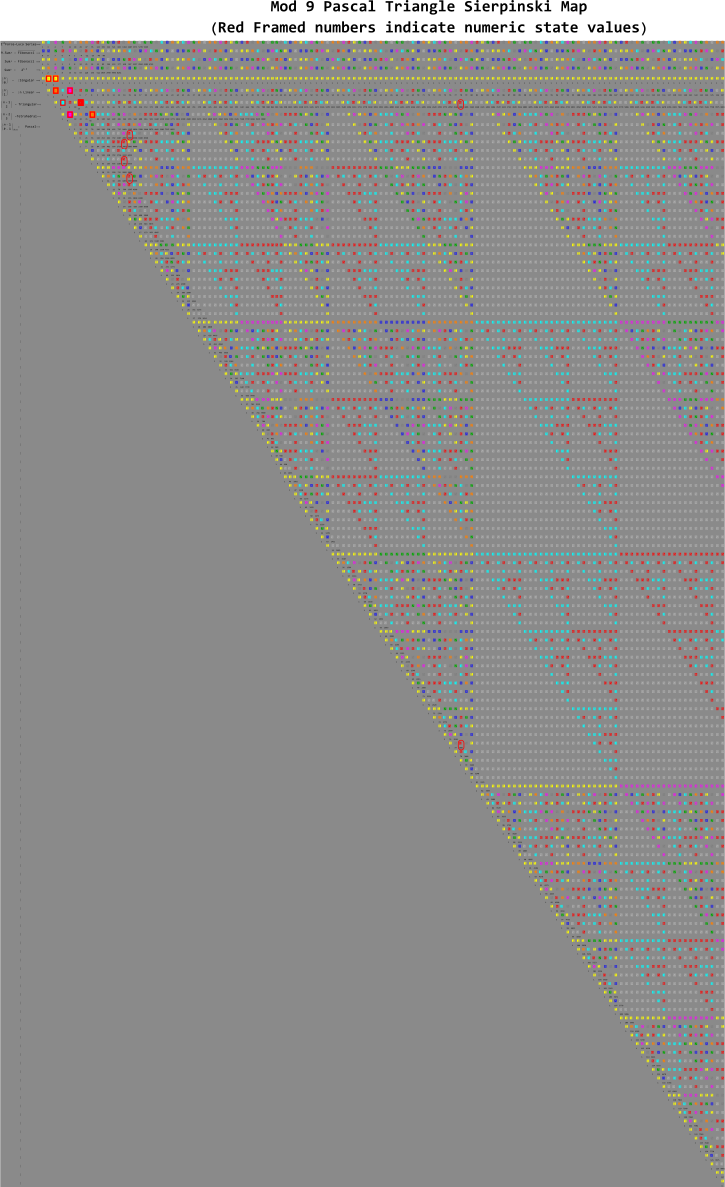
The image below was created from Pane #2 Math: Number Theory: Mod 2-9 Pascal and Sierpinski Triangle. It is used here to annotate the above binomial collisions which are all contained in the standard Pascal Triangle.
This #2 pane (Pascal) was created for visualizing the Pascal and Sierpinski triangles, along with the Fibonacci and Lucas numbers. In addition to allowing the change in size of the triangle, it highlights the binomial functions and allows the changing the modulus of the numbers used. The number backgrounds are colorized in the selected gradient. This pane was created with ideas from Peter S. Williams’ Mod 9 Pascal Triangle Physics http://naturalnumber.com/