Please refer to the Baez blog post here.
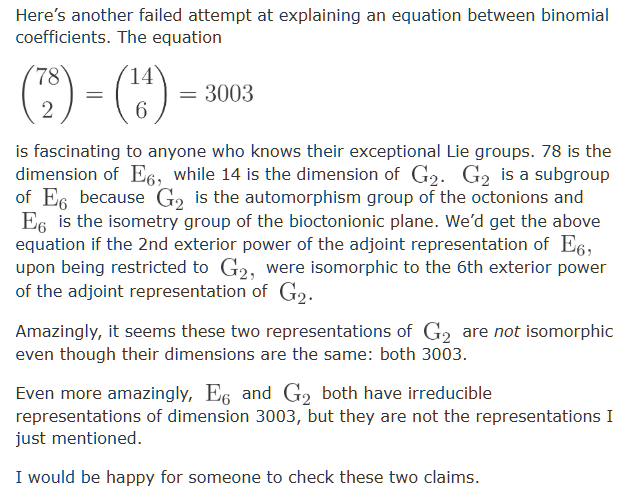
My first reaction is to question whether the “isomorphism of the irreducible representations” is or is not over-constraining the binomial’s numerical pattern match.
I found a possible alternate path via Λ SU(4) = ΛSO(6) with the Binomial[15,5]=3003.
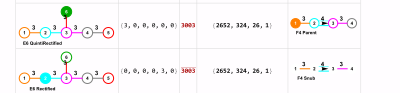
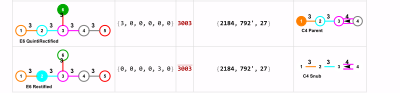
G2 has 3 and E6 has 8 representations of orbit dimension 3003 (each shown below).
The first column shows the G2 or E6 Coxeter-Dynkin diagram. The second column is the Weyl orbit. The third column is the identified maximal subgroup elements in the 3003 rep. The fourth column shows the maximal subgroup content and the fifth column shows its Coxeter-Dynkin diagrams.
Please forgive (ignore) my use of filled instead of ringed nodes. The relevant information is the subgroup content in the third column.