Category Archives: Physics
A ToE should…
An interesting post re:qualifications for a ToE prompted me to jot down my initial list of requirements. A ToE should inform, expand on, or rationalize, in a mathematically self consistent and rigorous way, the state of the current SM & GR confirmed experimental data:
1) Prescription (aka prediction, retrodiction or specific rationalization) for 3 generations of fundamental fermion and boson particles (and their resulting composite particles), including: charge, spin, color, mass, lifetime, branching ratio, and scattering amplitudes (aka. S-Matrix)
2) Prescription for CKM and PMNS unitary matrices and CPT conservation
3) Framework for the integration of QM and GR, including e/m, weak, strong and gravitational forces
4) Explanation for dark energy and dark matter in proportion to visible matter
5) Solution to the hierarchy problem
6) Provide a realistic computational model based on the above for the evolution of the Universe from BB to present
7) Explain an arrow of time that is consistent with GR and QM CPT conservation symmetries
…
Non-specific general appeals to the anthropic principle, landscapes, and/or multiverses tend to excuse or avoid prescription and thus become a benign point (or possibly even meta-physical or philosophical), such that they are not considered supportive of an actually verifiable (aka. scientific) theory.
If the theory says “we can’t know” or “we can’t measure” or “it just is that way” – it isn’t science or part of a ToE. again – my opinion and definition of “science”.
There is redundancy in this list, that is expected (even required). Of course, the beauty of the theory would be in conclusively demonstrating that throughout!
Until we can study an actual ToE that is put on the table – the list is only a guide to what might be needed. I am working on a ToE, but it doesn’t yet meet all the criteria (it’s hard work 😉
IF we have a ToE and really understand it, we should, as Feynman suggested, be able to explain it in plain language to anyone. But in the current state of physics, a completed ToE does not yet exist.
IMO, a ToE is about knowing the Universal Laws of Physics (ULPs). It isn’t, in detail, involved in knowing the Universal Initial Conditions UICs).
If you believe that the laws of “climate science” are known (don’t get me started…), then the only problem with predicting the weather is not so much about NOT knowing the laws – it is about not knowing with sufficient accuracy the initial conditions (location & momentum) of enough particles in the system. We’re missing the “butterfly flapping its wings in the Pacific” data points.
The Copenhagen interpretation of QM suggests that is impossible in principle to know any quantum system ICs (vs. the deterministic formulation of QM by DeBroglie-Bohm). Either way, my view is ToE=ULP.s w/o UICs. So prediction of all long term events specifically (like what I will think about next) is NOT the goal.
We just need enough of an idea about the UICs to initiate the computer model so it comes out close enough to get Earth like planets with weather and life forms thinking about this topic.
Easier, but NOT easy!
The Imaginary, Irrational and Transcendental in Linear Algebra and Trigonometry
E8 in E6 Petrie Projection
An article (interview) with John Baez used an E8 projection which I introduced to Wikipedia in Feb of 2010 here. Technically, it is E8 projected to the E6 Coxeter plane.

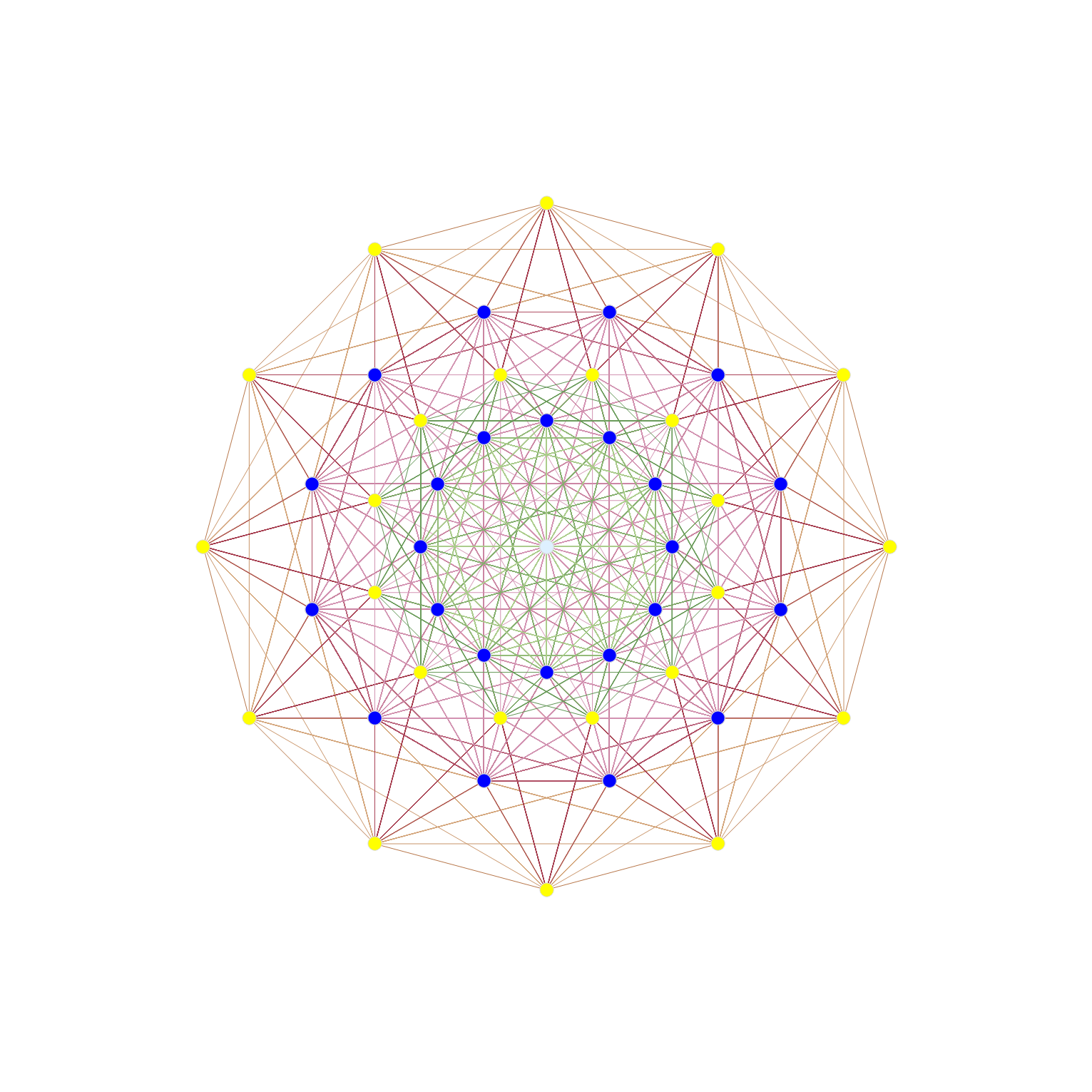
The projection uses X Y basis vectors of:
X = {-Sqrt[3] + 1, 0, 1, 1, 0, 0, 0, 0};
Y = {0, Sqrt[3] – 1, -1, 1, 0, 0, 0, 0};
Resulting in vertex overlaps of:
24 Yellow with 1 overlap
24 Dark Blue each with 8 overlaps (192 vertices)
1 Light Blue with 24 overlaps (24 vertices)
After doing this for a few example symmetries, Tom took my idea of projecting higher dimensional objects to the 2D (and 3D) symmetries of lower dimensional subgroups – and ran with it in 2D – producing a ton of visualizations across WP. 🙂
It was one of those that was subsequently used that article from the 4_21 E8 WP page.
Here is a representation of E6 in the E6 Coxeter plane:
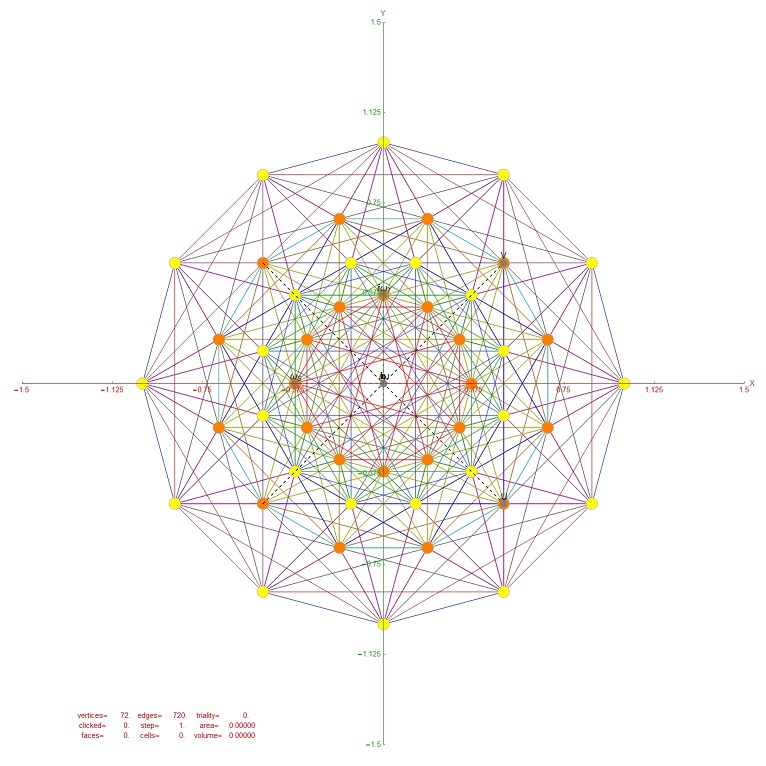
Resulting in vertex overlaps of:
24 Yellow with 1 overlap
24 Orange each with 2 overlaps (48 vertices)
The Sedenion “Fano Tesseract” Animation
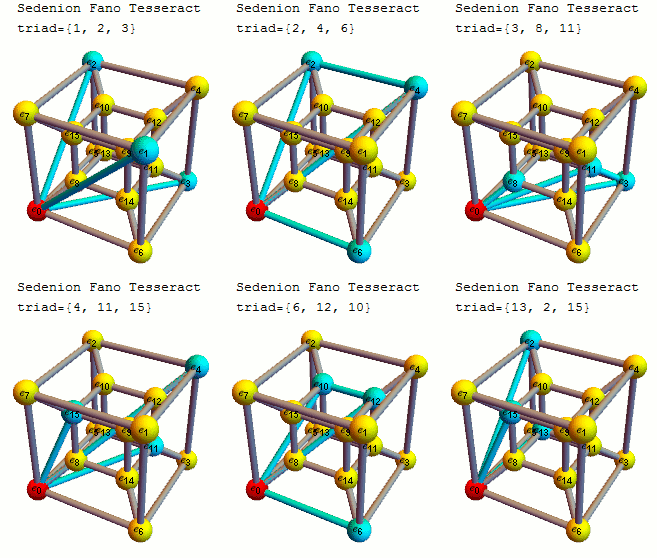
In order to better visualize the sedenion Fano Tesseract, I’ve created an animation that steps through highlighting the vertices and edges of the triads that make up its multiplication table.
I start by showing the simpler octonion version – an 8 dimensional (8D) “Fano Cube” projection. The example octonion is the one (of 480) shown on the octonion Wikipedia article.
[wlcode]{{1, 2, 3}, {1, 4, 5}, {1, 7, 6}, {2, 4, 6}, {2, 5, 7}, {3, 4, 7}, {3, 6, 5}}[/wlcode]
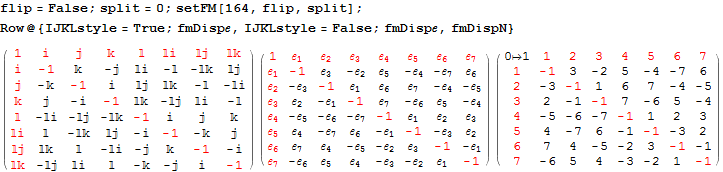
The Fano Cube (as introduced by John Baez here) is created from the ubiquiteous “Fano Plane” by keeping the Real component (e_0) of octonions and requiring that each line of the plane be shown as a hyper-plane through e_0. Each animation step is one of 7 triads representing the triality of 3 vertices in that particular octonion multiplication table:
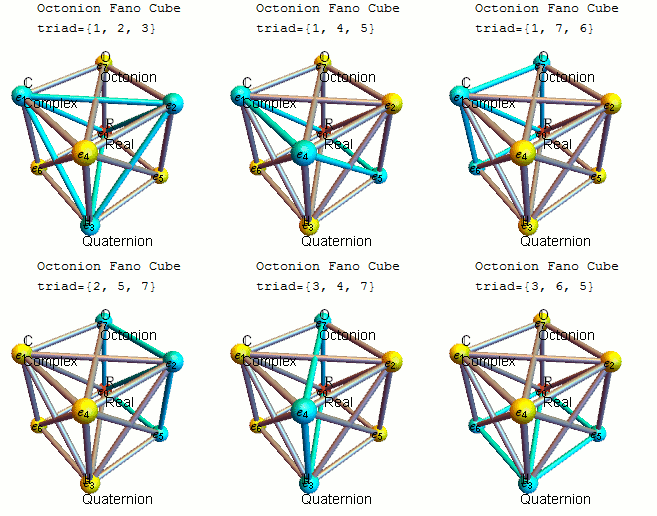
The 16D sedenion (one of many possible) used in this post uses the Cayley-Dickson doubling procedure on the “parent octonion” (above). The Fano Tesseract is created in the same manner as the octonion visualization, which uses the 16 vertex tesseract to show the sedenon’s 35 triads (with the triads from the “parent octonion” highlighted in red):

Introducing the Sedenion Fano Tesseract Mnemonic
The Sedenion “Fano Tesseract” Mnemonic is an extension of the “Fano Cube” idea introduced by John Baez in his much cited blog post. The Fano Cube identifies each valid each triad by a hyper-plane which intersects the e_0 node.
Notice in this VisibLie_E8 output for the pane #3 “Fano Visualization Demonstration”, there are 35 sedenion triads, 7 of which are from the octonion used as an upper left quadrant base for a Cayley-Dickson doubling (highlighted in red).
The 16 vertices of the tesseract are sorted by the same “triad flattening” process used to construct a consistent Fano Plane Mnemonic for all 480 unique octonion multiplication tables.
As in the Fano Cube, the edges are highlighted in Cyan if they are selected in the n1-n3 buttons. Unlike the Fano Plane and Cube, the edges represented by the split octonion multiplication table columns/rows are not highlighted in red.
While there are 32 edges in the formal tesseract, each valid sedenion triad is identified by a hyper-plane which intersects the e_0 node, which are not necessarily those of the formal tesseract.
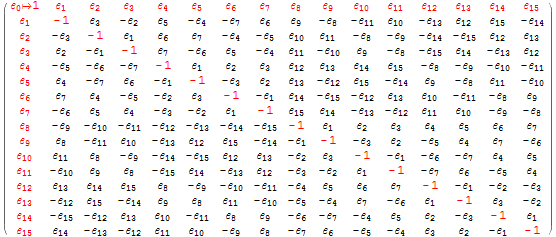
Here is the computation of the same sedenion table given in the Sedenion Wikipedia article as well as from this website: http://www.derivativesinvesting.net/article/307057068/a-few-hypercomplex-numbers/, which uses the harder to read IJKL style notation.

Incorporating Sedenions into the VisibLie_E8 visualizer
Here is a snapshot of the UI.
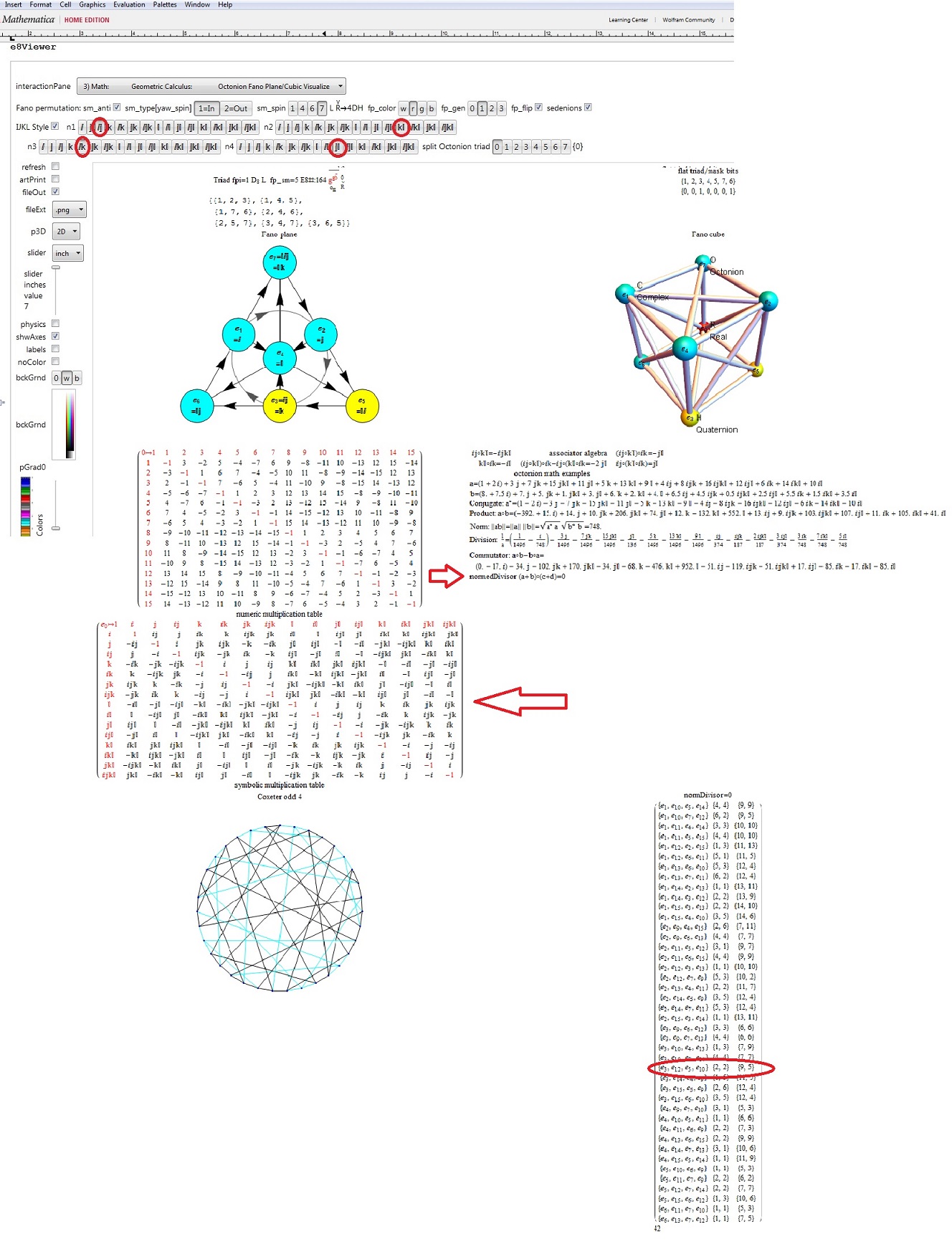
It is taken from an example given on this website: http://www.derivativesinvesting.net/article/307057068/a-few-hypercomplex-numbers/, which uses the harder to read IJKL style notation.
Compare the upper left quadrant of the multiplication table. It is the same as the octonion of E8 #164 (non-Flipped) used to generate the sedenion using the Cayley-Dickson doubling. It can be read off using the Fano Plane (or Fano Cube) mnemonic. My next post will show the Sedenion forms of these, namely the Fano Tetrahedron and Tesseract!
Notice the highlighting of the interesting aspect of sedenions, where some non-zero p=a+b and q=c+d give a product pq=0. These are given in a list of the {a,b,c,d} where p={a+b} and q={c+d} and pq=0 (along with the deltas between the indices), always 42 excluding trivial juxtapositions. In this case, it is the row entry with {3,12,5,10}.
Here is the computation of the same table in the format given in the Sedenion Wikipedia article.
G2 as the automorphism group of the (split) octonion algebra
More recent related developments are here.
For more information on this, please see this Wolfram MathSource page.
This post describes the derivation of G2 automorphisms for each of the 480 unique octonion multiplication tables, as well as each of the 7 split octonions (created from negating the 4 row/column entries which are not members of the split #, which is an index to one of the 7 triads that make up the octonion).
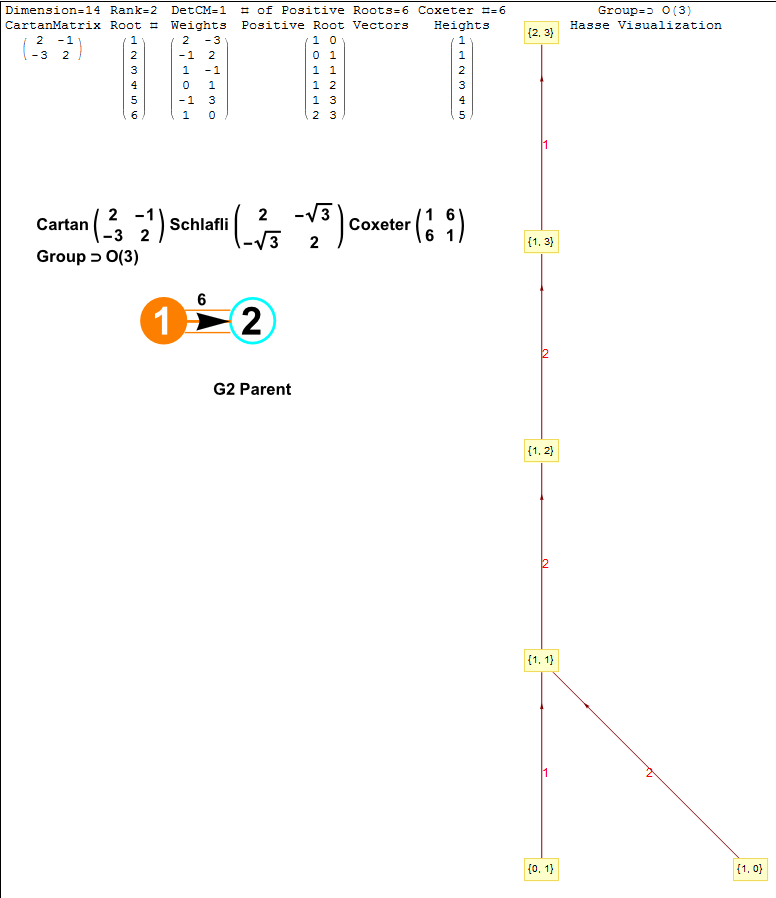
The Exceptional Lie Algebra/Group G2 is identified by its Dynkin diagram and/or associated Cartan Matrix (also shown here with its Hasse diagram):
The particular octonion multiplication table selected in the example referenced above is associated in my model as a “Non Flipped E8 #164”. The multiplication table in various formats (IJKL, e_n, and Numeric) is:
The selected multiplication table (fm) is the basis for the following octonion symbolic math:
[wlcode](* Octonion math from the matrix using 8D vector representations for x and y, this has the Subscript[\[ScriptE], 0]=1 first *)
octProduct[a_, b_] := Block[{c3 = Array[0 &, 8]},
Do[c3[[If[i != j, Abs@fm[[i, j]] + 1, 1]]]+=Sign@fm[[i, j]] a[[i]] b[[j]],
{i, 8}, {j, 8}];
Chop@c3];
(* Complex, quaternion and octonian multiplication Subscript[\[ScriptE], a]\[SmallCircle]Subscript[\[ScriptE], b] *)
quat2oct@in_ := Block[{a3},
If[QuaternionQ@in,
a3 = FromQuaternion@in;
Switch[Length@a3,
0, Re@a3 + Im@a3 Subscript[\[ScriptE], 1],
2, If[Length@a[[1]] > 0, a3,
If[Head@a3 === Times, a3[[1]] a3[[2]],
1\[SmallCircle](Re@a3[[1]] +
Im@a3[[1]] Subscript[\[ScriptE], 1]) + a3[[2]]]],
3, Re@a3[[1]] + Im@a3[[1]] Subscript[\[ScriptE], 1] +
a3[[2 ;;]]],
“not Quaternion”] /. Most@Thread[octIJKL -> oct]];
(* Octonion math with conversions, leave final as octonion *)
SmallCircle[a_List, b_List] := octonion@octProduct[a, b];
SmallCircle[a_, b_Quaternion] := a\[SmallCircle]quat2oct@b;
SmallCircle[a_Quaternion, b_] := quat2oct@a\[SmallCircle]b;
SmallCircle[a_, b_Complex] := a\[SmallCircle]ToQuaternion@b;
SmallCircle[a_Complex, b_] := ToQuaternion@a\[SmallCircle]b;
SmallCircle[a_, b_] := oct2List@a\[SmallCircle]oct2List@b;
associator[a_List, b_List,c_List] := (a\[SmallCircle]b)\[SmallCircle]c-a\[SmallCircle](b\[SmallCircle]c);
associator[a_, b_, c_] :=associator[oct2List@a, oct2List@b, oct2List@c];[/wlcode]
Each set of 21 upper triangle pairs of octonion elements (utOct) has 14 “derivations” which are null
(alternatively, the NullSpace of the derivation vectors of utOct has 7 which are NOT null…)
A derivation pair D_{x, y} is defined by:
[wlcode](* Commutator *)
commutator[x_,y_]:=x\[SmallCircle]y-y\[SmallCircle]x;
CircleDot[x_,y_]:=commutator[x, y];
(* Commutator matrix *)
comMat[x_, y_] := x.y – y.x;
comMat[{x_, y_}] := comMat[x, y];
(* Derivation matrix and vector *)
derivation[x_,y_][a_]:=(x\[CircleDot]y)\[CircleDot]a-3 associator[x,y,a];
Square[{x_, y_, a_}] := derivation[x, y][a];
derMatrix[x_,y_]:=Table[Coefficient[\[Square]{x,y,oct[[i]]},oct[[j]]], {j, 7}, {i,7}];
derVector[x_,y_]:=derMatrix[x, y]//Flatten;[/wlcode]
The 14 null pairs define G2 for a SPECIFIC octonion multiplication matrix.
For each of 7 non-null derivations there is a triple of D_{x1, y1}=D_{x2, y2}+D_{x3, y3} related derivations.
There is a 7×21 matrix describing the non-NullSpace for the octonion given in the Wolfram MathSource reference above along with the 7 non-null triples. This is generated by g2Null:
[wlcode]g2Null:=NullSpace[derVector[Subscript[\[ScriptE], #1], Subscript[\[ScriptE],#2]]&@@@utOct//Transpose];
(* Formatting all non-Null upper triangle pairs derivation entries *)
outG2Null := MatrixForm[parallelMap[Grid[{
{Row[
Subscript[D, Row@Flatten@##] & /@
Partition[Flatten@{utOct[[Flatten@Position[#, -1]]]}, 2]]},{“==”},
{Row[
Subscript[D, Row@Flatten@##] & /@
Partition[Flatten@{utOct[[Flatten@Position[#, 1]]]}, 2]]}(*),
{“\[LongDash]\[LongDash]\[LongDash]\[LongDash]”}**)}] &,
g2Null]];[/wlcode]
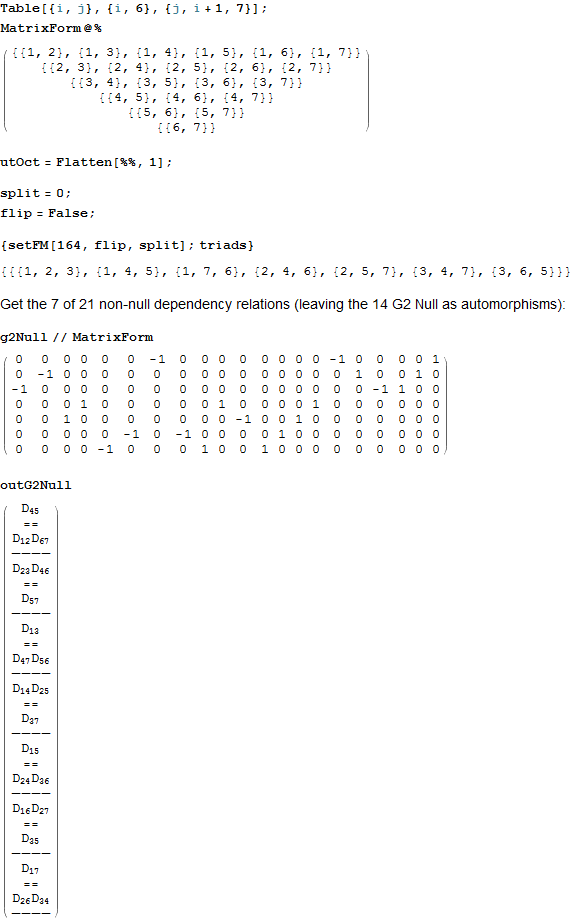
getG2Null (below) retrieves two octonion multiplication matrices for the flipped and non-flipped index on one of 240 E8 particles.
[wlcode]formG2Null := MatrixForm@{
Row@{Style[Row@{“flip=”, flip}, Blue],
Style[” split # \[DownArrow],”, Red]},
g2NullTbl = Table[{
split,
setFM[#, flip, split];
outG2Null},
{split, 0, 7}];
Row@triads,
MatrixForm[Column[#, Center] & /@ noNull@# & /@ Table[
(* Color the common Der in each column *)
cmnD =first@Select[g2NullTbl[[All,2,1,i,1,3,1,1,All]],
Length@# == 1 &];
cmnDclr = Style[cmnD, Magenta];
If[j == 1, {“”, Row@{
(* Highlight the missing index in the triple D_{x,y} for each row *)
Style[Complement[Range@7,Union@Flatten@g2NullTbl[[All,2,1,i,1,3,1,1,All,2,1]]][[1]],Darker@Green],
g2NullTbl[[1, 2, 1, i]] /. cmnD -> cmnDclr}},
(* Display only non-null derivations from the splits if not the same as the base octonion *)
If[g2NullTbl[[1,2,1,i]] =!= g2NullTbl[[j,2,1,i]],
{Style[g2NullTbl[[j, 1]], Red],
g2NullTbl[[j,2,1,i]] /. cmnD -> cmnDclr}]],
{i,7},{j,8}]]} &;
getG2Null := ColumnForm[{
Style[Row@{“E8#=”, #}, Darker@Green],
Row@{flip = False; formG2Null@#, flip = True; formG2Null@#}},
Center] &;[/wlcode]
Here we show the output of getG2Null for the example non-Flipped E8 #164):

Emergent patterns:
- For each of the 7 non-null derivation triples (the first column of the 7 rows), there are precisely 3 (of the 7) split octonions that don’t share the exact same non-null triple derivation pair as the parent (non-split) octonion (these deviations are shown in column 2 thru 4, along with the associated Fano plane diagrams for the parent and 7 split octonions of E8 #164).
- Each non-null derivation triple contains 6 of 7 indices, and each row is missing a different index (highlighted in green before the column 1 triple). The sequence of missing element numbers in each row of the given example follows the row number.
- It is only the equality relationship (signs) of the non-Null triple that change in 3 of the 7 splits, not the D_{x,y} itself.
- There are always 2 pairs of 2 D_{x,y} which are negative (i.e. with a -1 entry in the NullSpace matrix located above the “==”) that occur across the row.
- There is always a common positive D_{x,y} (i.e. with a +1 entry in the NullSpace matrix located below the “==”) in each entry of the row (colored magenta). The common positive entries in the 7 rows suggest a “distinguished” non-null indicator for the 14=21-7 G2 automorphism.
- All octonion multiplication matrices have the first 3 rows of distinguished entries of {6,7},{5,7} and {5,6} in that order (i.e. the last 2 rows of utOct).
- There are several possible choices for G2 automorphism sets of 14 elements within each of 480 octonions based on the 7 non-Null entries. Interestingly, there are the 4 sets of rows in utOct which sum to 14 elements, specifically rows {{1, 2, 4}, {1, 2, 5, 6}, {1, 2, 4, 6}, {2, 3, 4, 5}}). The distinguished entries of the flipped E8 #164 example below (as in the MathSource post referenced above) suggests a G2 created by rows {1,2,4} of utOct. Although, not all G2 sets must use complete rows as in this example.
This is octonionG2-nonNull, a 480 page (15 MB) which lists each of the 7 non-Null parent octonion derivations (and for each of those, the 3 other split octonion non-null derivations) which are NOT a member of the 14 null derivations for each of 480 octonion multiplication matrices and 7 splits for each (480*8=3840). It includes the Fano plane mnemonics for the parent and 7 split octionions. This is a smaller 240 page (1MB) version of octonionG2-nonNull.pdf without the Fano plane mnemonics.
Octonion triality testing
I am working on validating some theoretical work on the triality automorphisms of the split octonions. This is a post with preliminary work on that… for those who are interested 🙂
BTW – It requires the here.
An addendum to the original post (below):
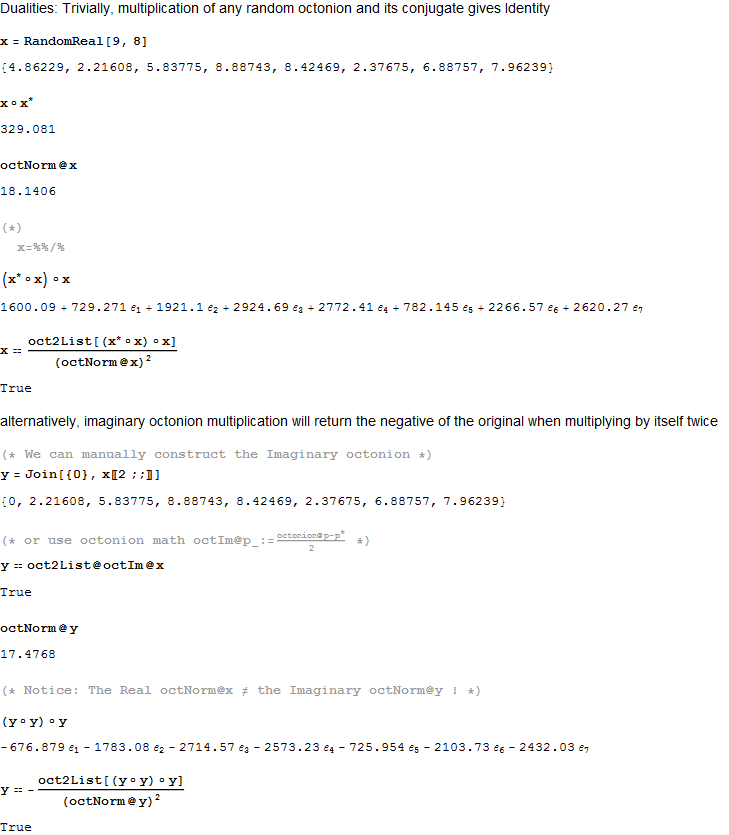
[WolframCDF source=”http://theoryofeverything.org/TOE/JGM/octonion triality checks.cdf” width=”900″ height=”8000″ altimage=”http://theoryofeverything.org/TOE/JGM/octonion triality checks.png” altimagewidth=”900″ altimageheight=”8000″]
Testing the new site
Testing the new site