
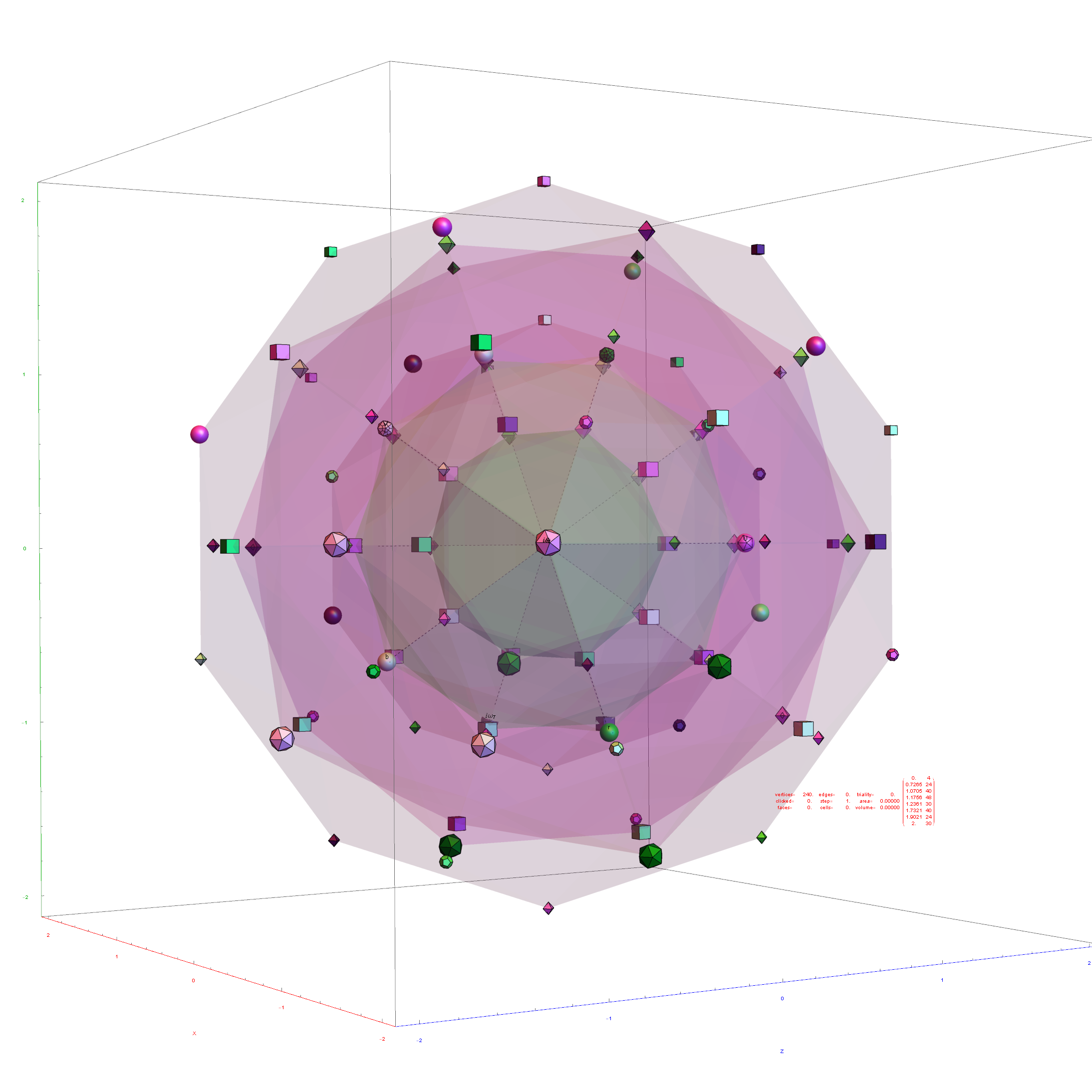
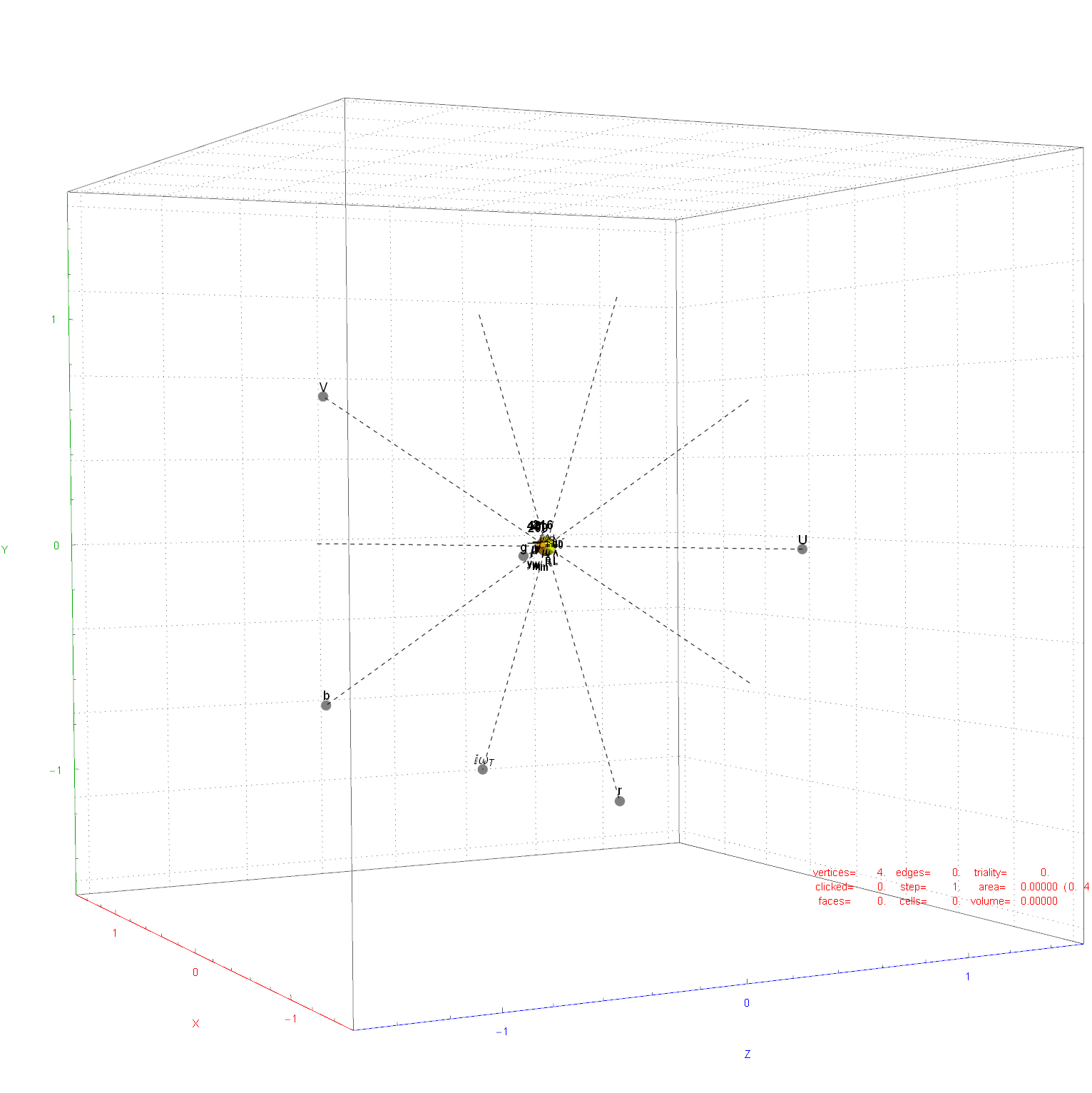
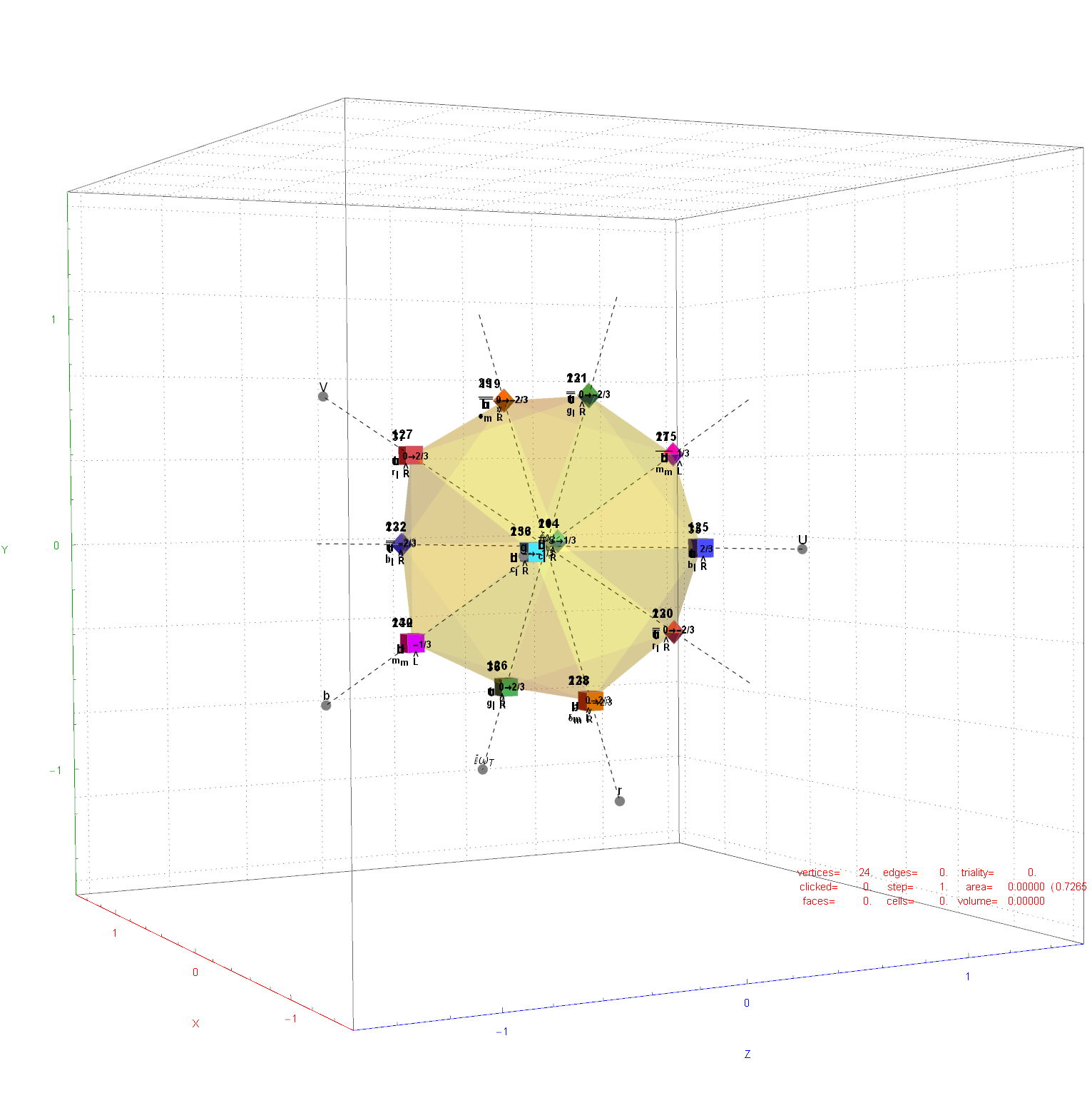
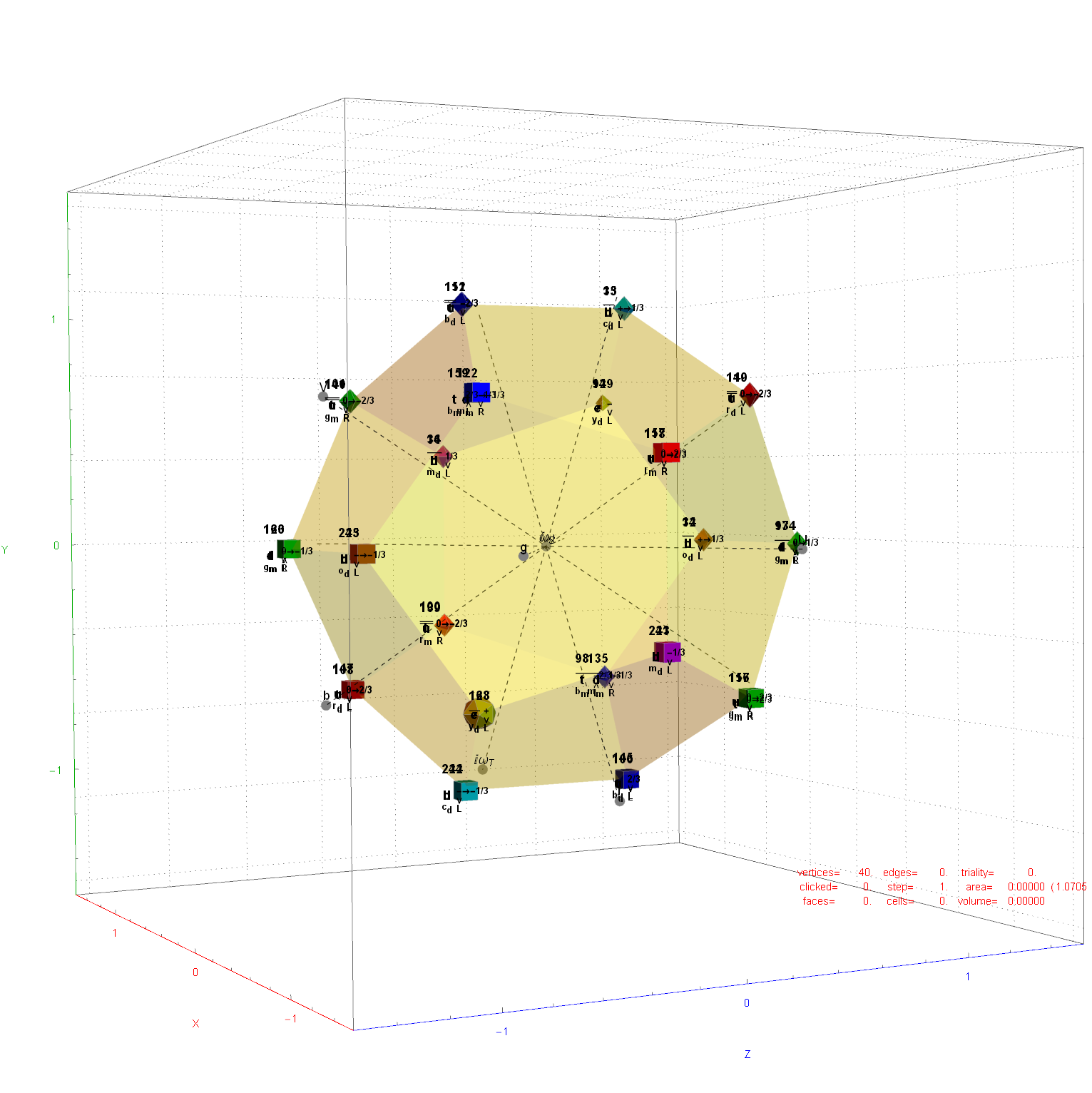
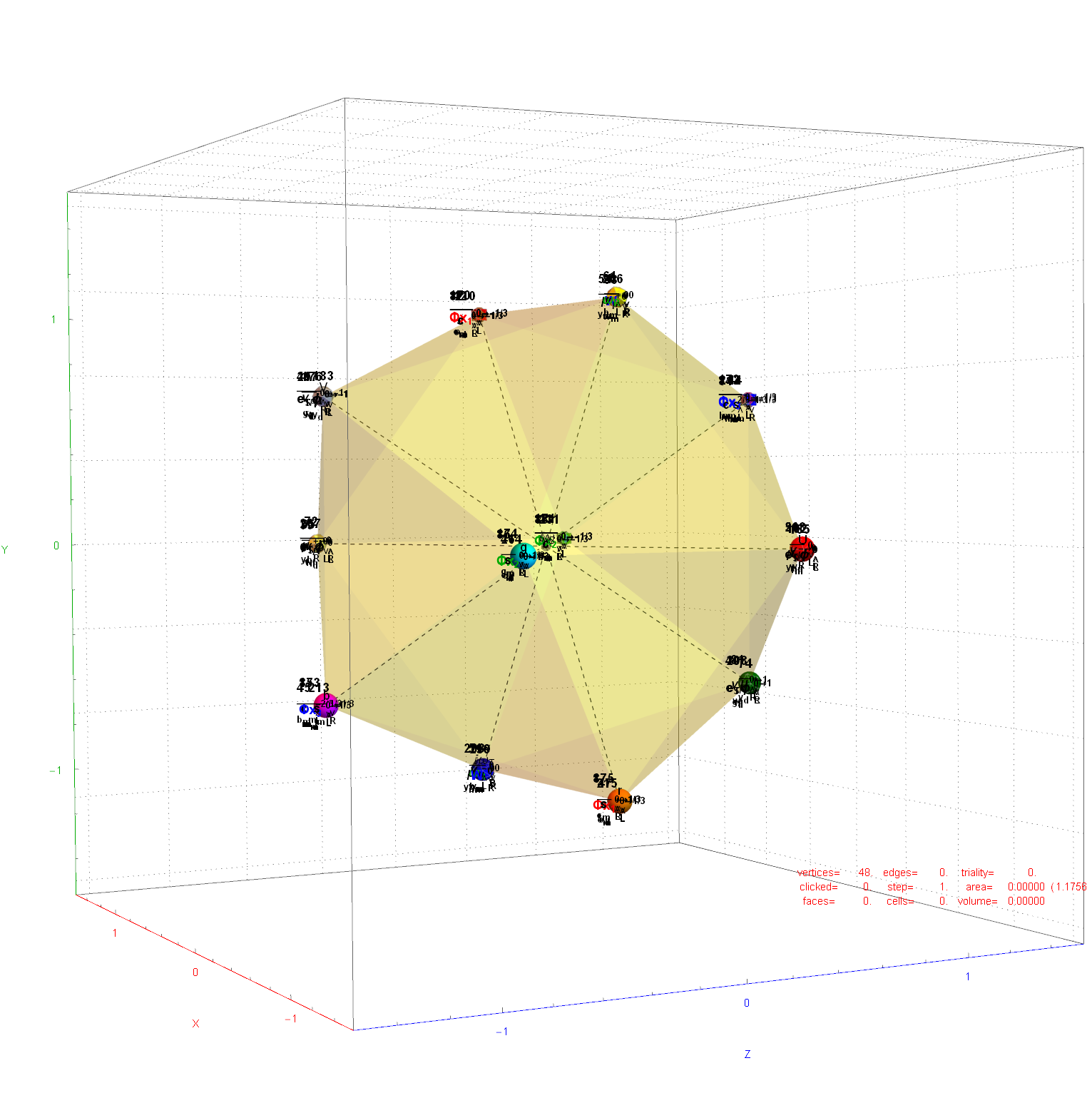
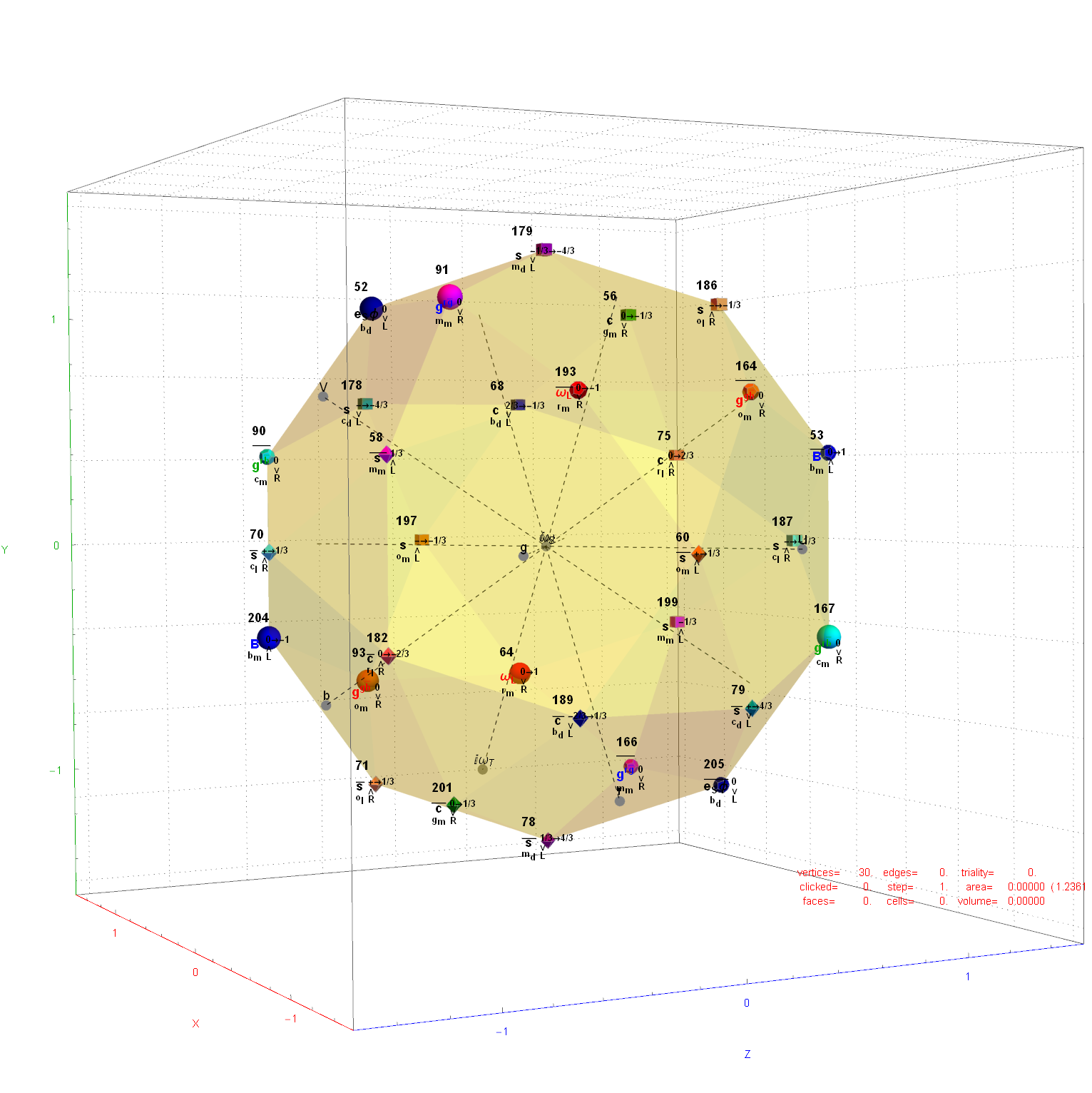
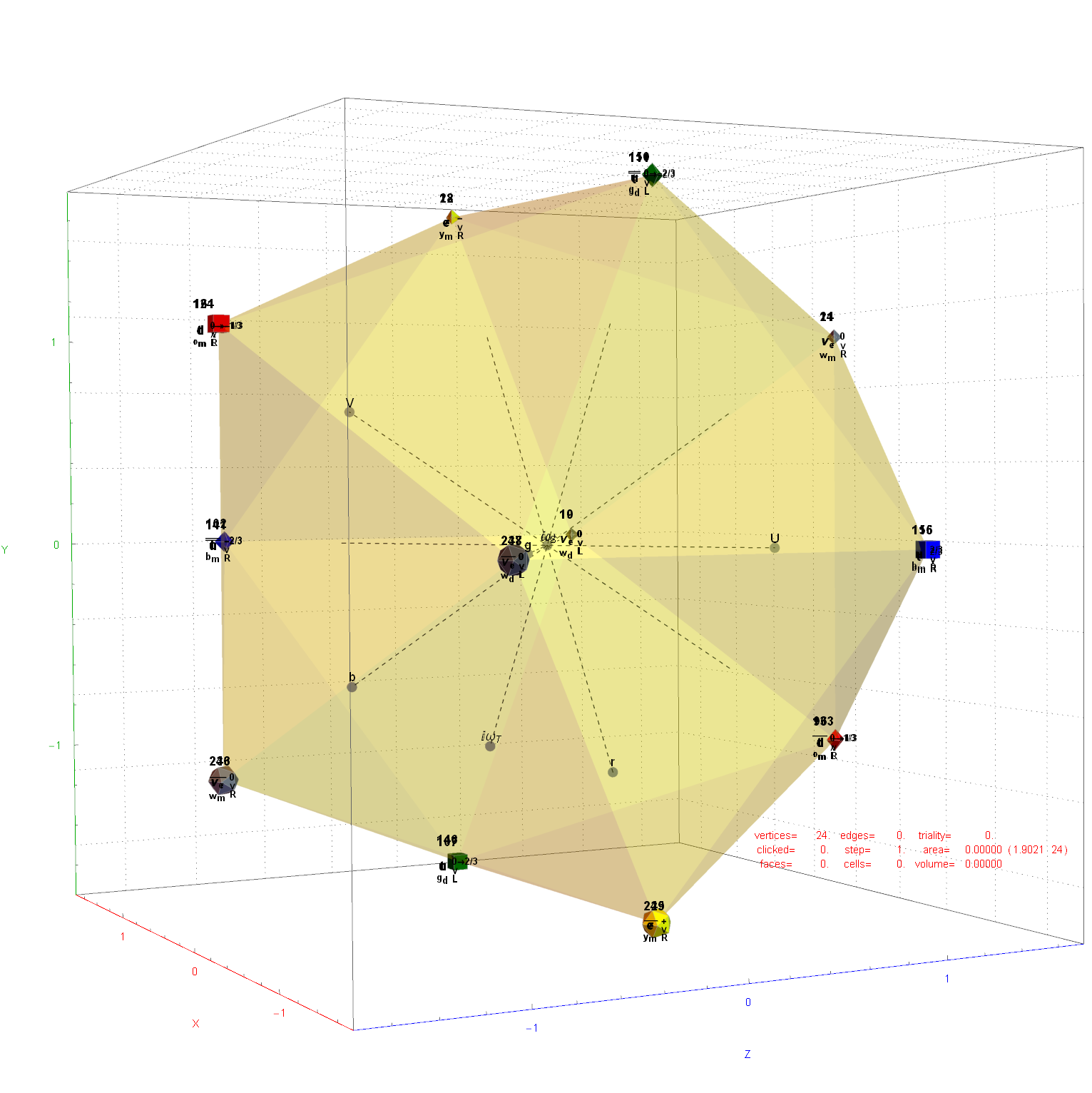
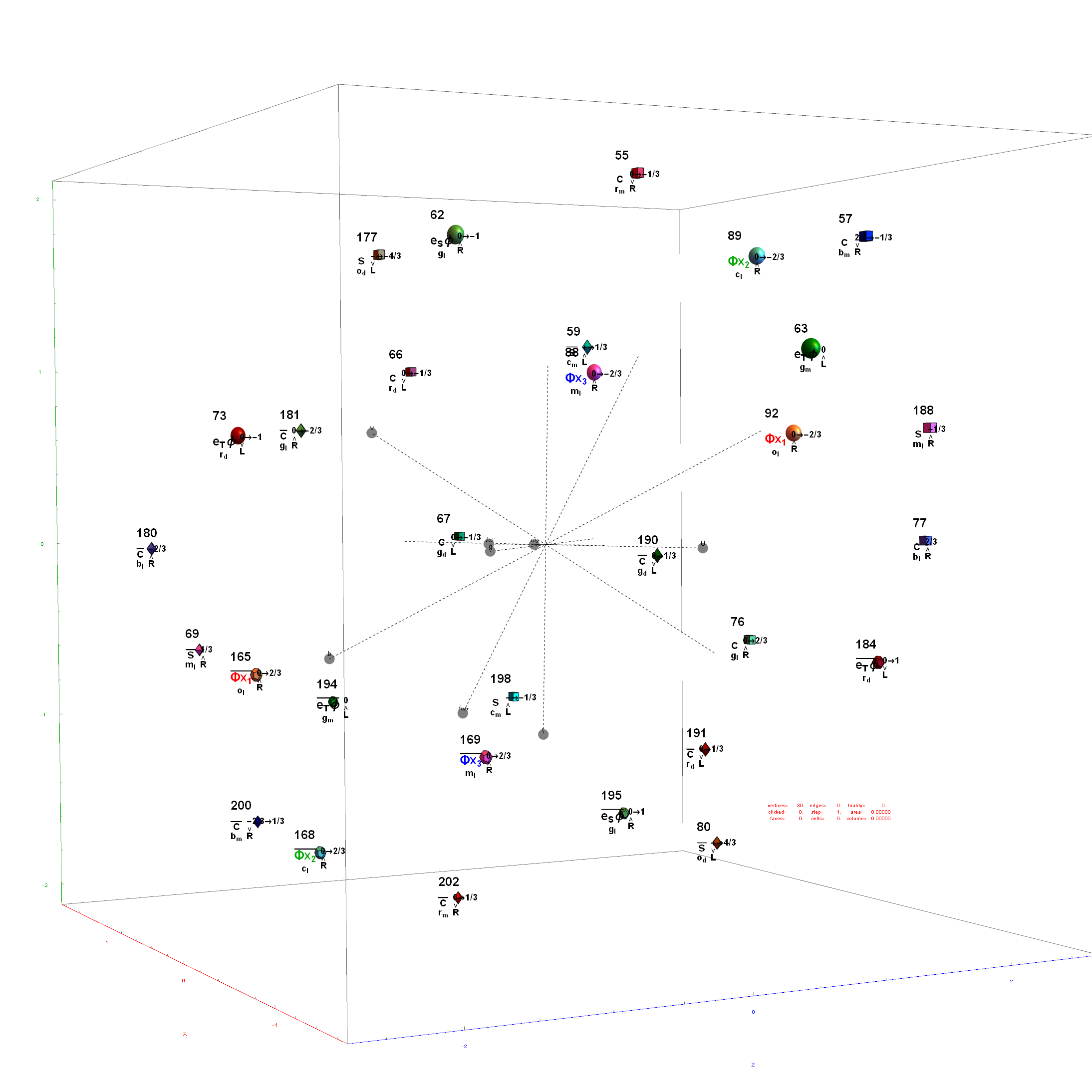
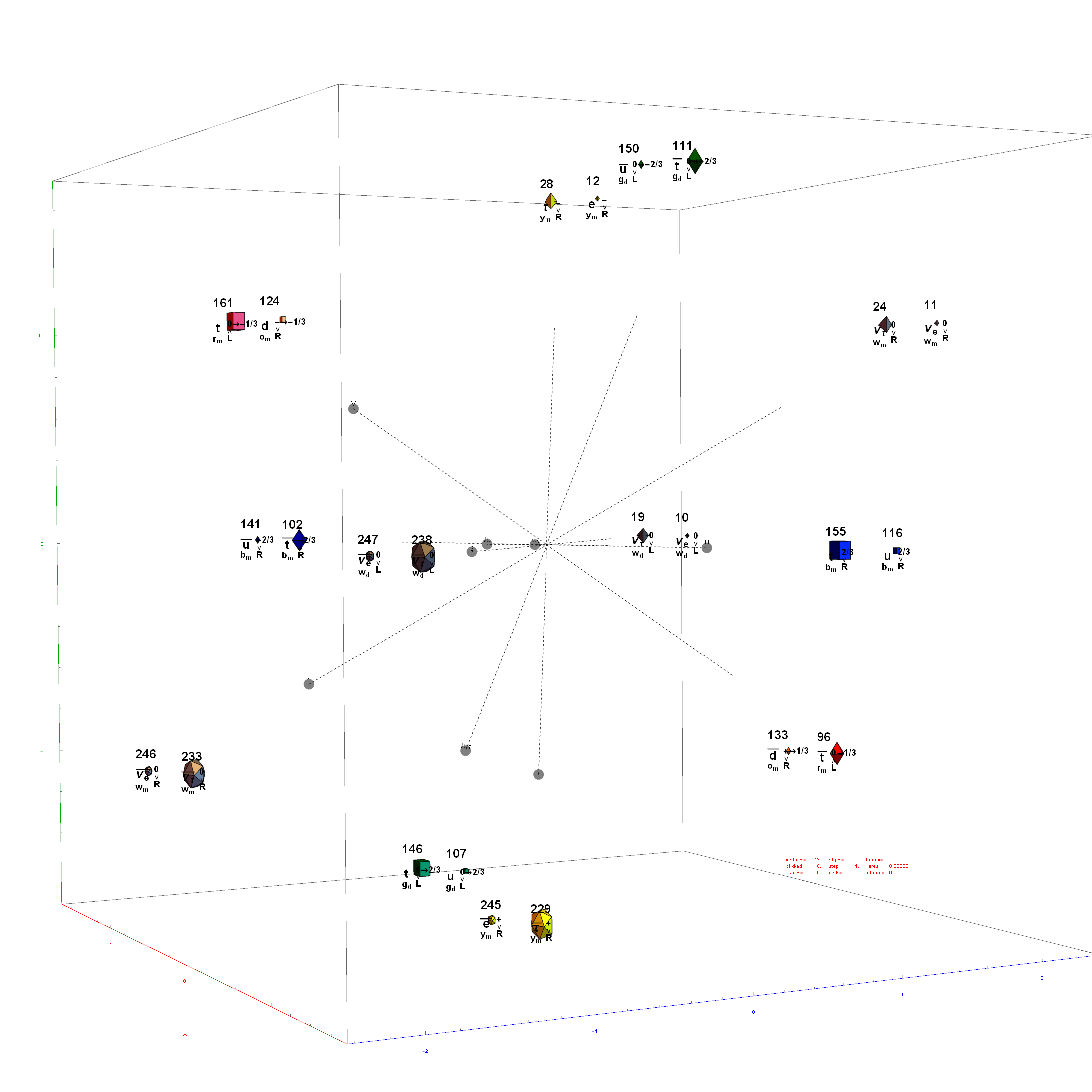
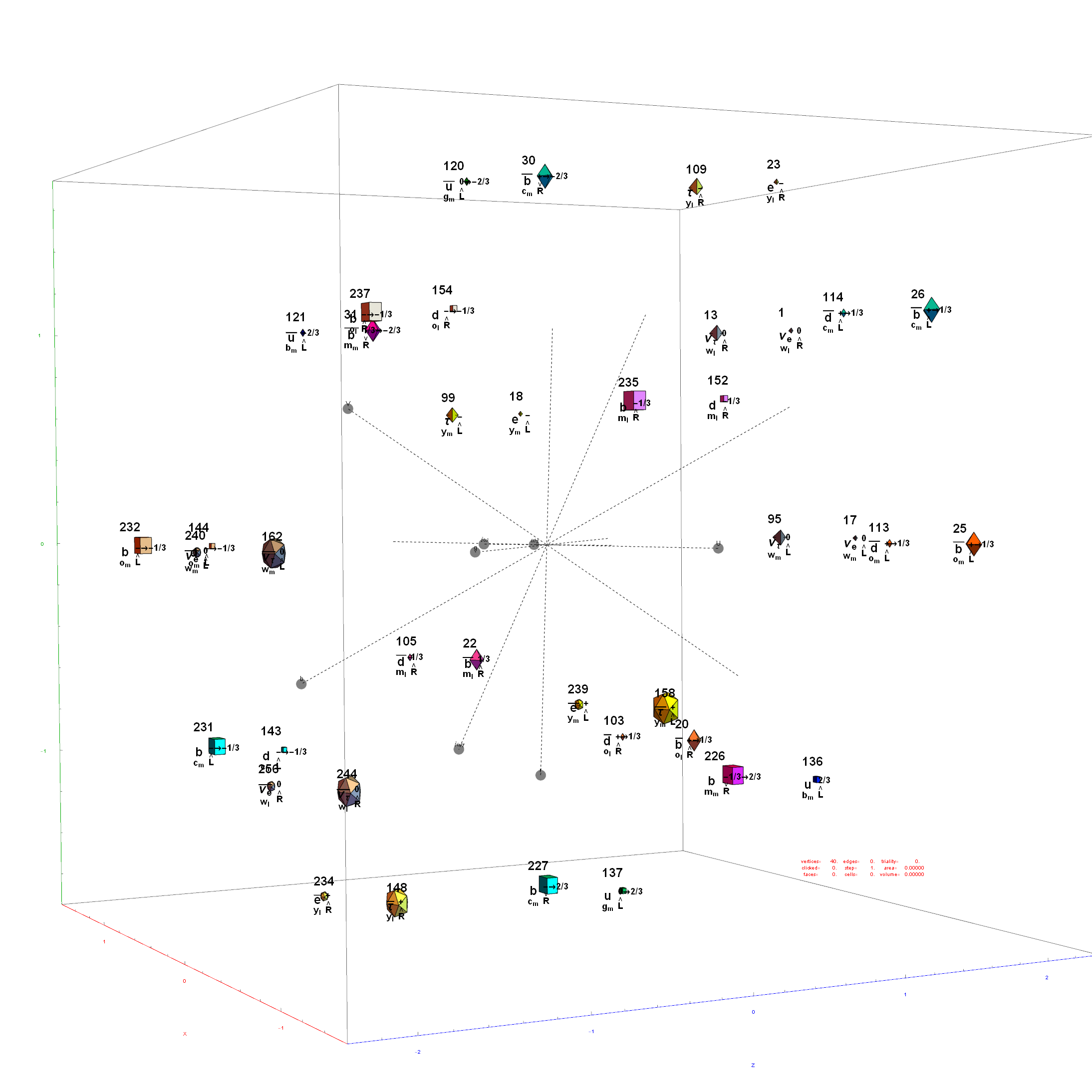
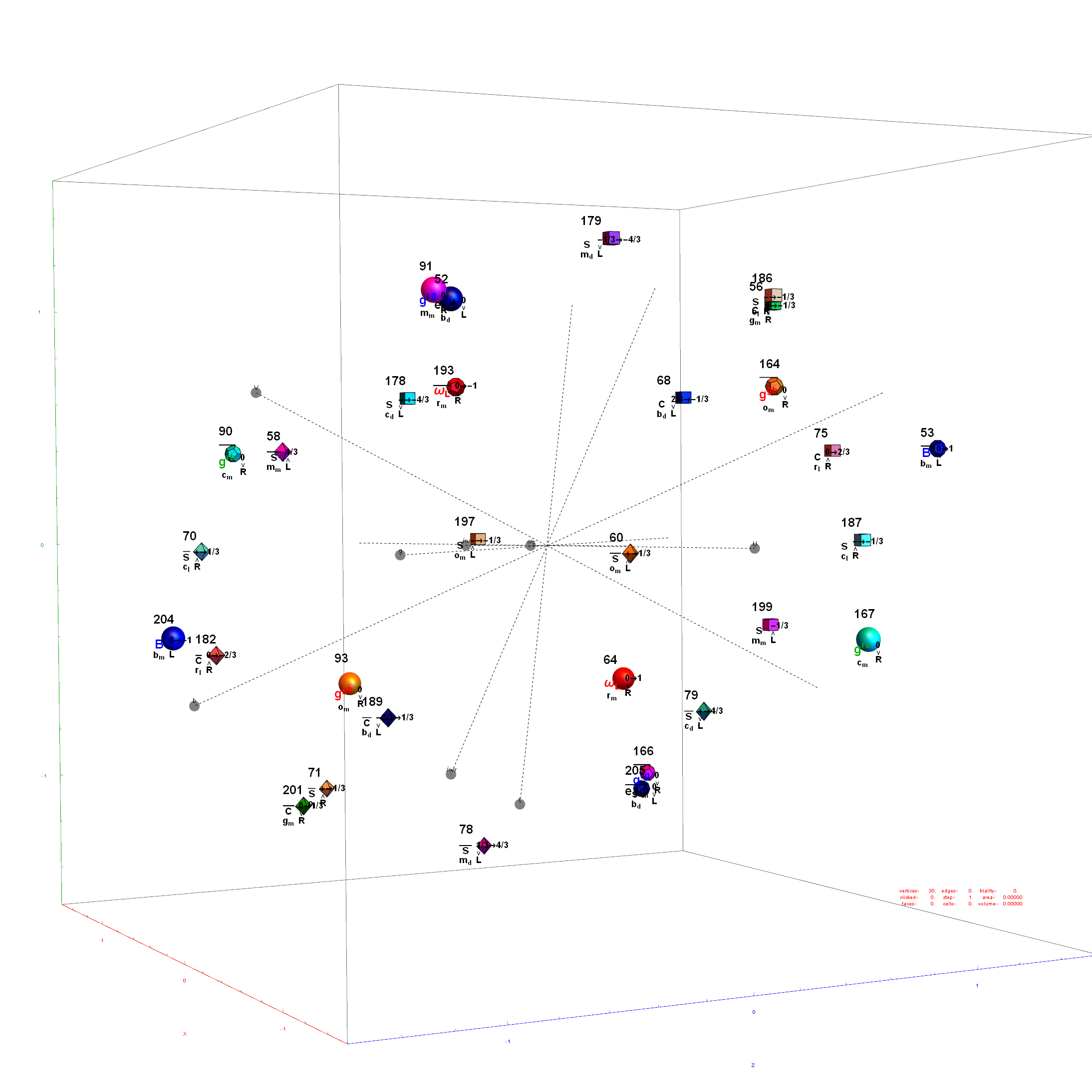
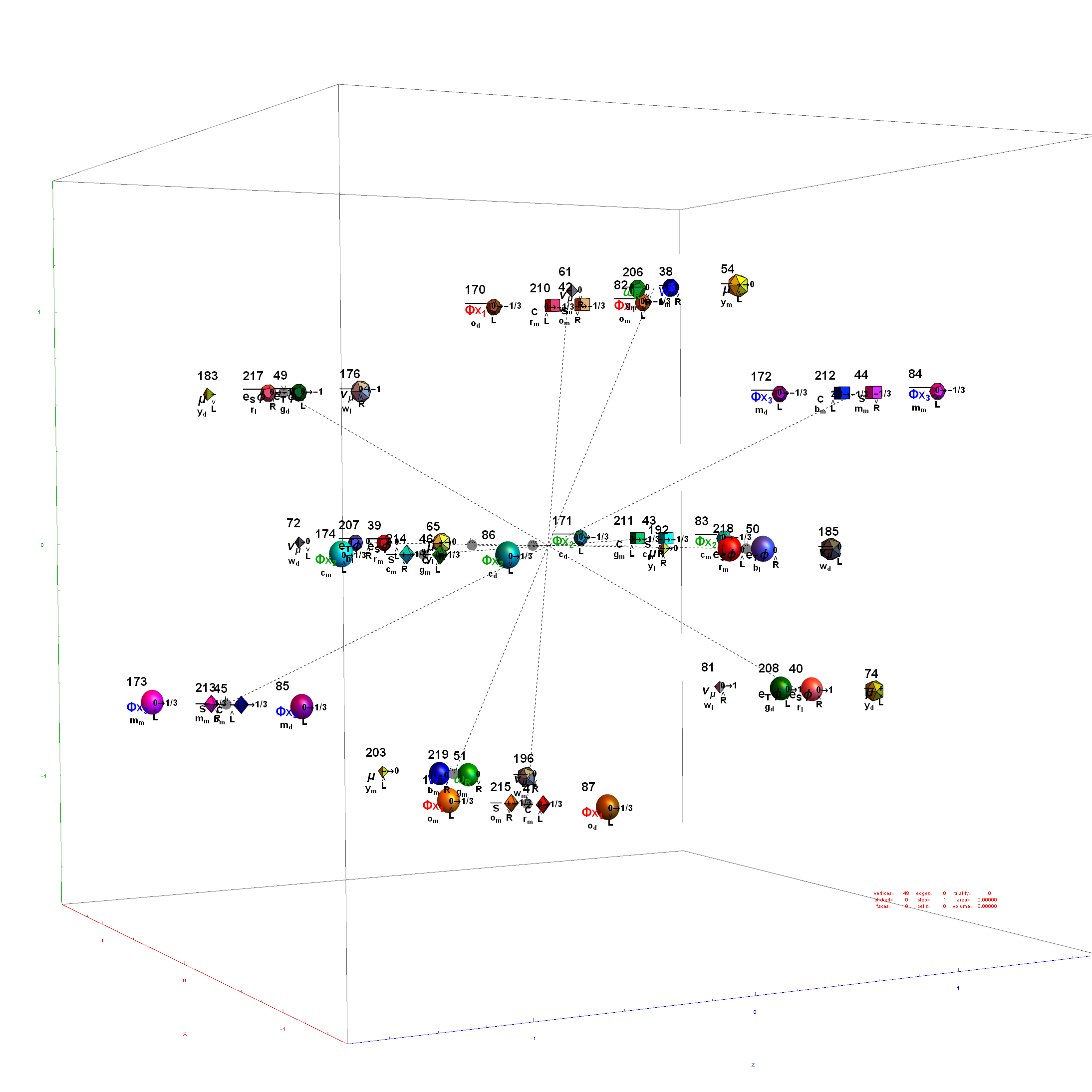
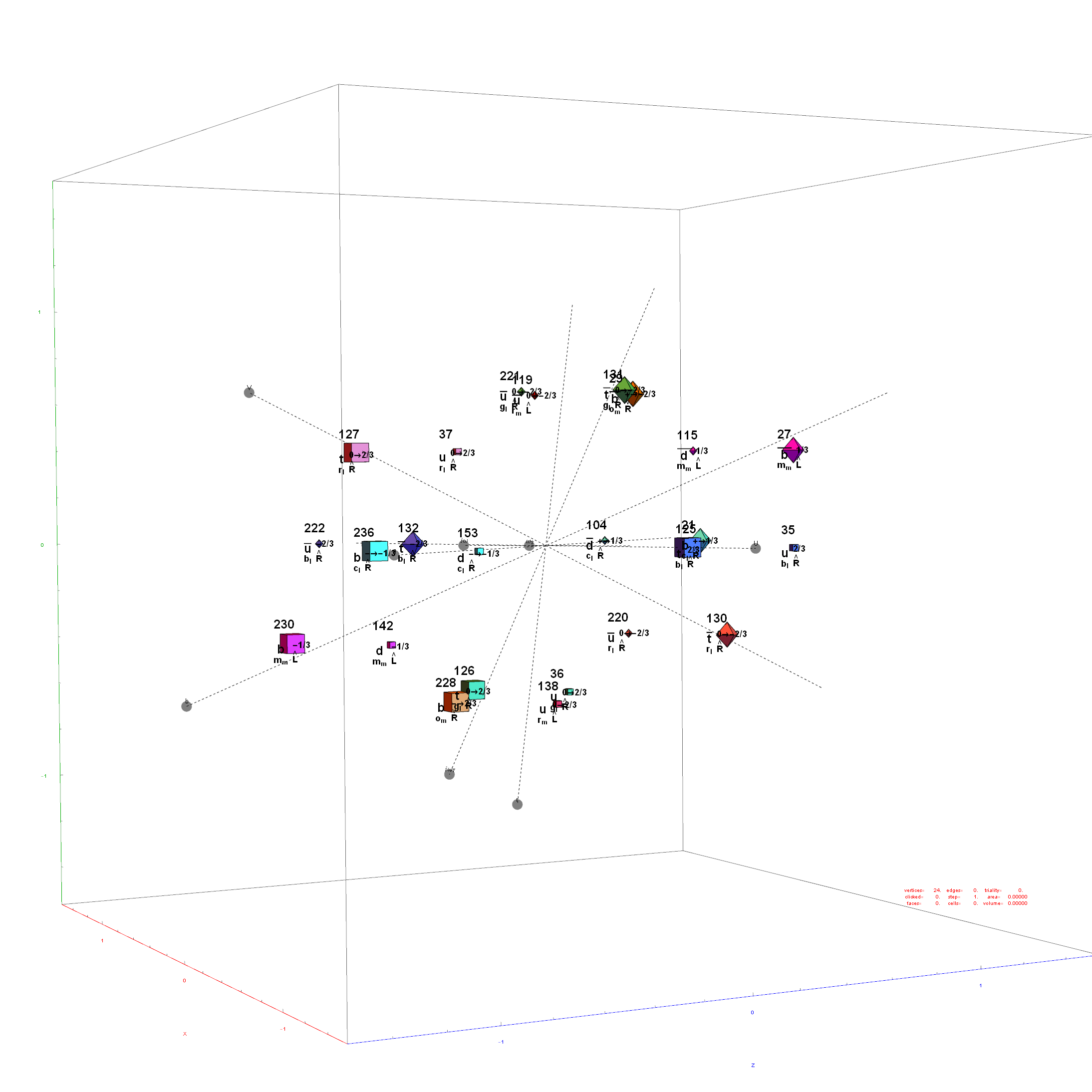
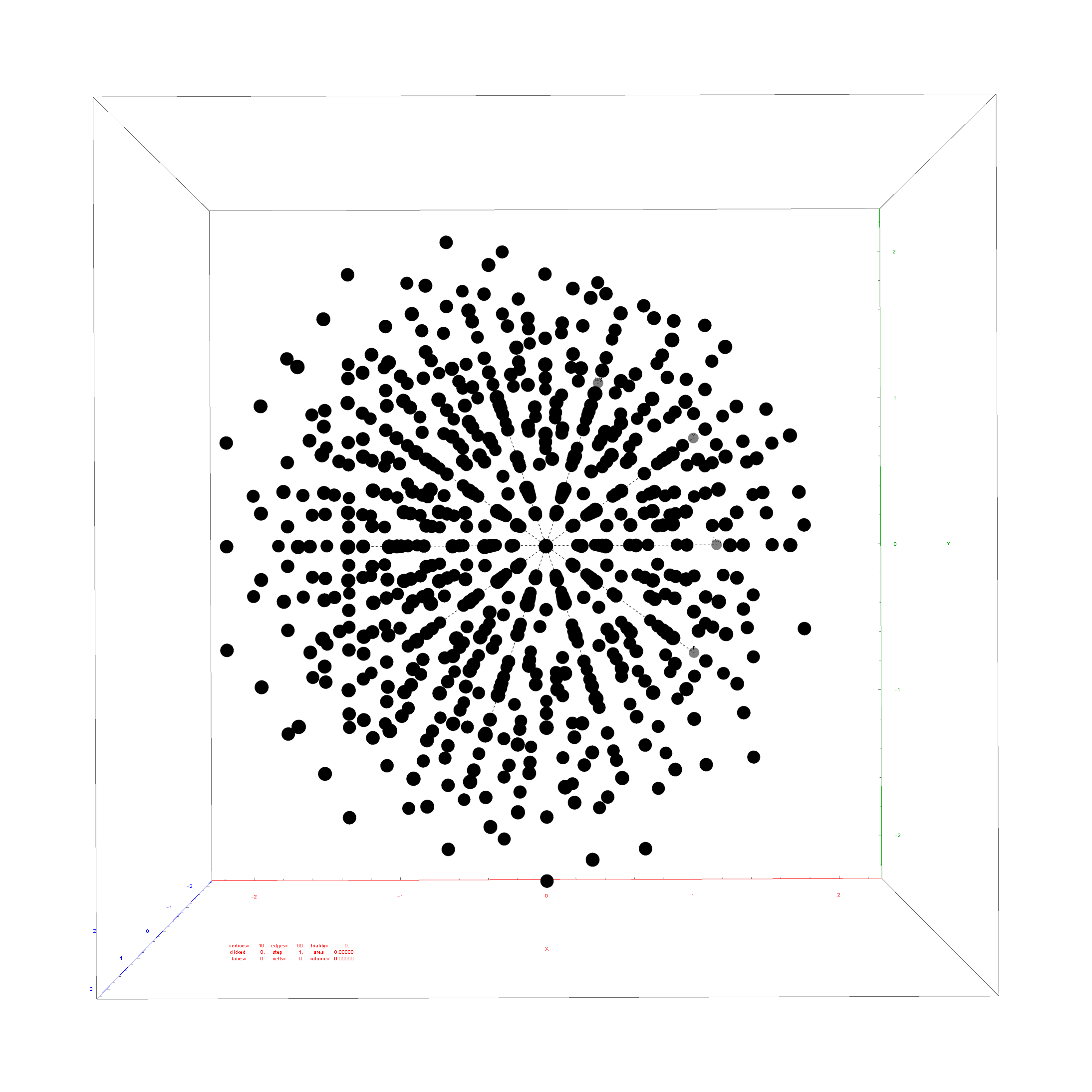
Here are the G2 gluons connected by their trialities shown in a 3D concentric hull projection of E8 using the E8 to H4 folding matrix basis vectors. This is the 4th hull, which is the outer hull of the inner H4 600 cell (an icosadodecahedron). For more on E8 hulls, see this post.
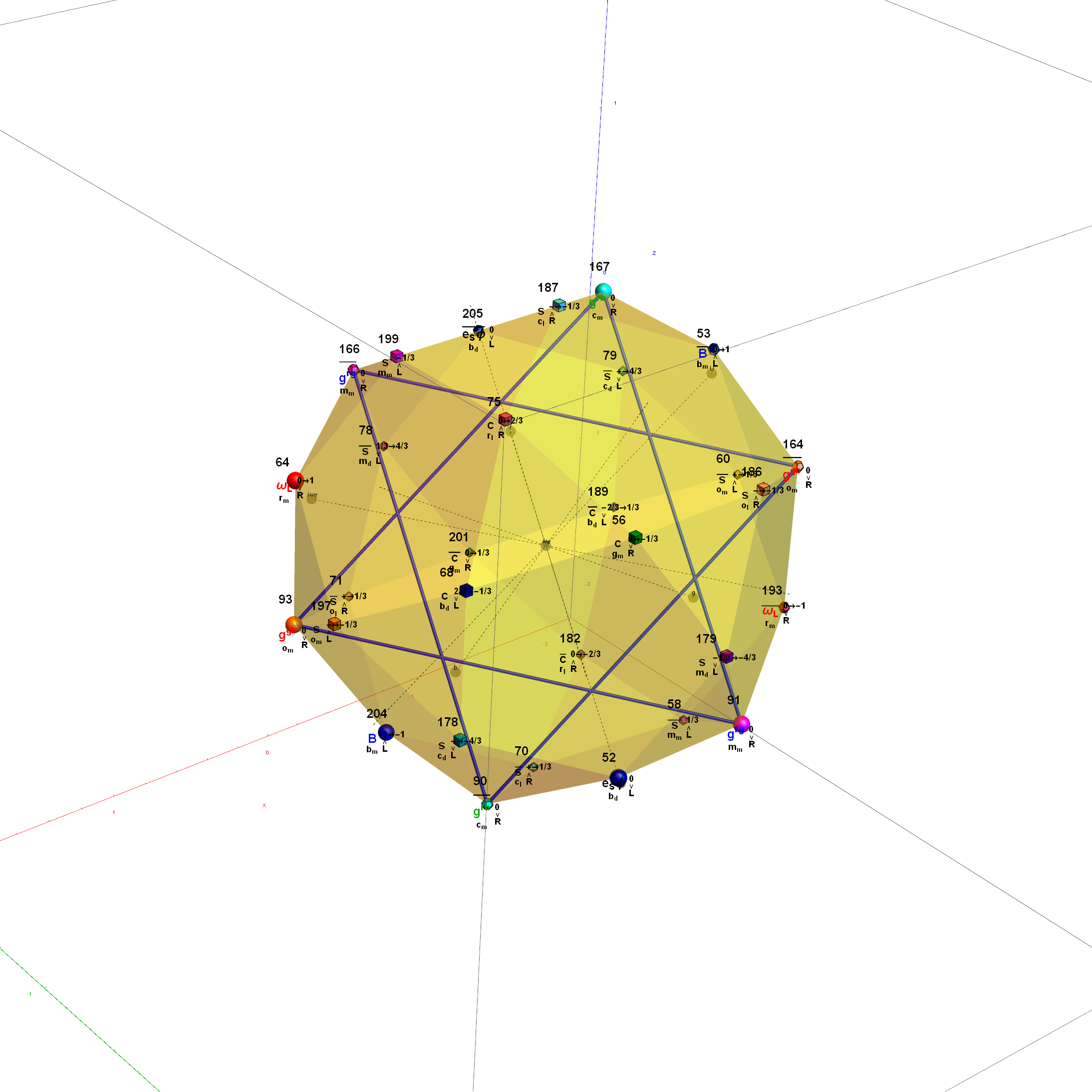
The full F4 group with 10 T2 and 12 T4 trialities affecting the bosons is contained in the outer icosadodecahedron (1st hull) combined with the 3rd (quad icosahedral) and 4th icosadodecahedron hulls.
It is interesting to note that the two icosadodecahedron hulls comprise the 60 vertices of D6.
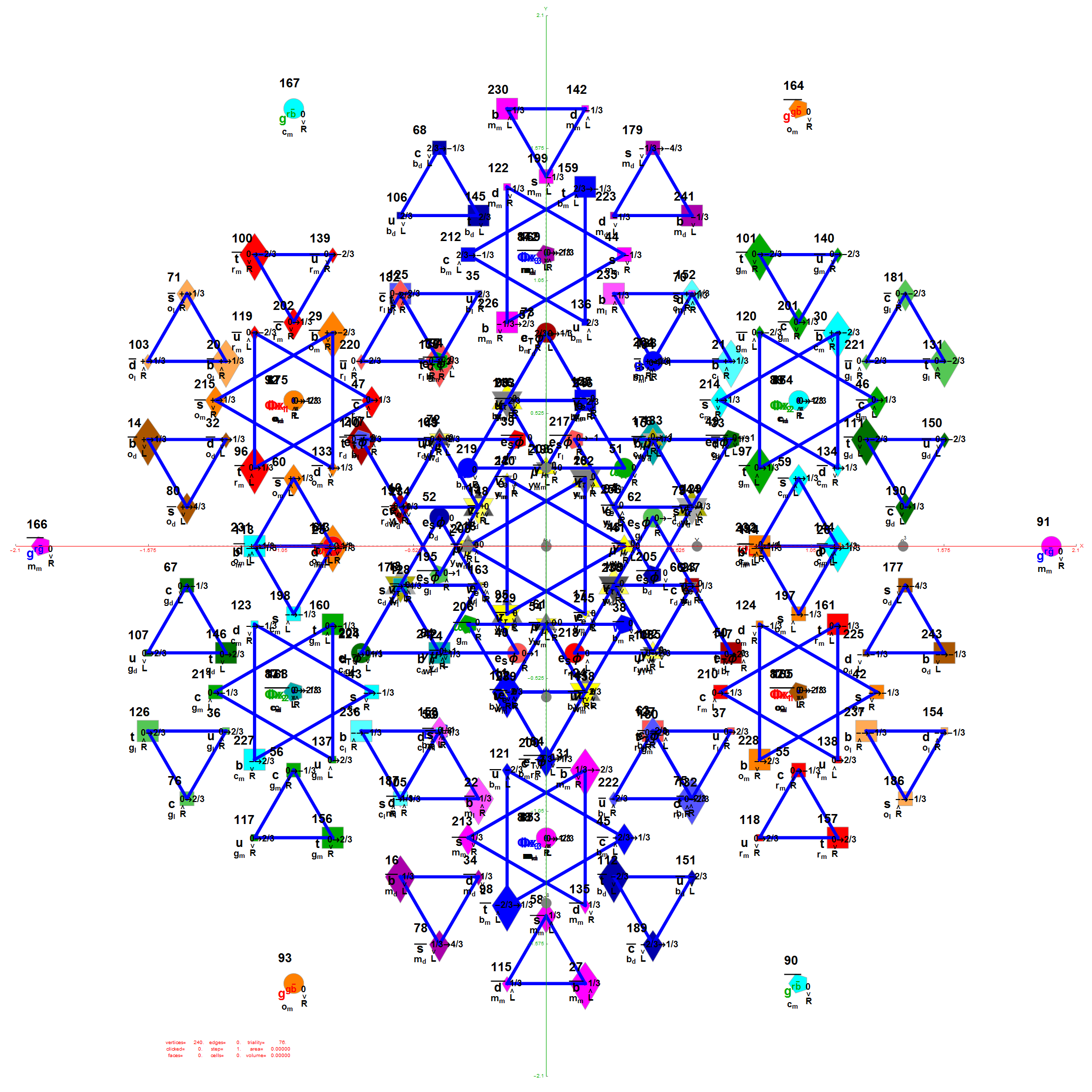
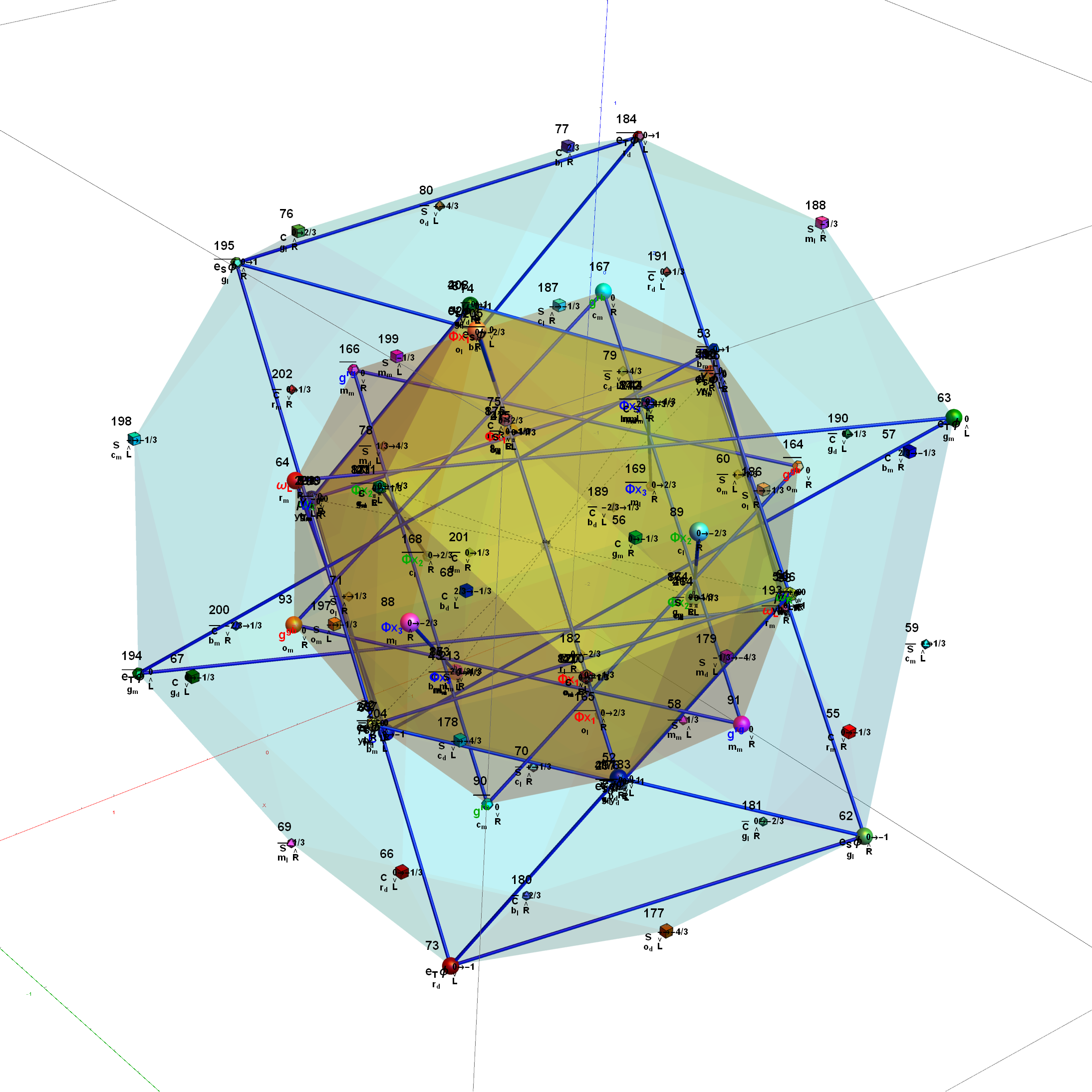 Below is the full E8 with all trialities shown in 3D concentric hull projection.
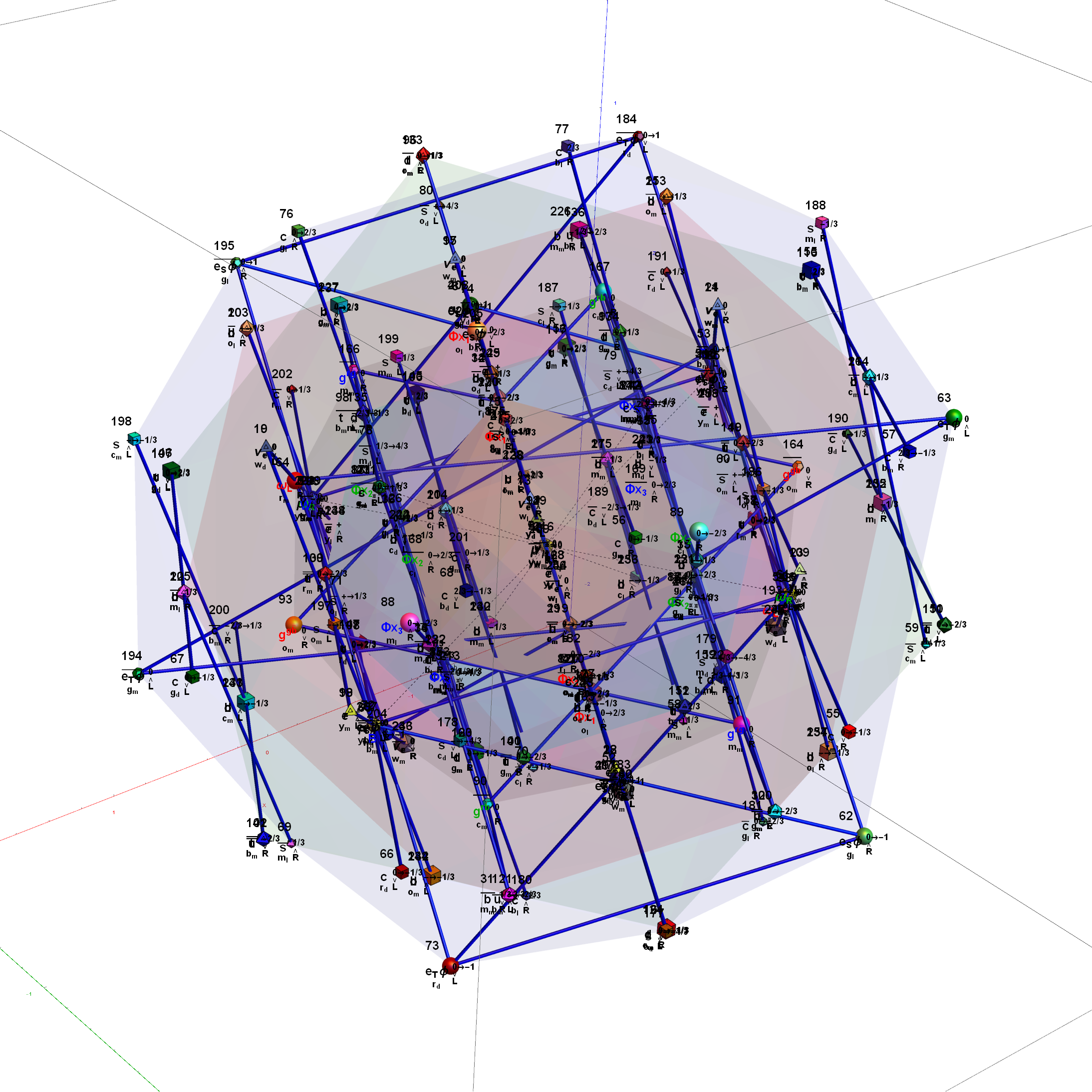
BTW – if you find this information useful, or provide any portion of it to others, PLEASE make sure you cite this post. If you feel a blog post citation would not be an acceptable form for academic research papers, I would be glad to clean it up and put it into LaTex format in order to provide it to arXiv (with your academic sponsorship) or Vixra. Just send me a note at: jgmoxness@theoryofeverthing.org.
For a full discussion of the particle assignment symmetries involved, see http://vixra.org/pdf/1503.0190v1.pdf
E8 as 240 split real even vertices with vertex color, size, shape, and labels from a modified A.G. Lisi particle assignment algorithm. The vertex number is the position in the Pascal Triangle (Clifford Algebra) representation of E8. The blue lines forming equilateral triangles represent the 10 Bosonic (or Color) Triality (T2) and 76 Fermionic (T4) rotations (using the 8×8 matrices shown below) that transform each member of the triangle into the next member.
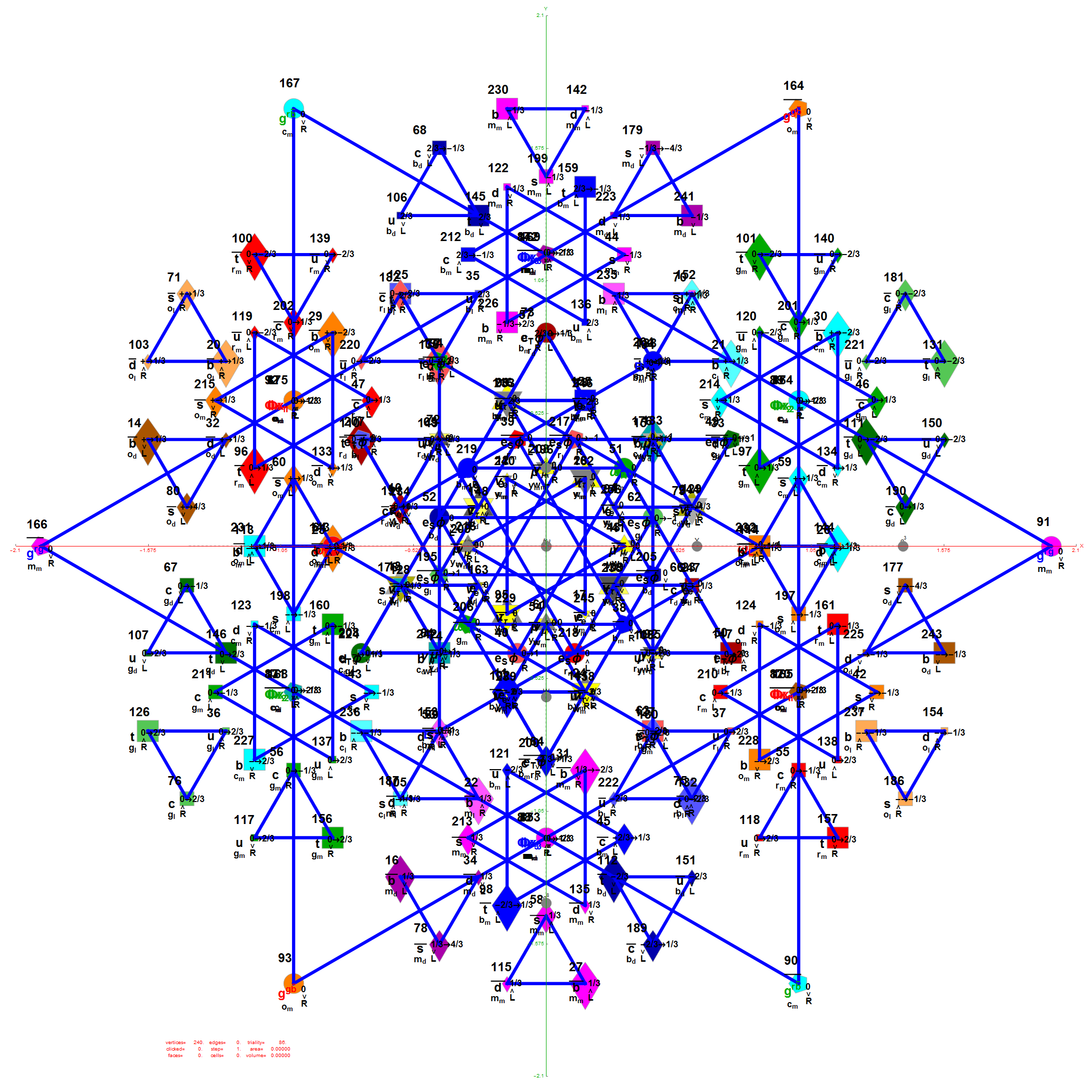
E7 as derived from E8 above by taking the vertices of E8 with the last two columns being equal.
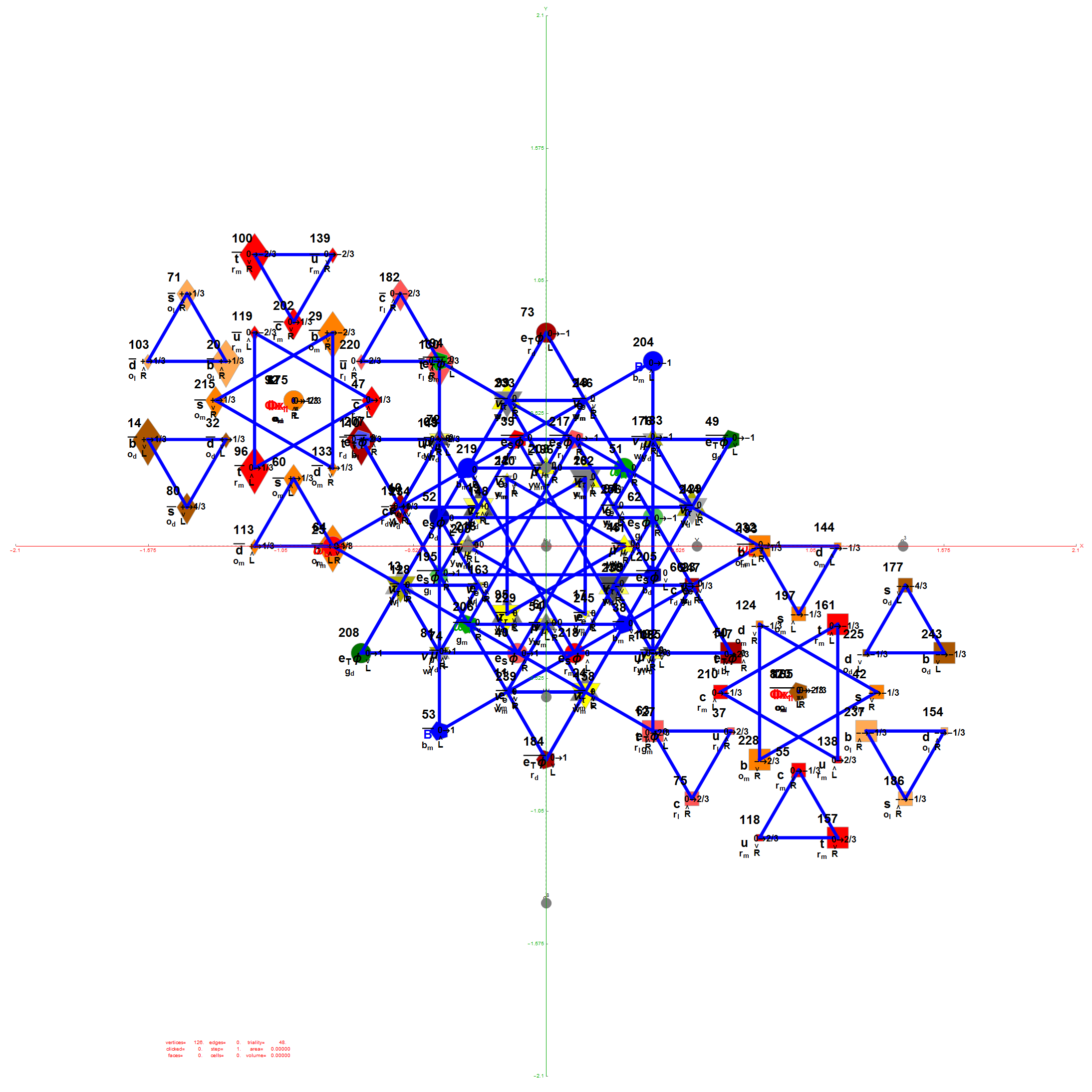
E6 as derived from E8 above by taking the vertices of E8 with the last three columns being equal.
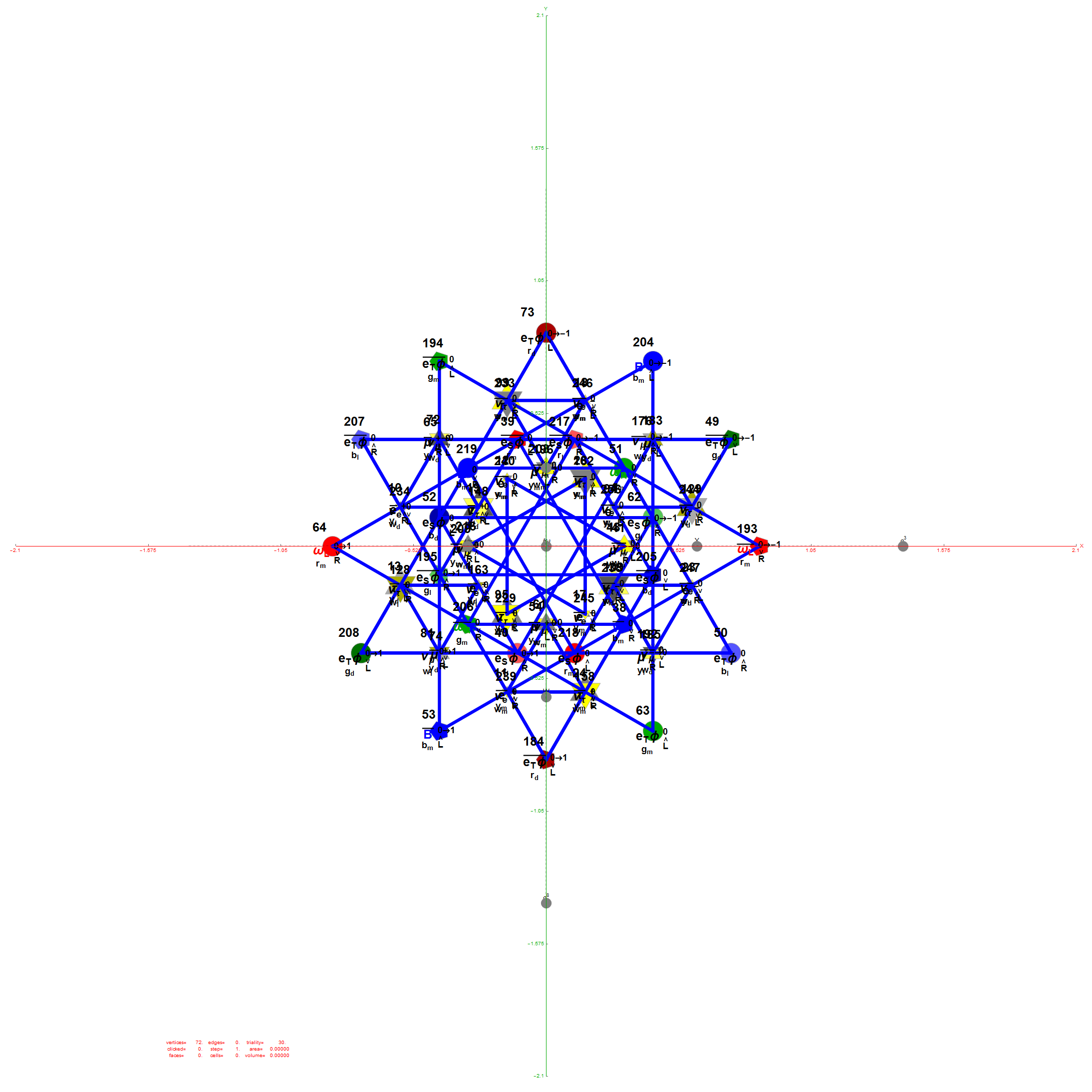
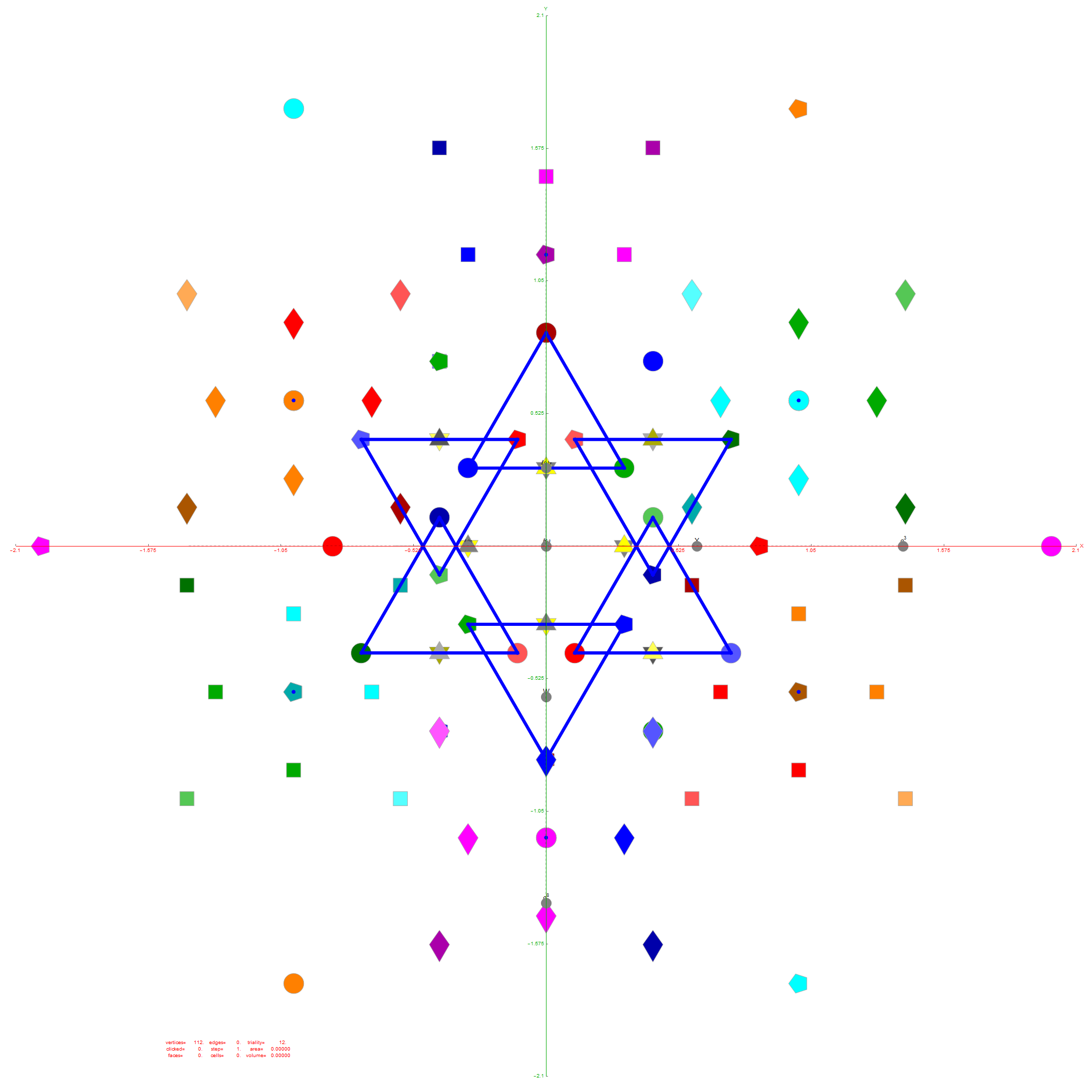
The 48 vertices of F4 are made up of the 112 (D8) +/-1 integer pair vertices that are assigned to bosonic particles, which includes 22 trialities (10 from T2 and 12 from T4). The other 64 of 112 D8 vertices are assigned to the 2nd generation of Fermions. F4 is shown below with its sub-group G2 assigned to the gluons in the larger triality triangles. 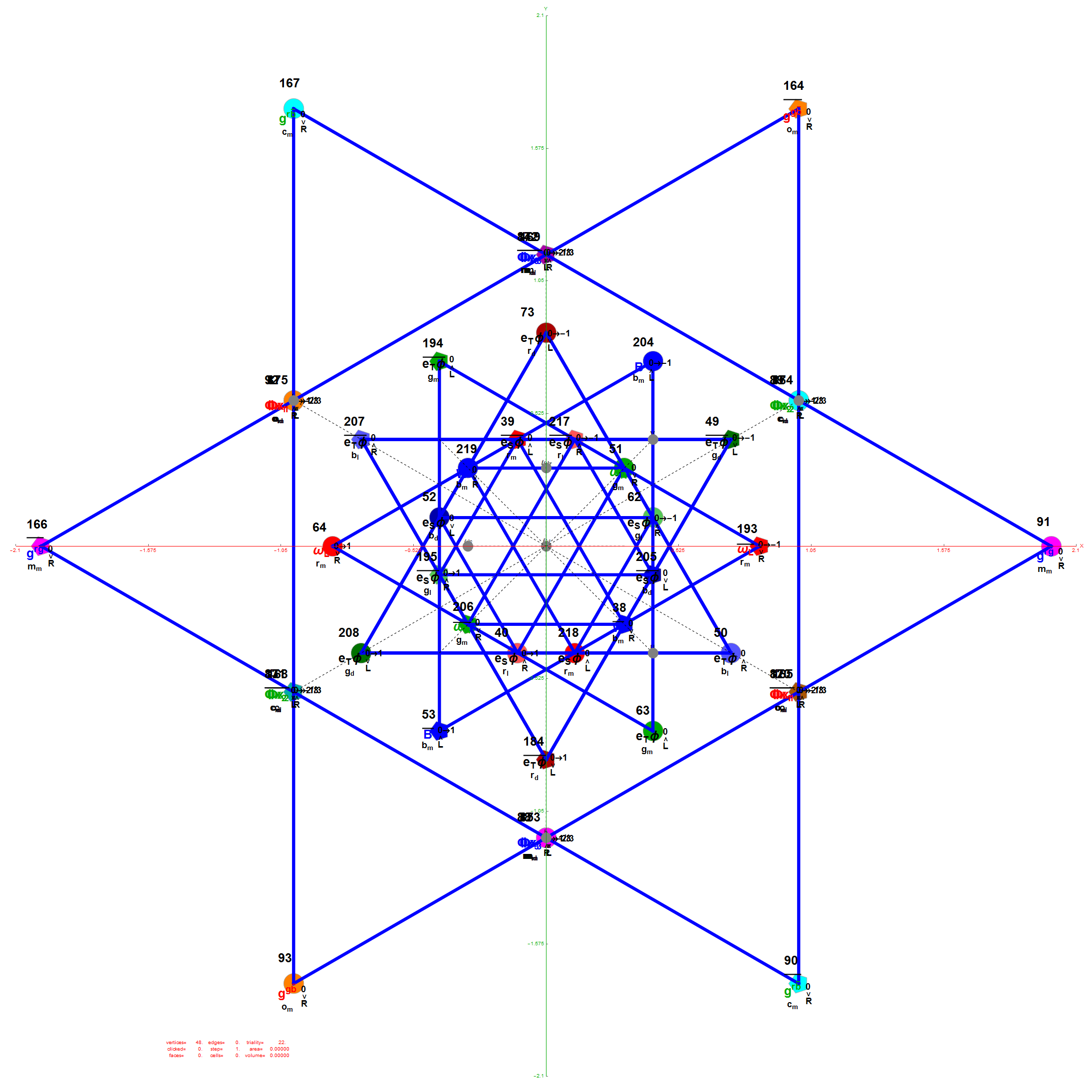 Projection Basis for X and Y are H (first row) and V (second row) in the matrix below respectively
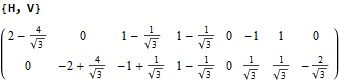 The Triality Matrices are:
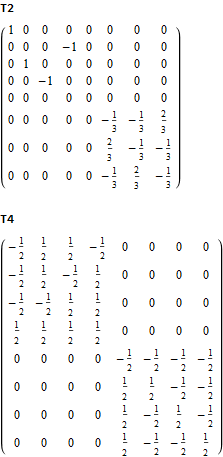
The 10 Bosonic (Color) Triality Rotation Matrix (T2) equilateral triangles exclusively affect the particles that are derived from F4.
T2 rotates through the bosonic colors indicated by the last 3 columns of the E8 vertices appropriately labeled (r,g,b).
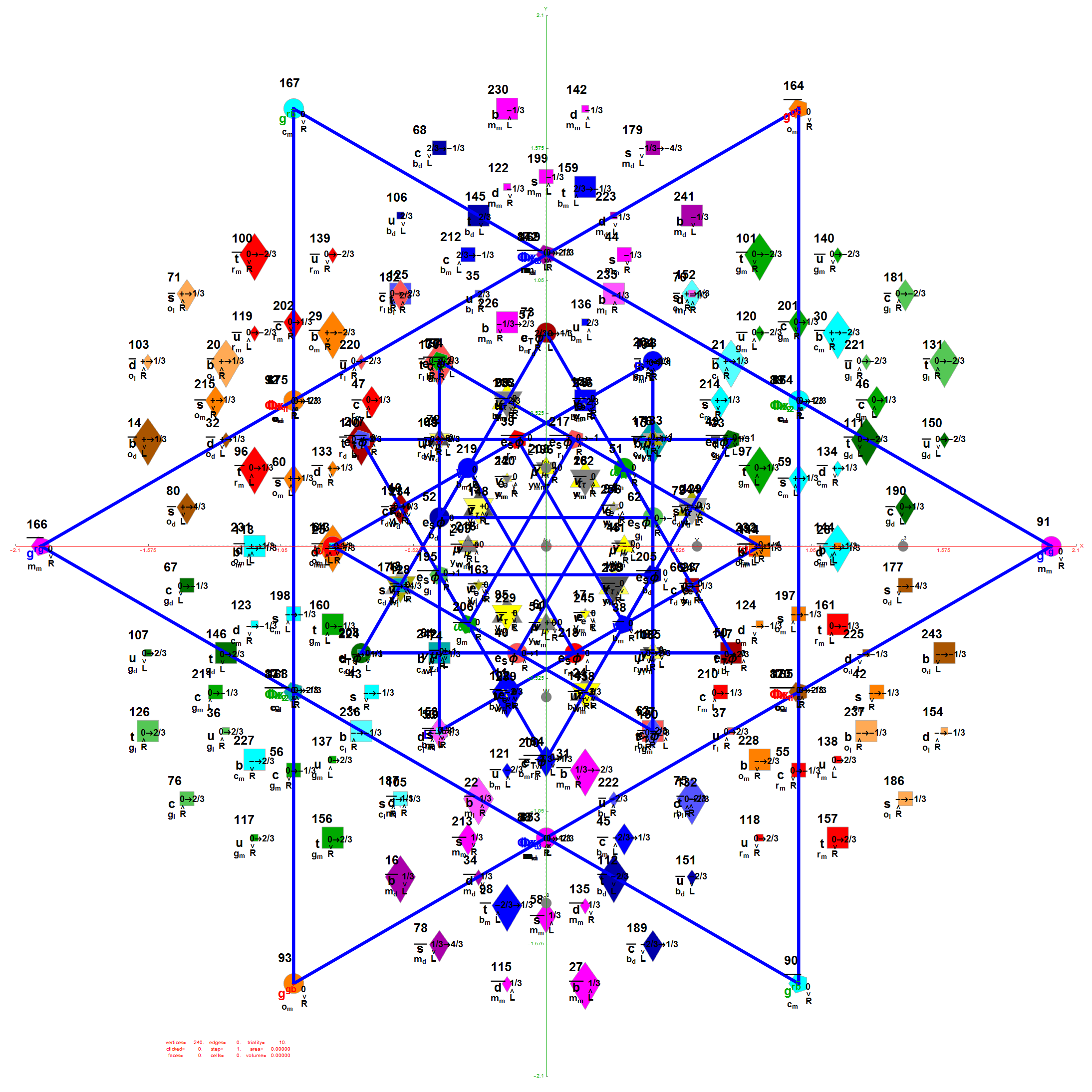 The 76 Fermionic (Generation) Triality Rotation Matrix (T4) equilateral triangles. There are 64 fermion particle trialities that are derived from the 128 (BC8) half integer vertex assignments plus the 64 fermions assigned from the 112 (D8) +/-1 integer pair vertices. There is always one integer (2nd Generation) and two 1/2 integer vertices (1st and 3rd Generation) in every fermionic triality.
That is, T4 rotates through the fermionic generations.
 There are 12 trialities from these 76 that are associated with the inner E6 & F4 Lie Group vertices assigned to bosons, shown below with only the 112 (D8) +/-1 integer pair unlabeled vertices:
 Of course, there are a number of overlapping vertices in this projection stemming from the 112 (D8) +/-1 Bosonic sector. The following image colors the vertices by overlap count, with 120 Yellow with no overlaps, 24 Cyan with 2 overlaps (48), and 24 Cyan with 3 overlaps (72).
Notice the 8 projection basis vectors with dark gray circles. Of course, these projection basis vectors are the 8 “generator vertices” of E8 vertices with permutations of {+1,0,0,0,0,0,0,0} giving it the full 240+8=248 dimension count. Add to that the -1 “anti-generators” being the opposite end of the projection basis vectors and you get the full 256 vertices representing the full Clifford Algebra on the 9th row of the Pascal Triangle.
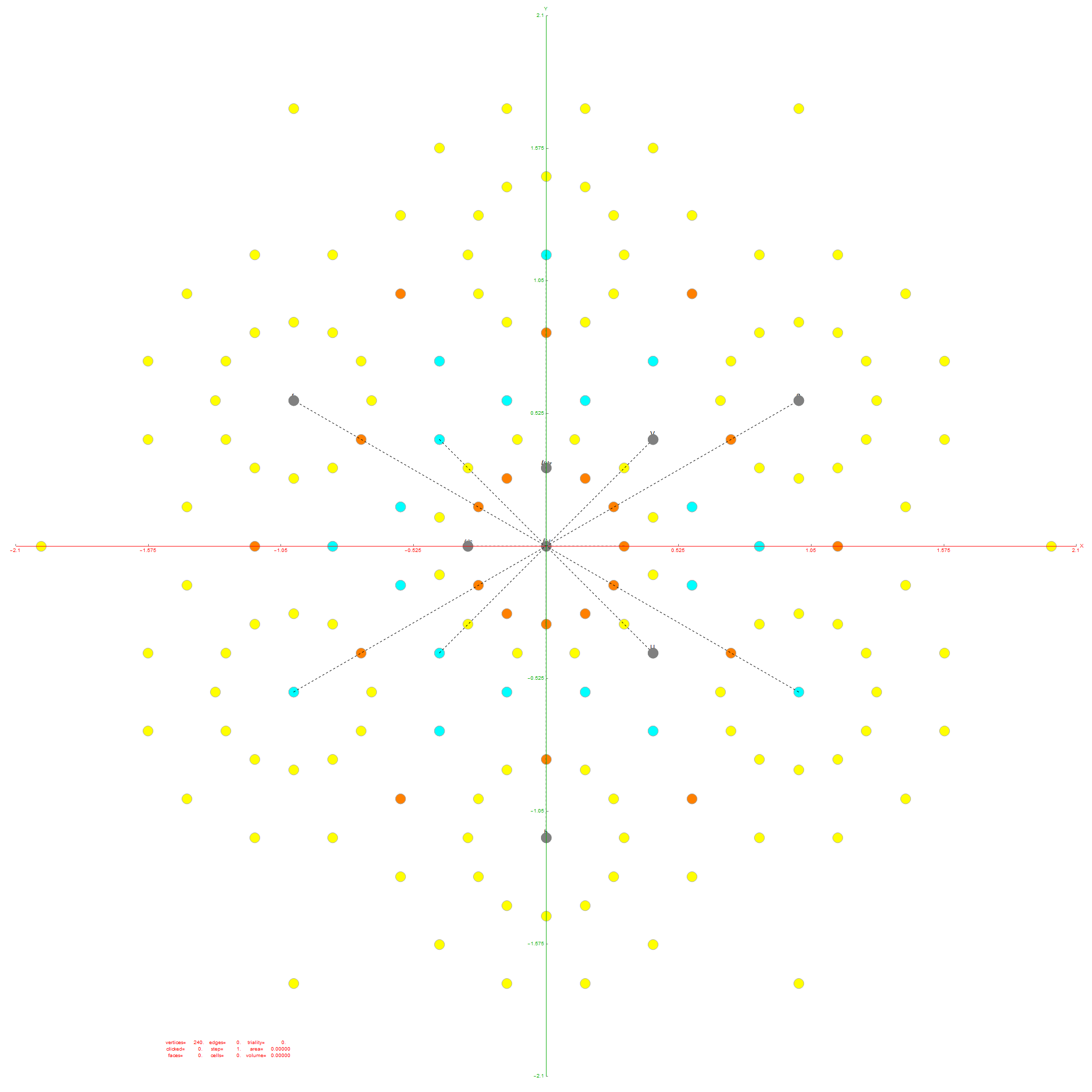
There are 6720 edges in E8 with an 8D length Sqrt[2].
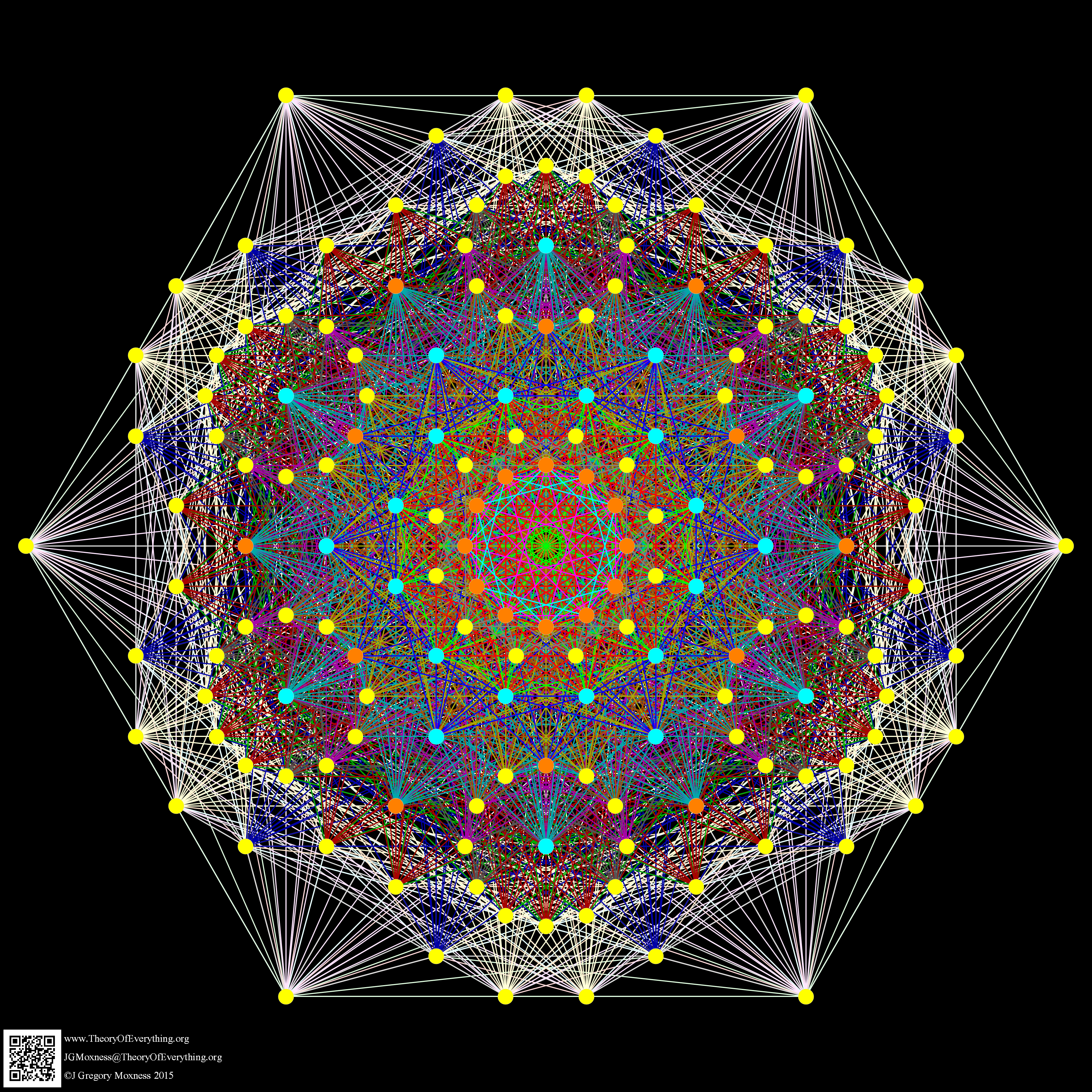
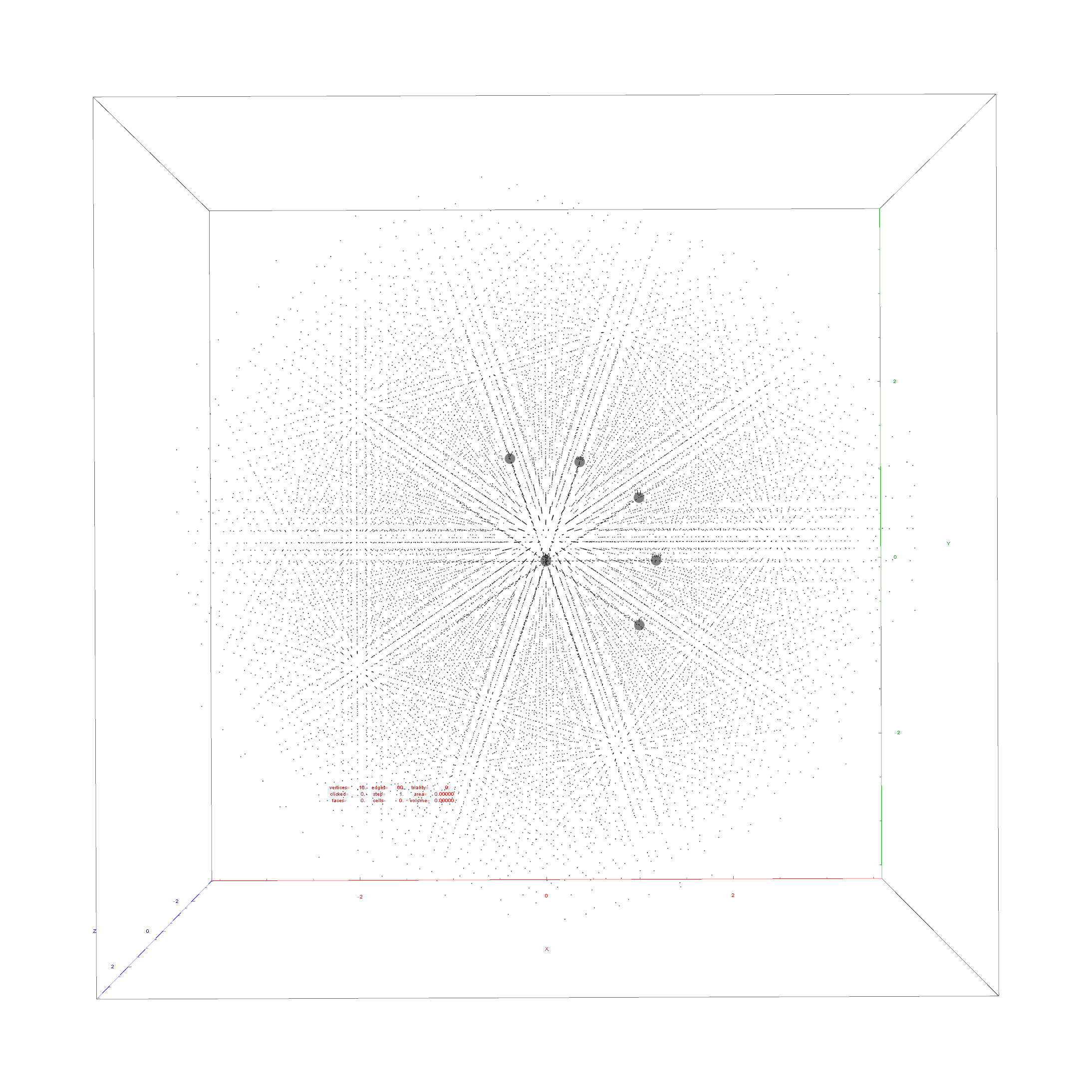
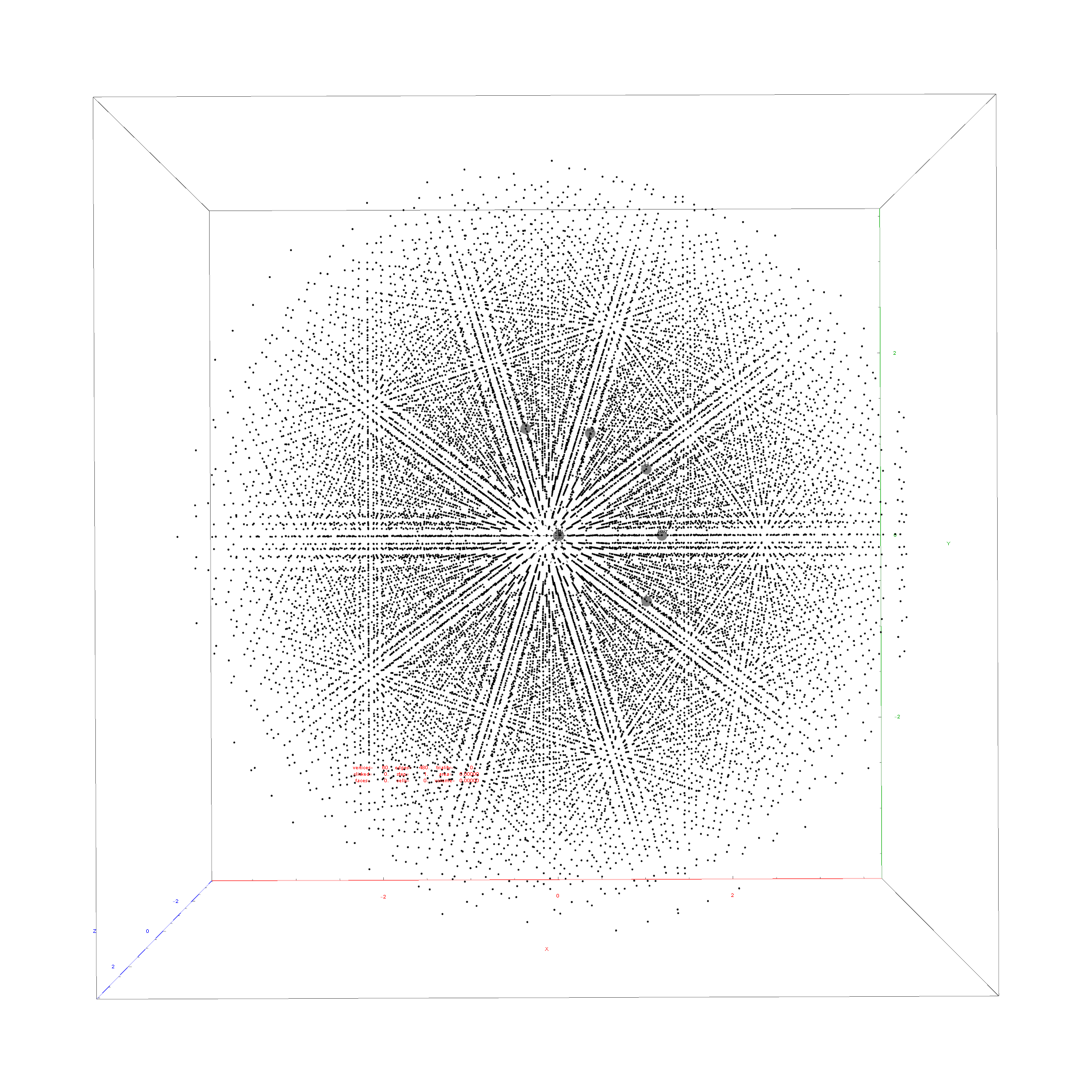
Just for fun, I introduce to you the 6720 rectified E8 vertices taken from the midpoint of each edge and using the same projection with coloring of the spheres based on overlap count. Enjoy!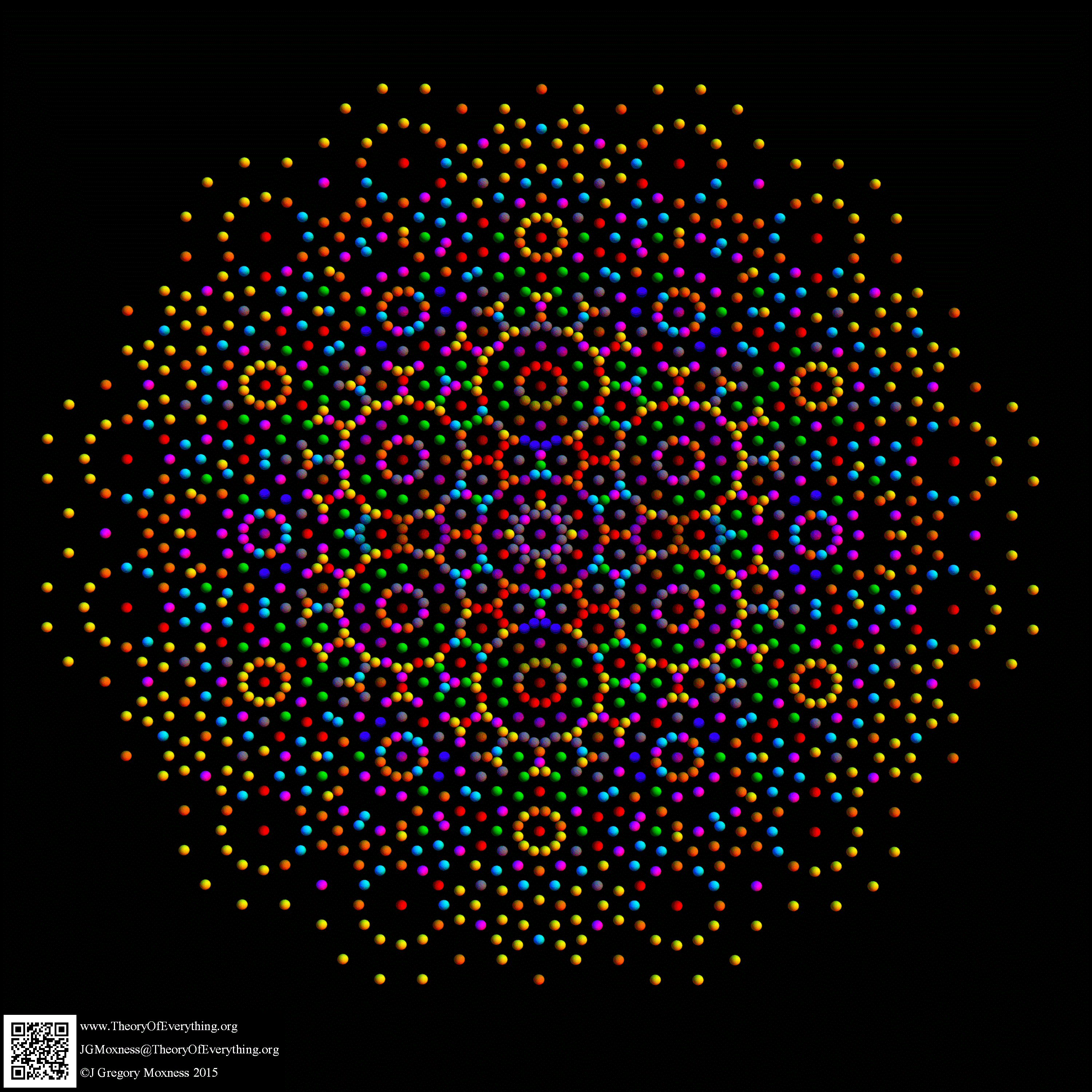
Here are the G2 gluons connected by their trialities shown in a 3D concentric hull projection of E8 using the E8 to H4 folding matrix basis vectors. This is the 4th hull, which is the outer hull of the inner H4 600 cell (an icosadodecahedron). For more on E8 hulls, see this post.
The full F4 group with 10 T2 and 12 T4 trialities affecting the bosons is contained in the outer icosadodecahedron (1st hull) combined with the 3rd (quad icosahedral) and 4th icosadodecahedron hulls.
Below is the full E8 with all trialities shown in 3D concentric hull projection.
BTW – if you find this information useful, or provide any portion of it to others, PLEASE make sure you cite this post. If you feel a blog post citation would not be an acceptable form for academic research papers, I would be glad to clean it up and put it into LaTex format in order to provide it to arXiv (with your academic sponsorship) or Vixra. Just send me a note at: jgmoxness@theoryofeverthing.org.





I’ve created a sort of place-holder demonstration that stubs out 60 orders of magnitude of the 15 major eras or epochs of the history of the Universe. Here are a few artifacts from that simulation (also available in the full interactive demonstration).
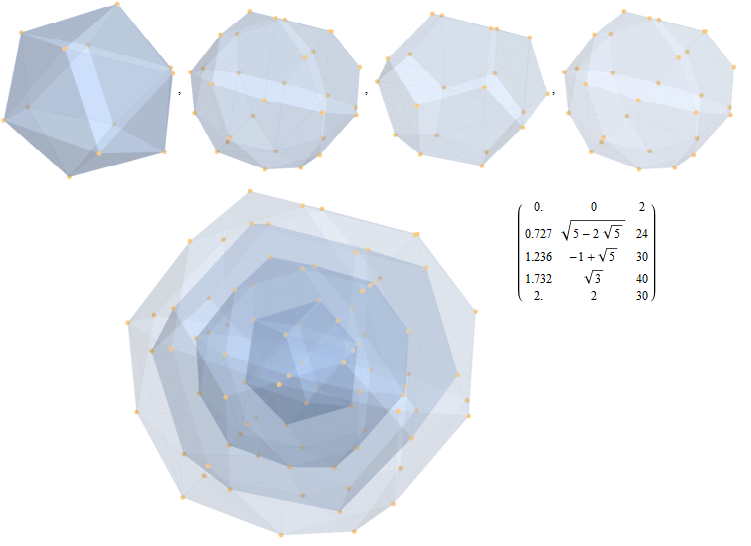
The 8 concentric projected 3D hulls from the vertices of the 4_21 polytope (using the split real even E8 roots) and a projection basis from 3 of the 4 rows of the E8 to the H4+H4 Phi folding matrix produce from inner to outer (sorted by vertex Norm):
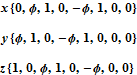
Projection Basis:
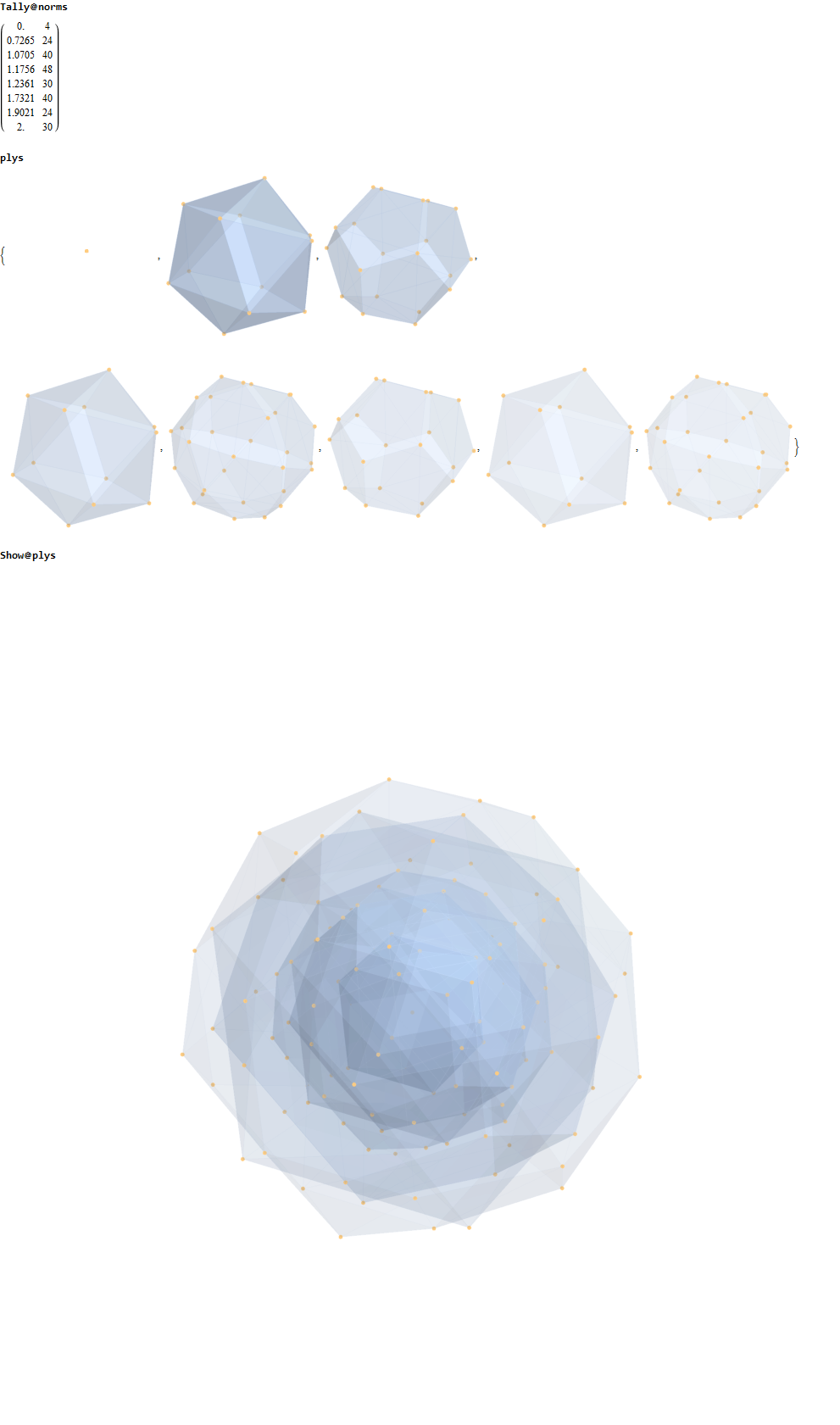
Looking at it as an orthonormal 3D projection of 2 600-cells (from the fully folded E8 to H4+H4 Phi), which is the same (as it should be), but rotated.
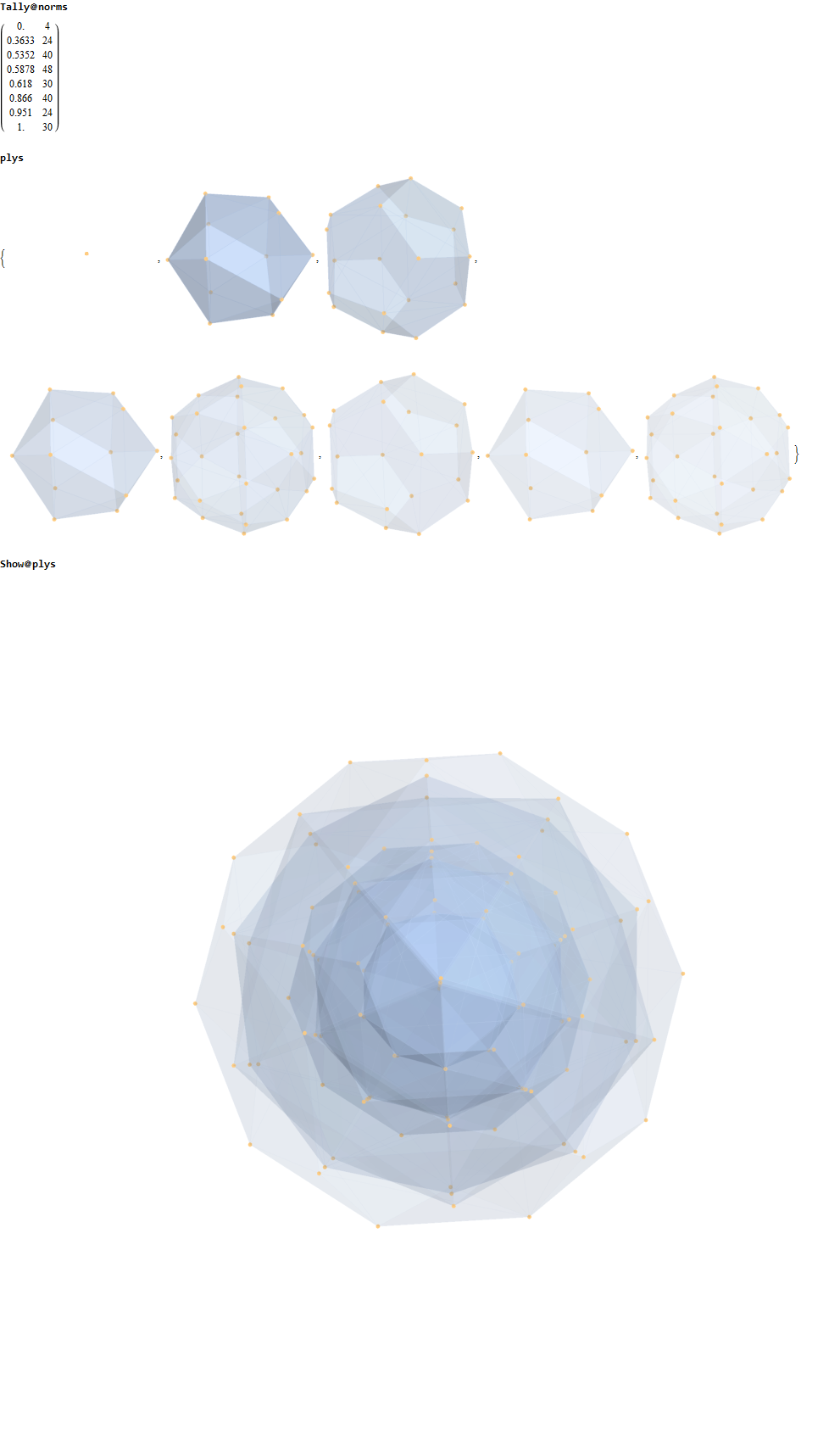
Here is just one 600-cell (interior).
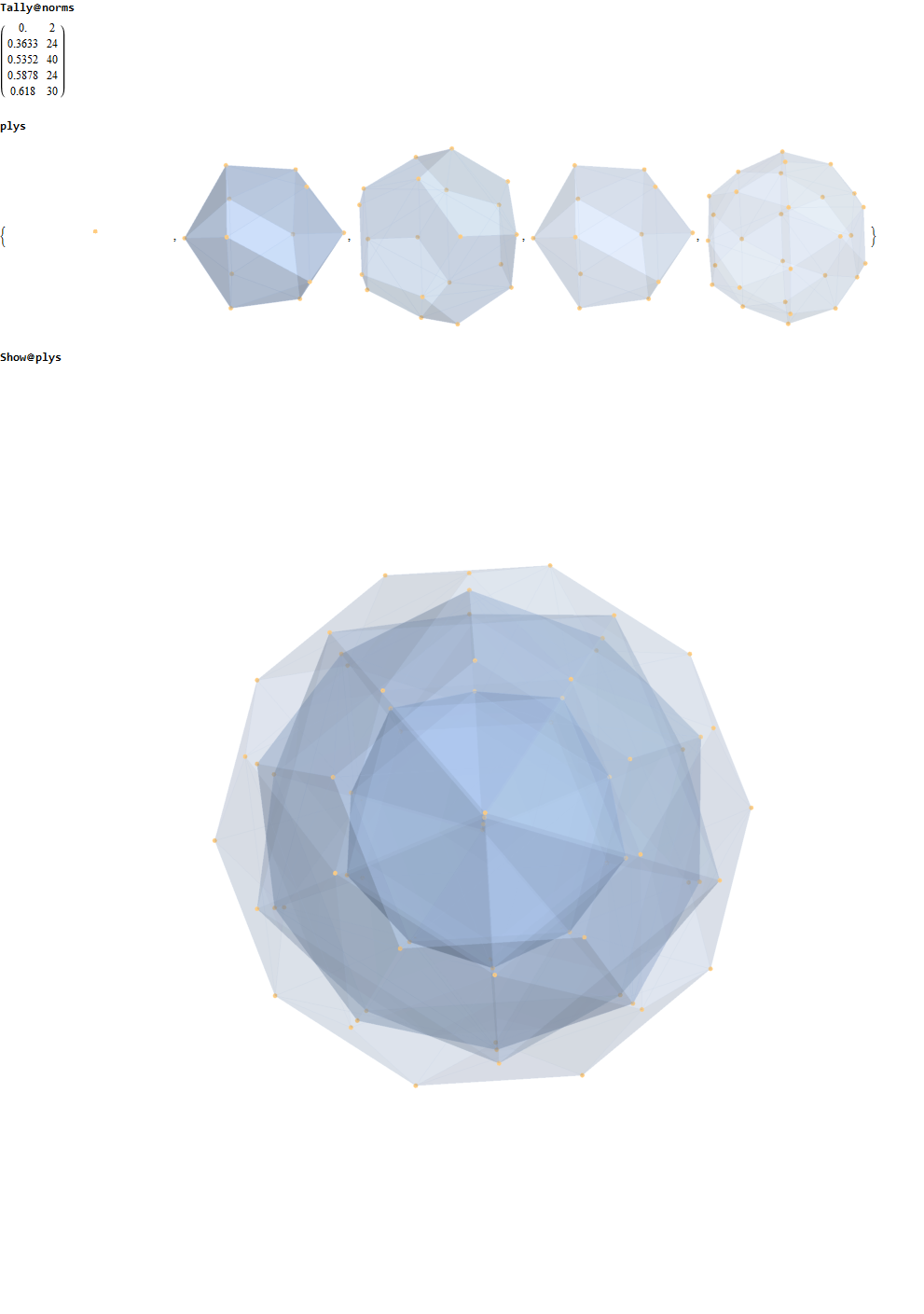
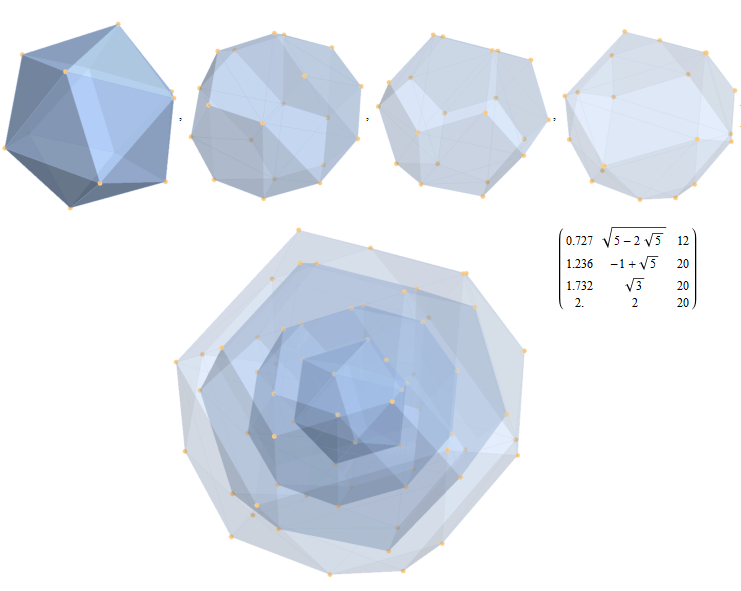
Here is E7 doing the same procedure:
And again for E6
BTW – if you find this information useful, or provide any portion of it to others, PLEASE make sure you cite this post. If you feel a blog post citation would not be an acceptable form for academic research papers, I would be glad to clean it up and put it into LaTex format in order to provide it to arXiv (with your academic sponsorship) or Vixra. Just send me a note at: jgmoxness@theoryofeverthing.org.
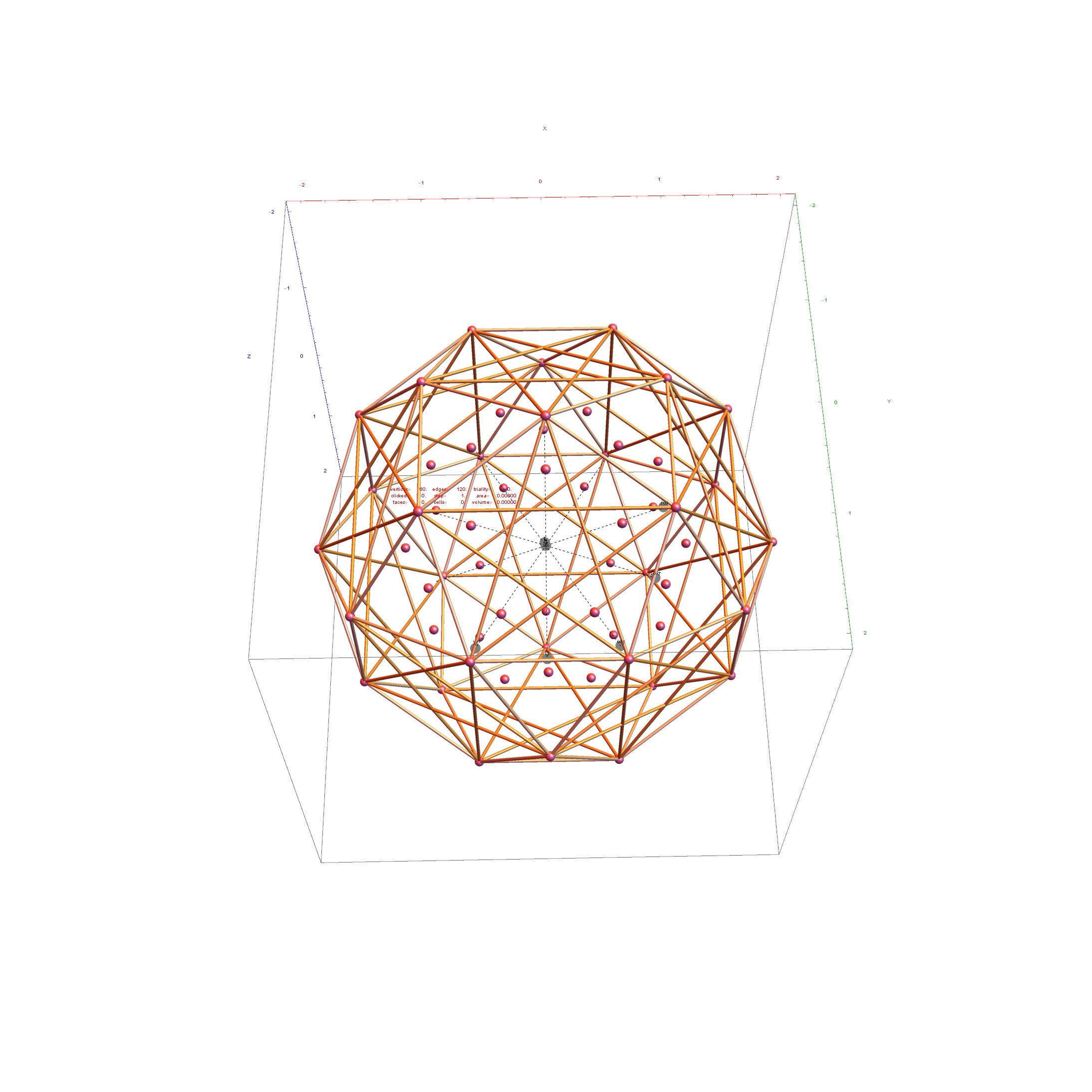
While the interior vertices are shown, only the exterior 120 hull edges were used in the rectifications.
3D StereoLithography Model for 3D Printing
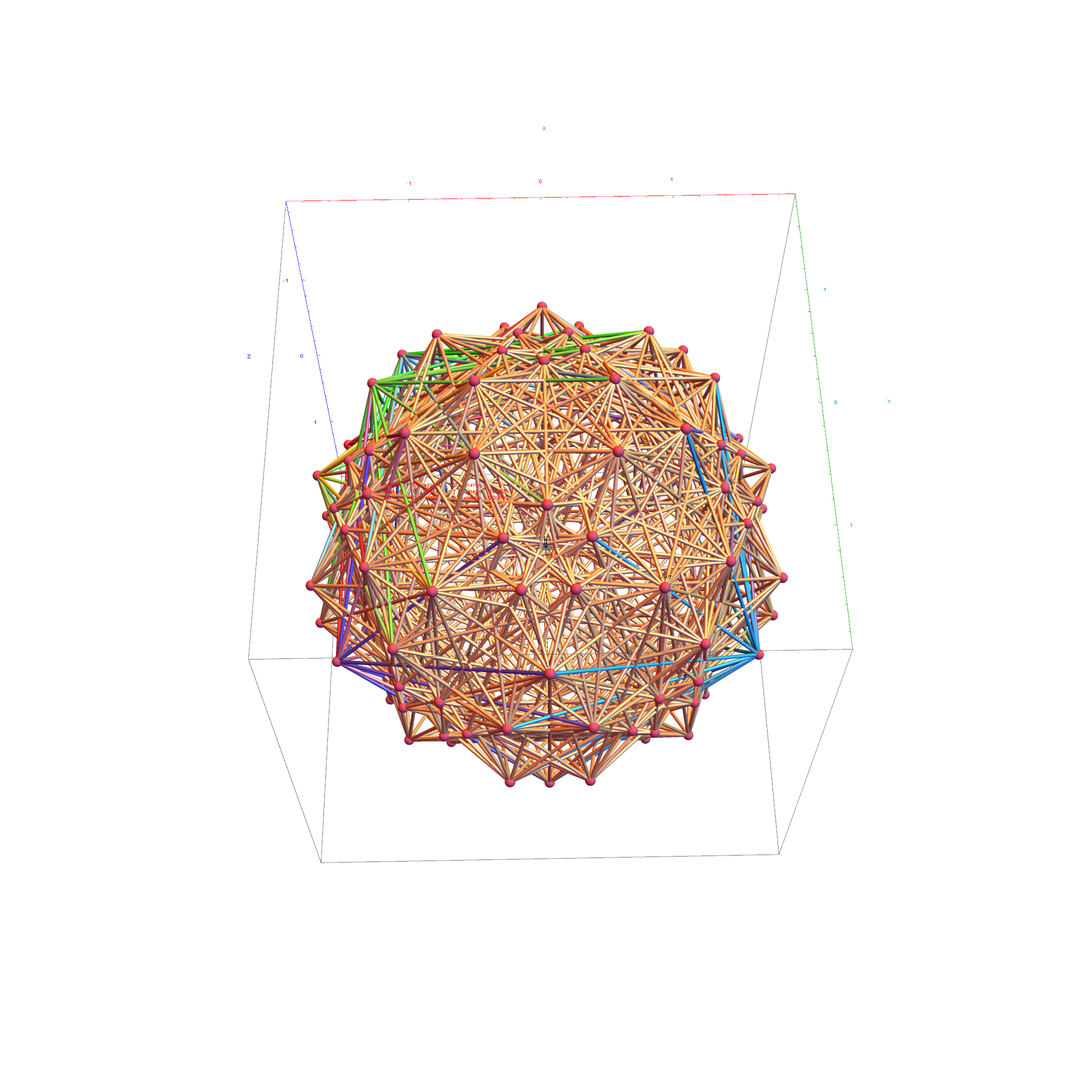
3D StereoLithography Model for 3D Printing
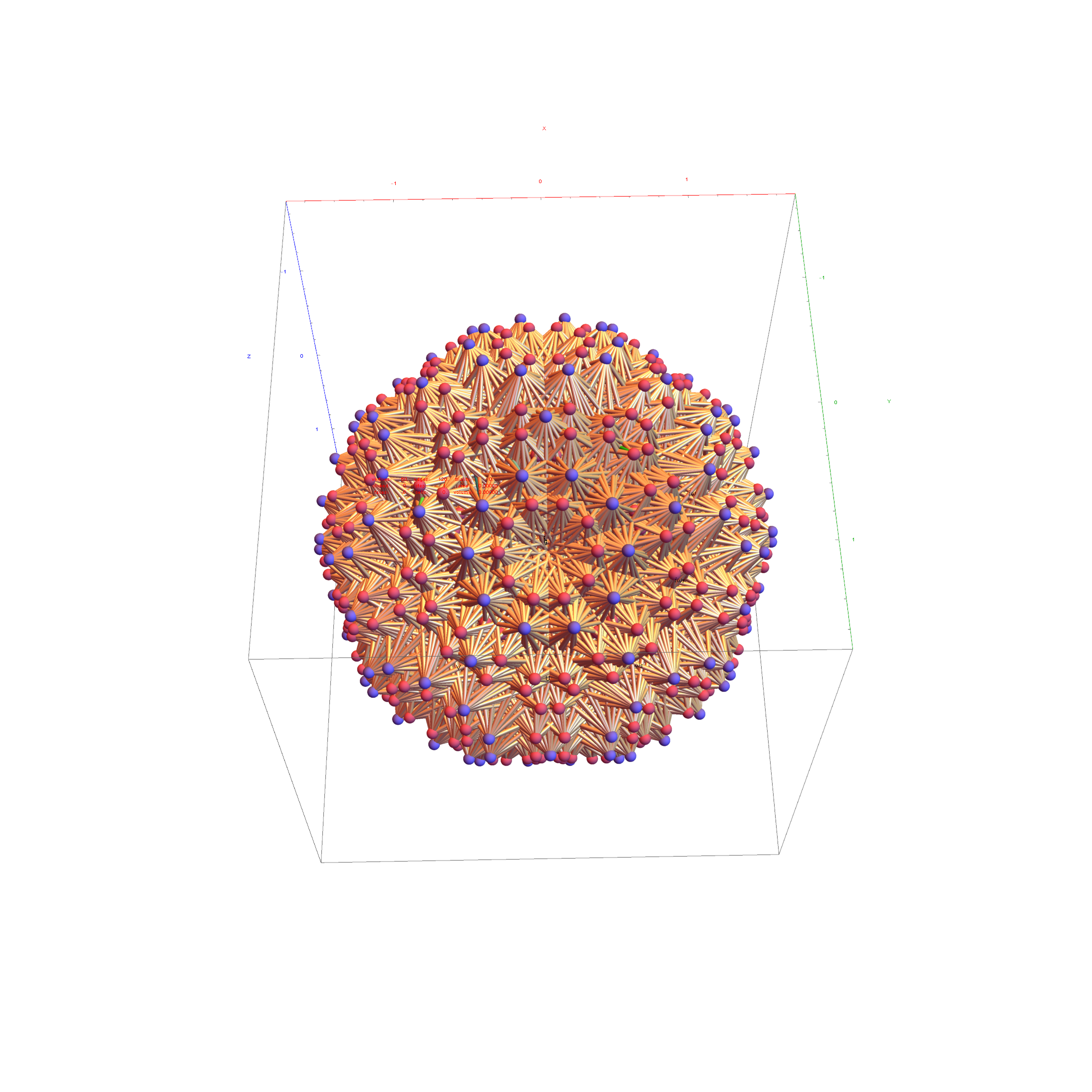
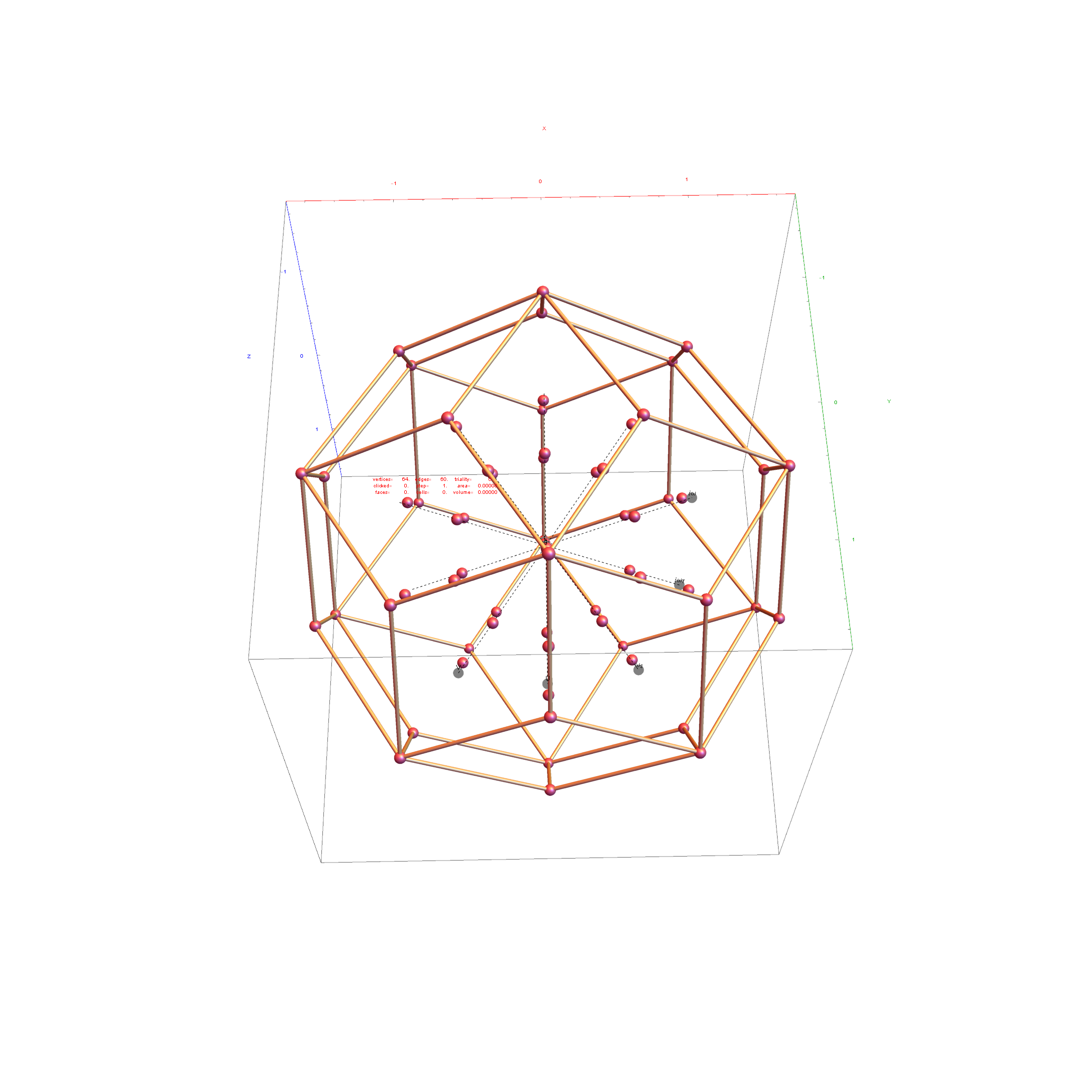
While the interior vertices are shown, only the exterior 60 hull edges were used in the rectifications.
3D StereoLithography Model for 3D Printing
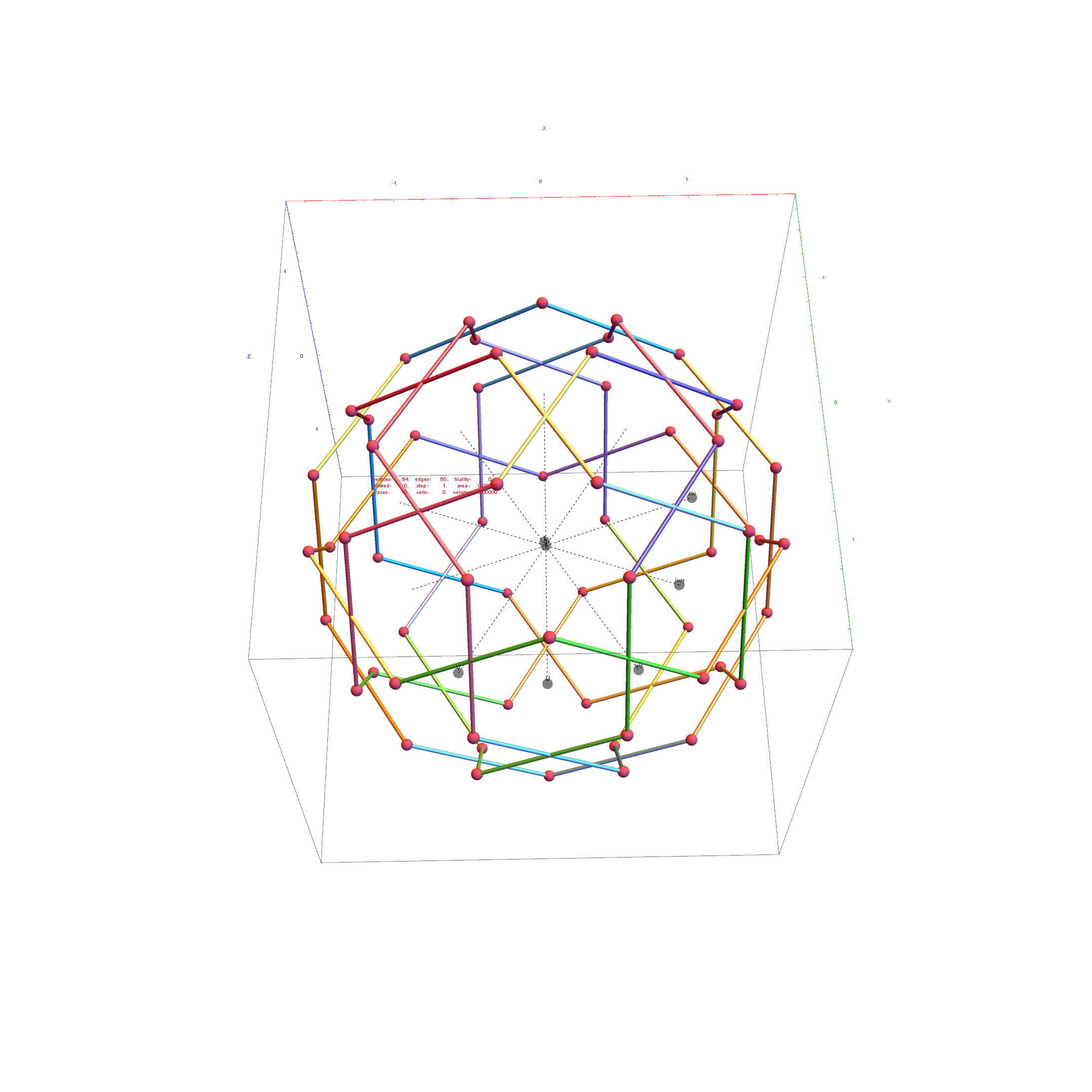
3D StereoLithography Model for 3D Printing
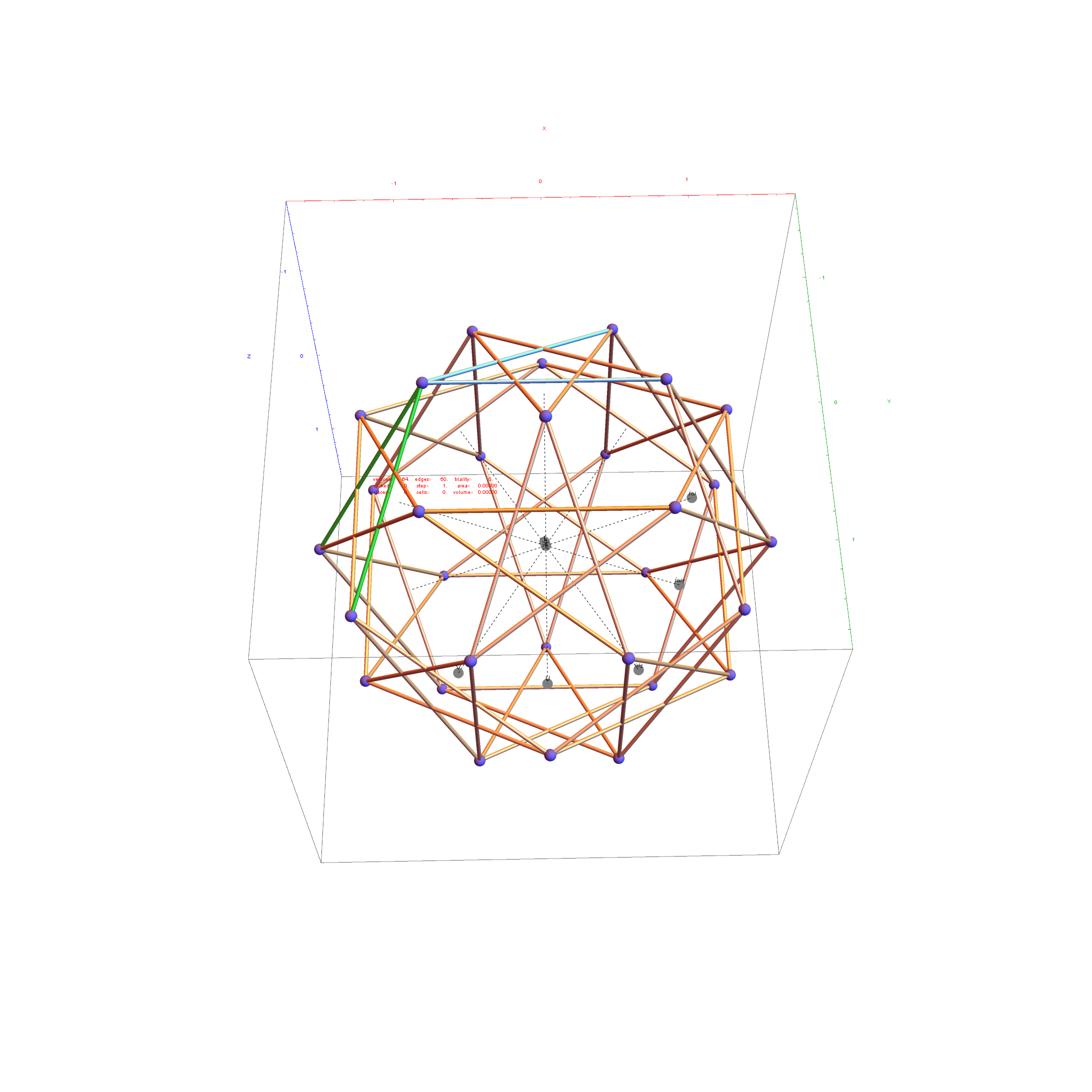
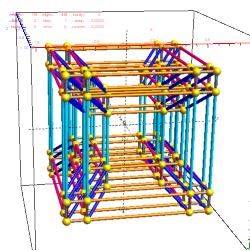
These objects are projected using an {x,y,z} orthonormal basis. For n={5,6,7} I add a small delta (.2) to {x,y,z} basis vectors in columns {n-2,n-1,n} in order to keep vertices from overlapping. There is an enhanced perspective applied to vertex location as well.
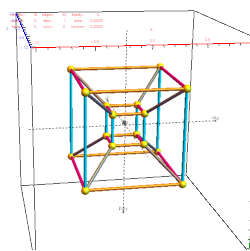
4Cube 3D StereoLithography (STL) model for 3D Printing
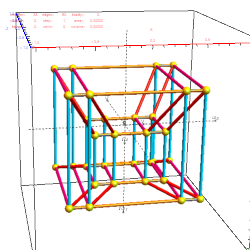
5Cube 3D StereoLithography (STL) model for 3D Printing

6Cube 3D StereoLithography (STL) model for 3D Printing
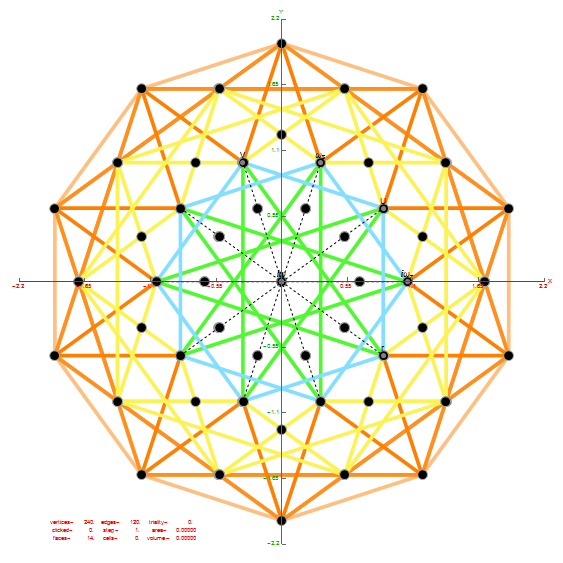
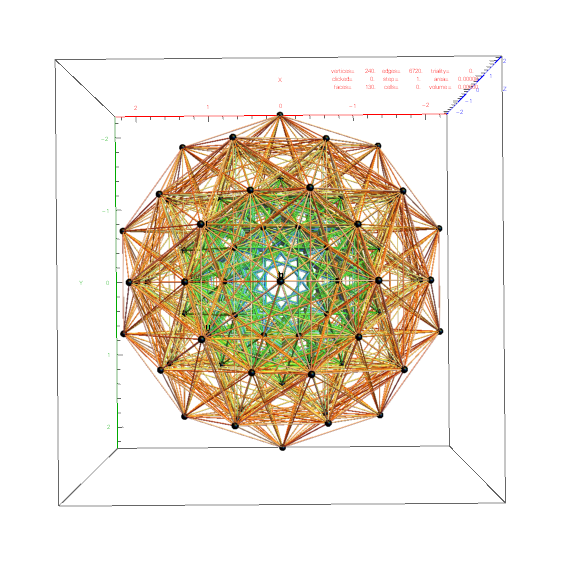
Interestingly, these 2D and 3D projections includes all 240 vertices and 6720 edges of E8 with the same 2D and 3D projection. Only the vertex and edge overlap are different.
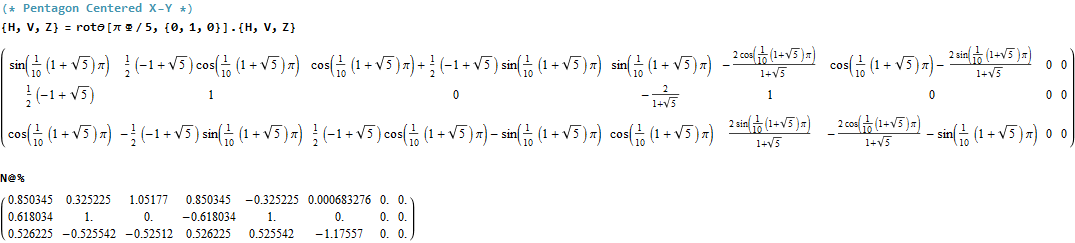
The D6 to H3 projection based on 3 rows of the E8 to H4+H4 Phi folding matrix.
The rotation off of the D6 to H3 projection based on the E8 to H4+H4 Phi folding matrix is
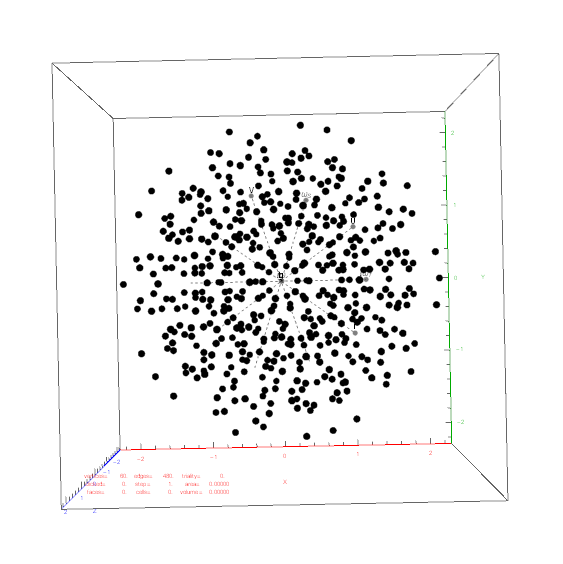
Using this rotated basis, we now show rectified D6 (Cantellated 6-Orthoplex t0,2{3,3,3,3,3,4})
Bi-rectified D6
6-Orthoplex

Rectified 6-Orthoplex (D6)
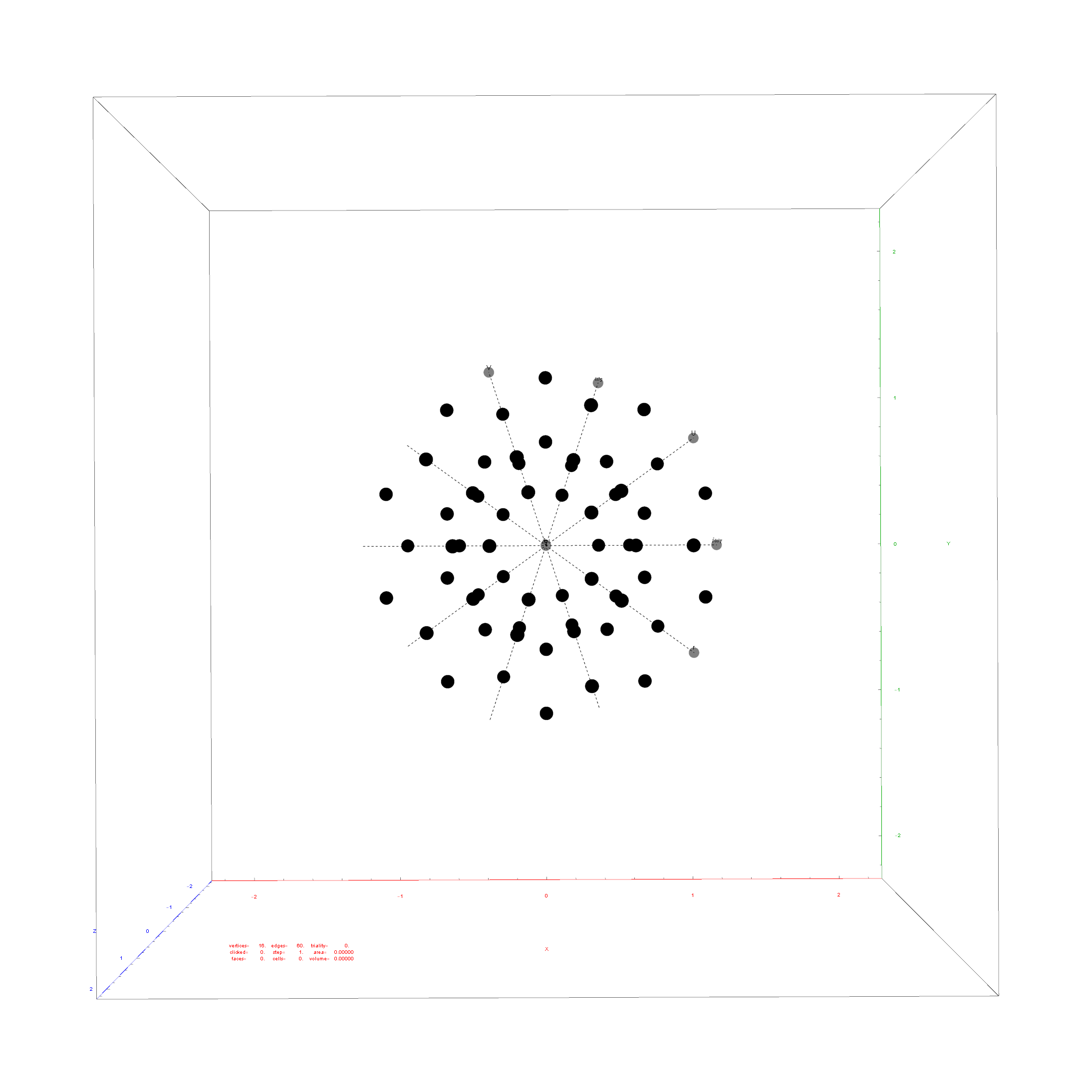
Bi-Rectified 6-Orthoplex
Tri-Rectified 6-Orthoplex