Tag Archives: Math
Mapping the fourfold H4 600-cells emerging from E8: A mathematical and visual study
My latest paper is now available here or on Vixra.
{abstract}
It is widely known that the E8 polytope can be folded into two Golden Ratio (Φ) scaled copies of the 4 dimensional (4D) 120 vertex 720 edge H4 600-cell. While folding an 8D object into a 4D one is done by applying the dot product of each vertex to a 4×8 folding matrix, we use an 8×8 rotation matrix to produce four 4D copies of H4 600-cells, with the original two left side scaled 4D copies related to the two right side 4D copies in a very specific way. This paper will describe and visualize in detail the specific symmetry relationships which emerge from that rotation of E8 and the emergent fourfold copies of H4. It will also introduce a projection basis using the Icosahedron found within the 8×8 rotation matrix. It will complete the detail for constructing E8 from the 3D Platonic solids, Icosians, and the 4D H4 600-cell. Eight pairs of Φ scaled concentric Platonic solids are identified directly using the sorted and grouped 3D projected vertex norms present within E8. Finally, we will show the relationship of the Beordijk-Coxeter Tetrahelix emerging from the Petrie projection’s concentric rings of 30 vertices of the H4 600-cells.
This paper builds off of some recent work here, and here.
Below are a few figures from that paper.
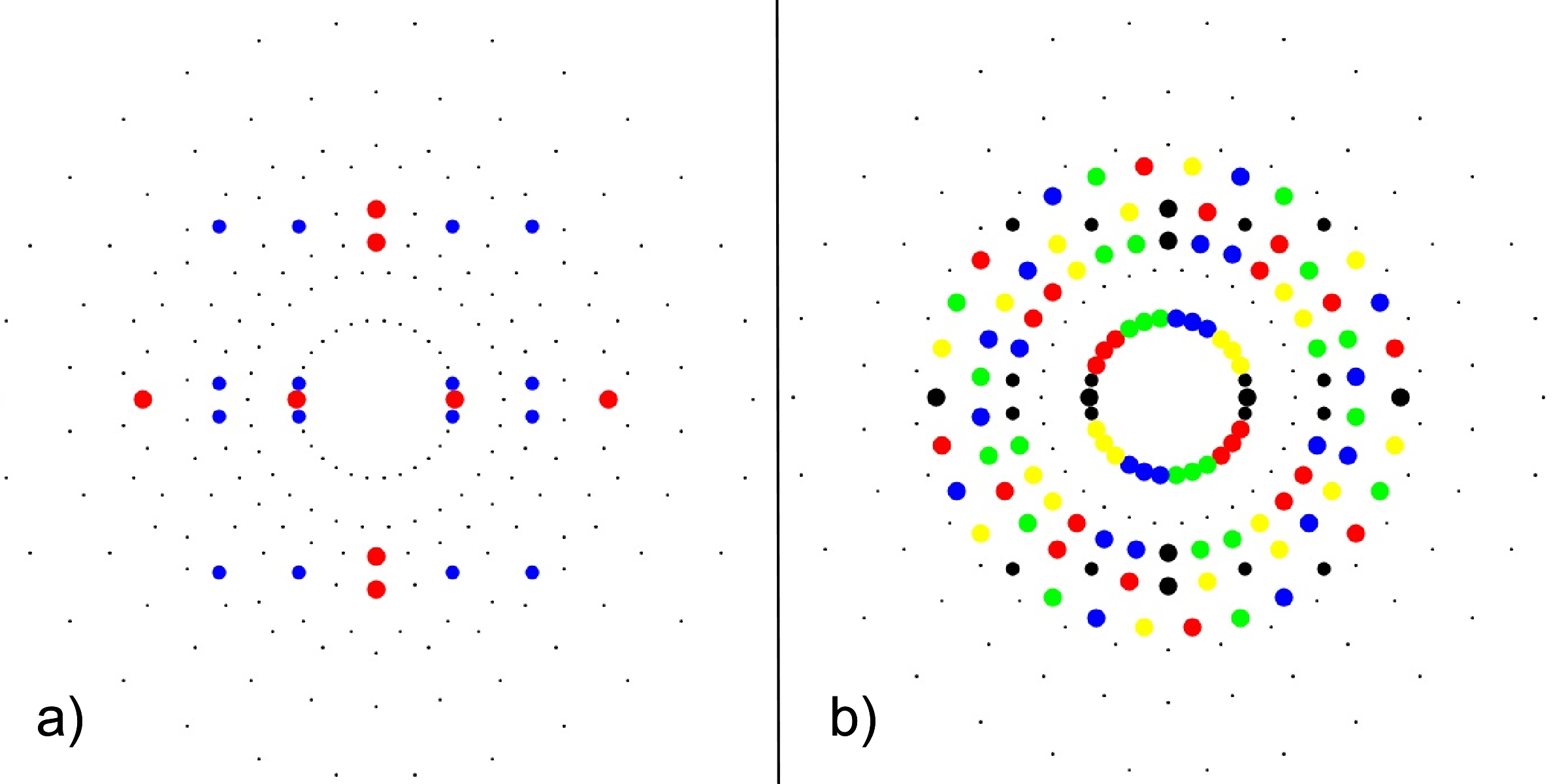
FIG. 3: a) 24-cell highlighting the 16-cell (red on-axis vertices) and 8-cell (blue off-axis vertices), b) Snub 24-cell highlighting four pi/5 rotations of the 24-cell (black) in red, green, blue, yellow.
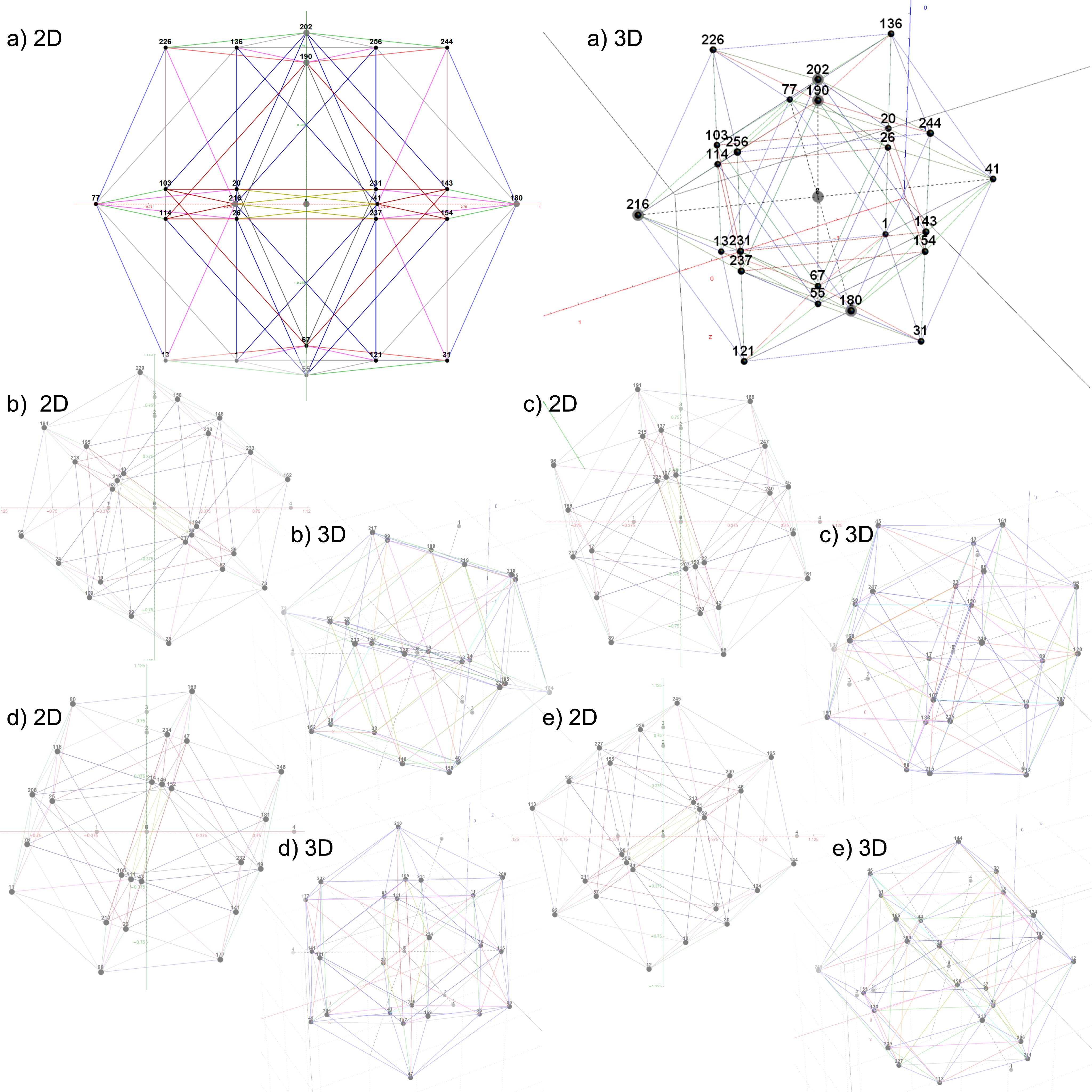
FIG. 4: The 5 24-cell decomposition of one 600-cell, each with 2D and 3D vertex numbered projections including edges; a)
24-cell, b-e) Snub 24-cells from four pi/5 rotations of the 24-cell in a)
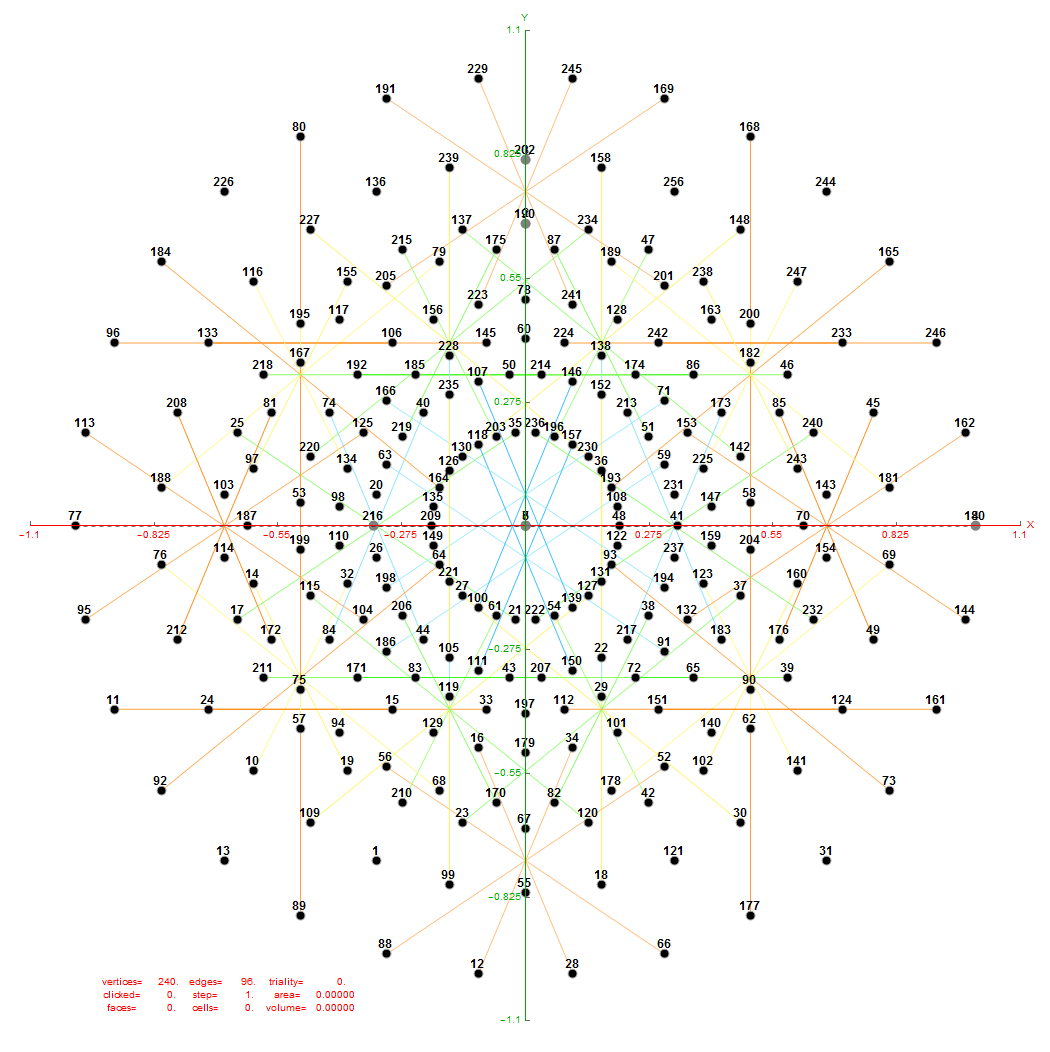
FIG. 6: Vertex numbered Petrie projection of the rotated E8, showing the 96 edges of 8D norm l = 2Φ which links the Snub 24-cell H4 and H4Φ (L<->R) vertices (Note: the 8 excluded positive E8 8-Orthoplex (or equivalently, the H4 and H4Φ 4-Orthoplex) “generator vertices” are shown as larger gray labeled axis dots which overlap their darker black E8 vertices)
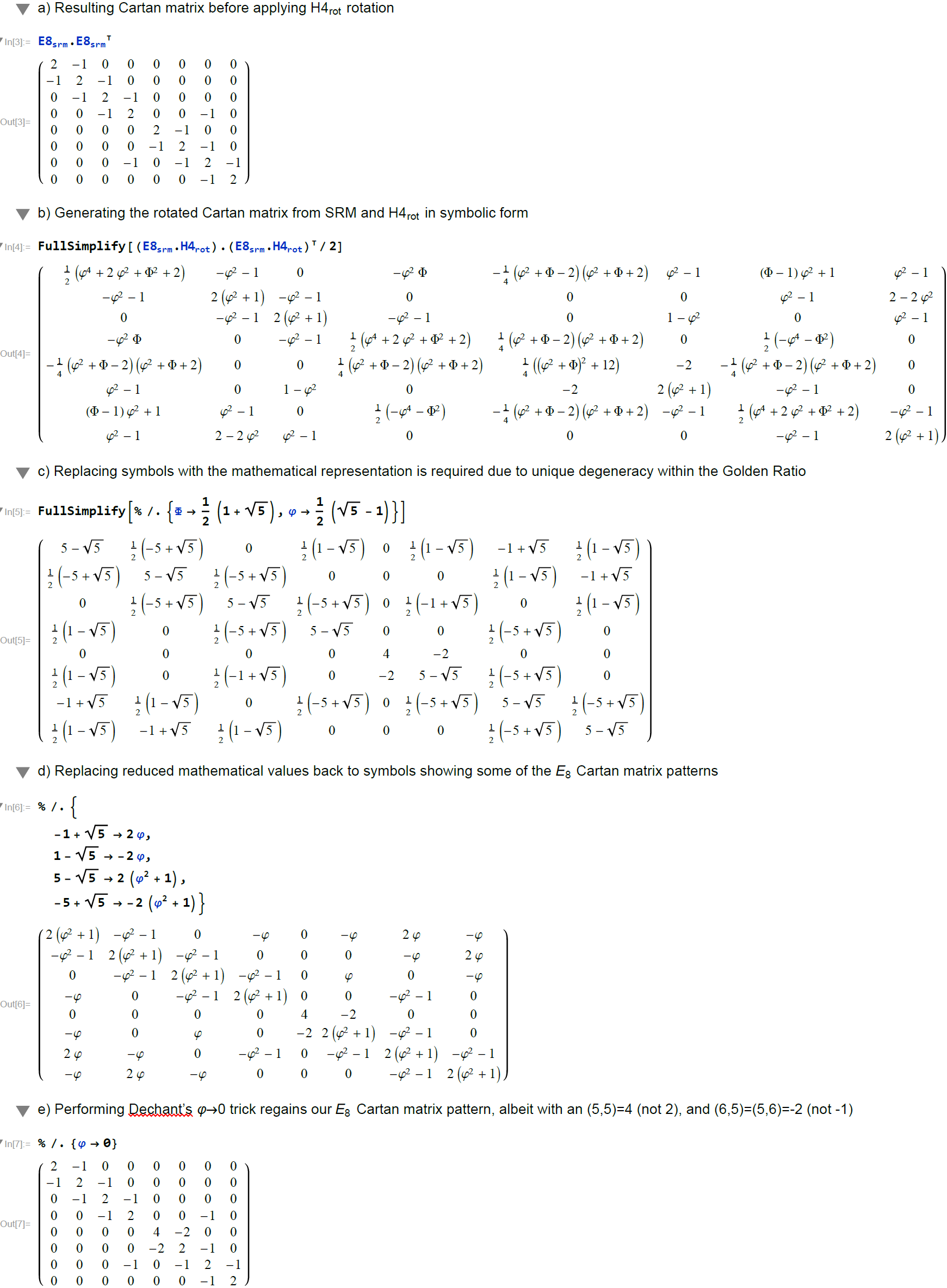
FIG. 7: Symbolic analysis using MathematicaTM comparing the Cartan matrix before and after rotating the simple roots matrix (E8srm) used to create it (Note: the resulting Cartan matrix is not precisely that of E8, even after applying the Dechant’s Φ=0 trick)
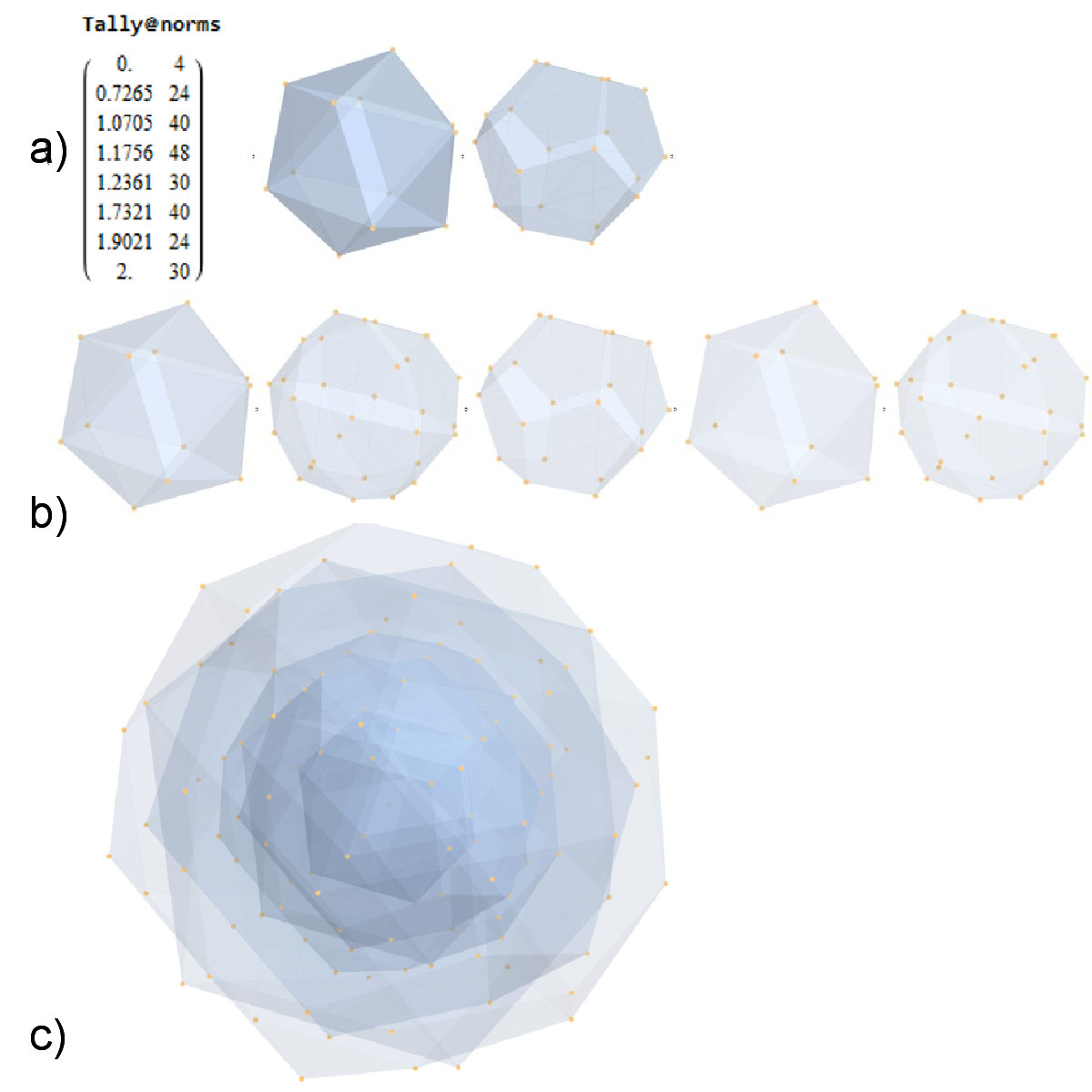
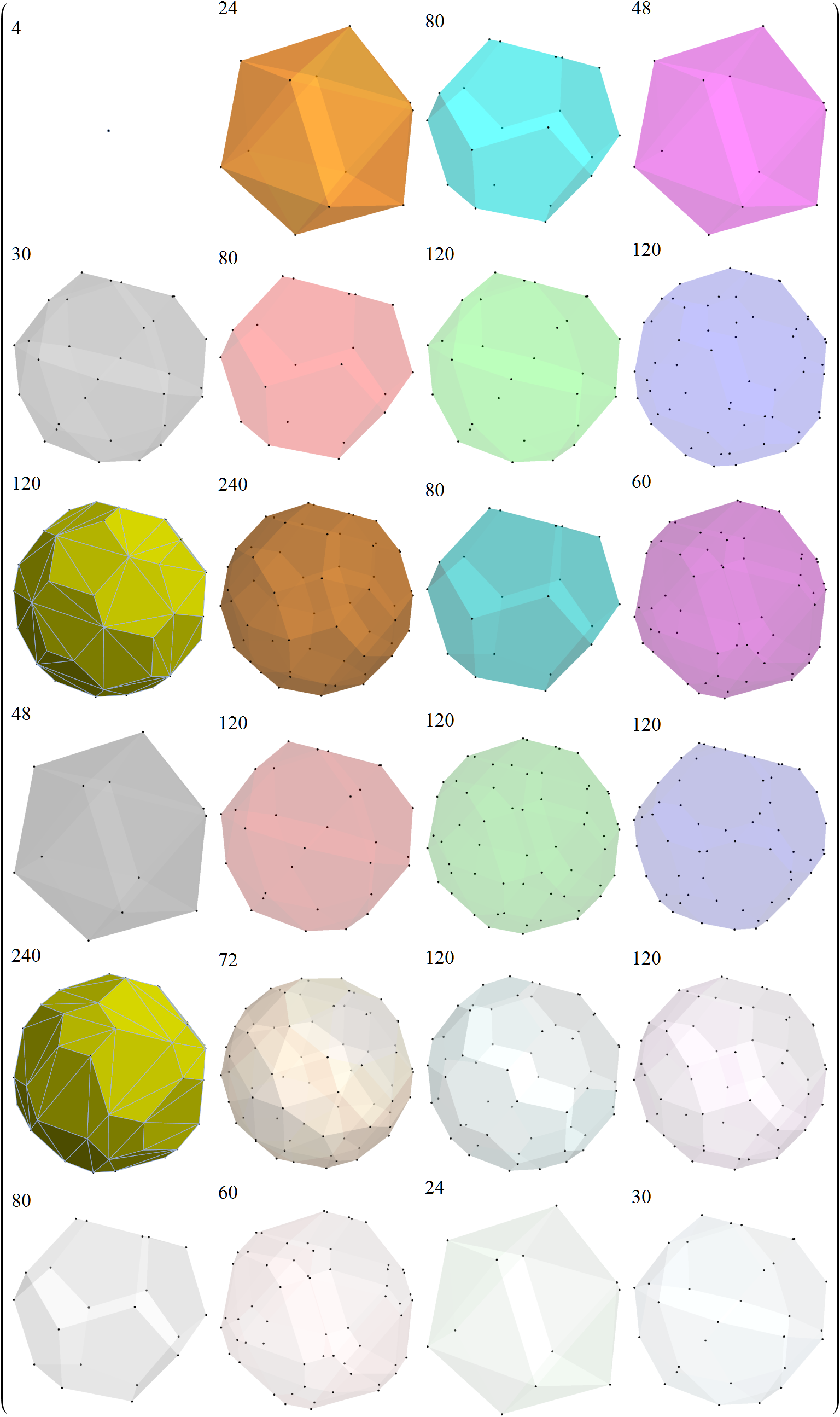
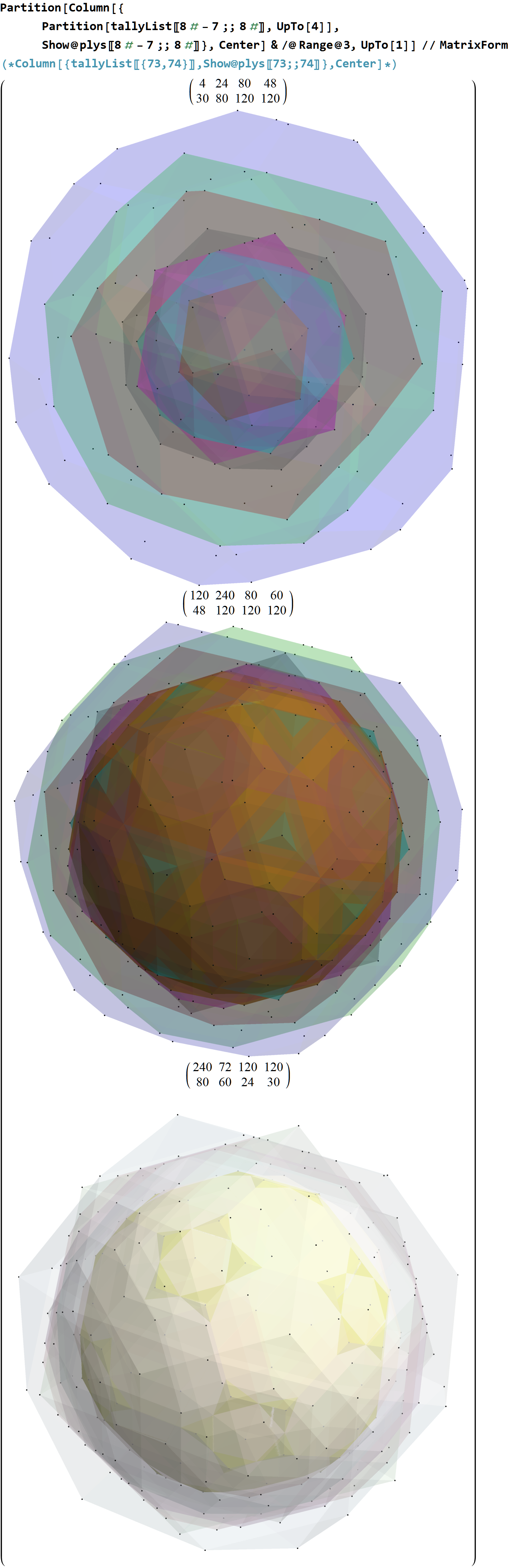
FIG. 8: a) Sorted list of the vertex norms with their grouped vertex counts. b) 3D surface models for each of the 7 hulls of vertices c) Combined 3D surface model with increasing transparency for each successive hull.
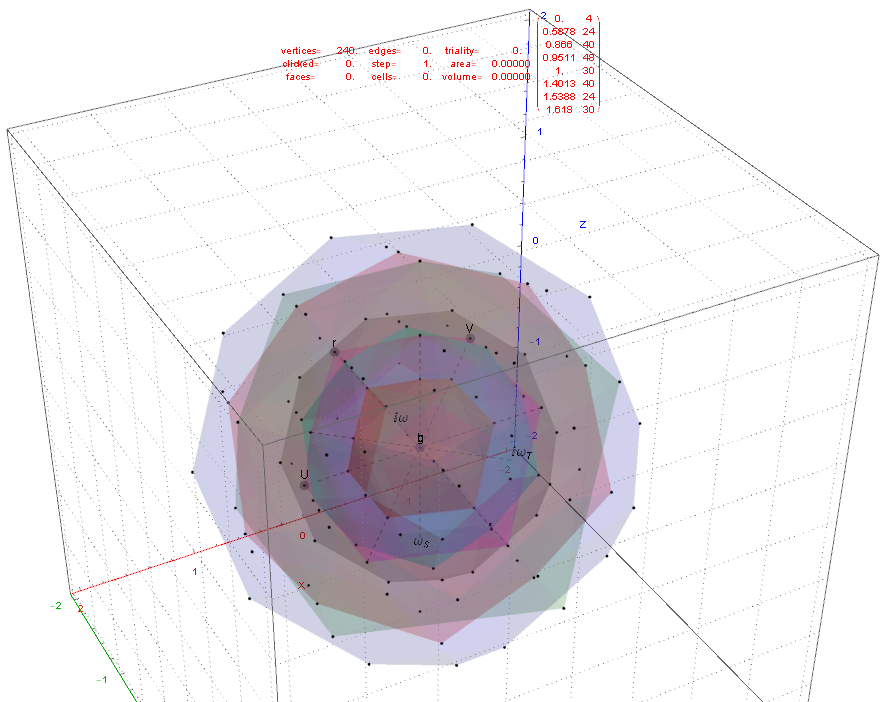
FIG. 11: 3D projection using an orthonormal basis on H4 and H4Φ vertices (i.e. the rotated E8)
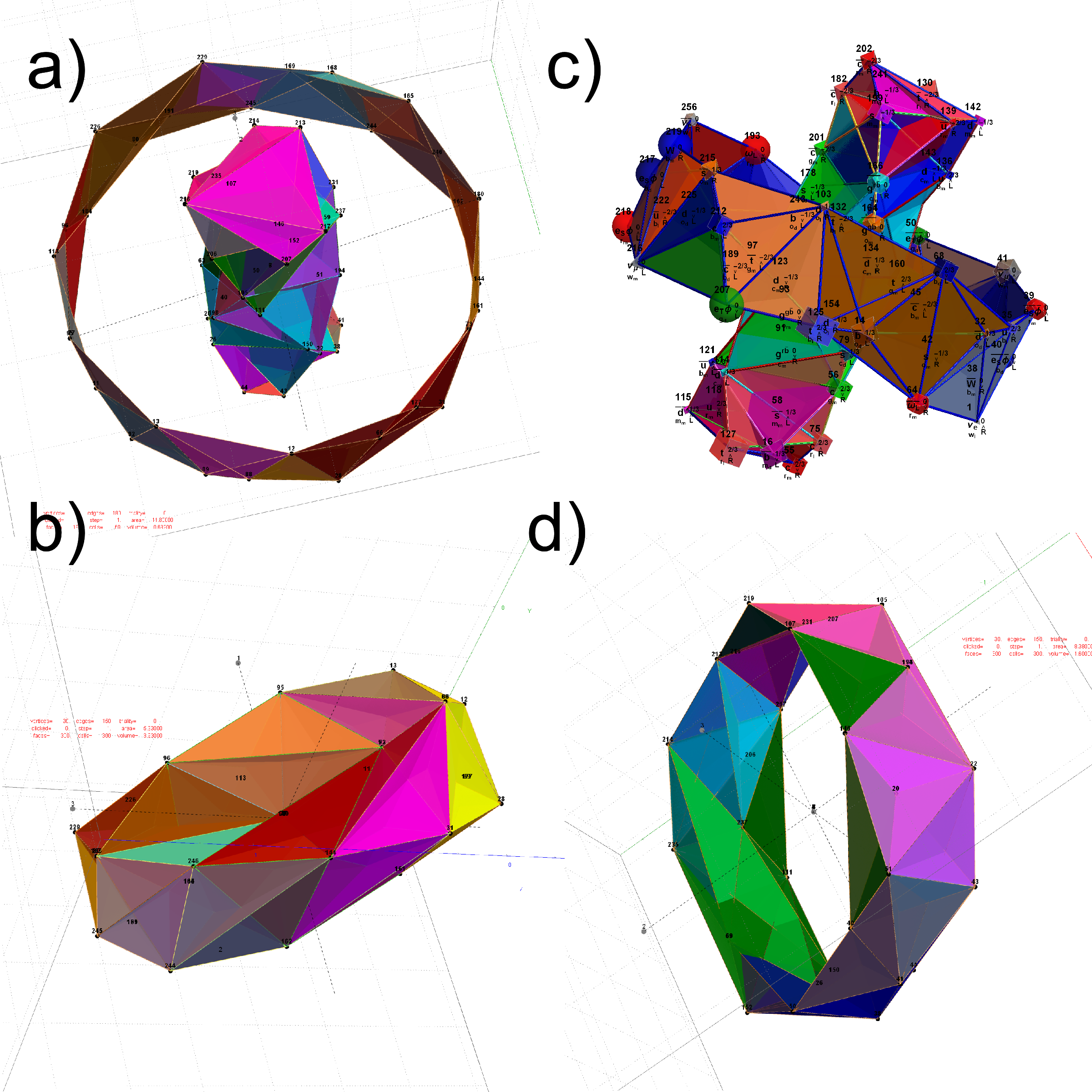
FIG. 12: The Beordijk-Coxeter Tetrahelix emerging from the 8 concentric rings of 30 E8 and H4+H4Φ Petrie projection vertices; a) H4 inner and outer ring in 3D, b) with vertex size, shape, color assigned from physics model, c-d) inner and outer ring in orthonormal projection of H4Φ
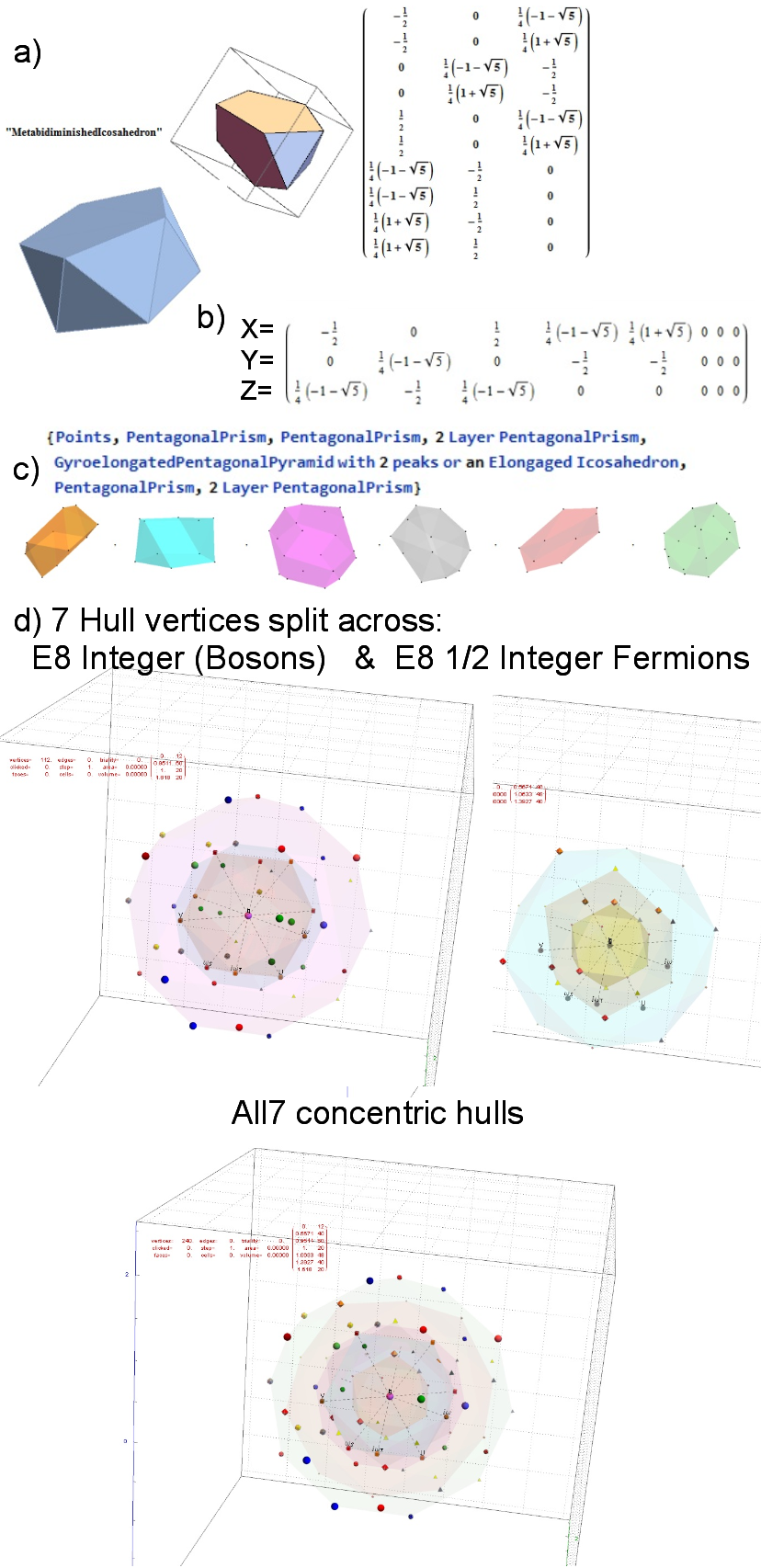
FIG. 15: MetabidiminishedIcosahedron (with its negated vertices gives the GyroelongatedPentagonalPyramid) Crystal Projection Prism projecting E8 a) the crystal prism geometry and vertices, b) the selected basis vectors, c) the individual 3D projected concentric hull objects, d) the combined set of concentric objects with progressively increasing transparency and tally of vertex norms.
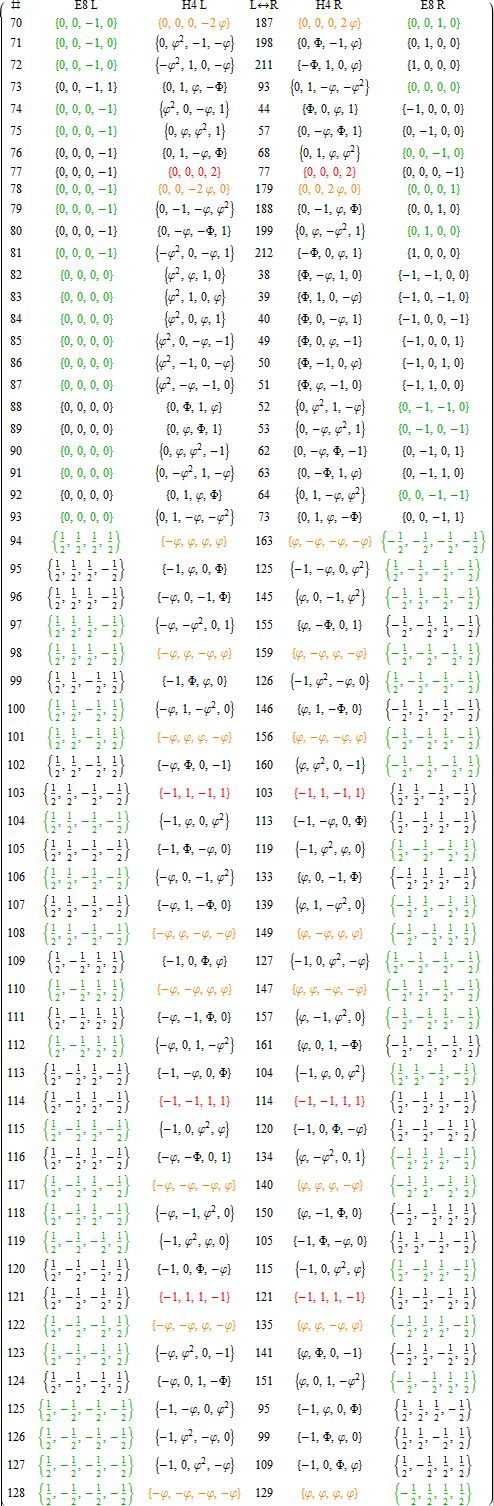
APPENDIX A: LIST OF E8 AND ITS ROTATED H4 AND H4Φ VERTICES
This table splits the E8 and its rotated H4 vertices into L/R 4D elements.
1. Table structure
The first column is an SRE E8 vertex index number derived from sorting the E8 vertices by their position based on the 256=2^8 binary pattern from the 9th row of the Pascal triangle (1, 8, 28, 56, 70, 56, 28, 8, 1) and its associated Cl8 Clifford Algebra. This construction is described in more detail in [3]. The odd groups (1,3,5,7,9) with (1,26,70,26,1) elements (respectively) are the 128 1/2 integer vertices. The even groups (2,4,6,8) with (8,56,56,8) elements (respectively) are the 112 integer vertices along with the 16 excluded 8 generator (and 8 anti-generator) vertices (2-9 and 248-255) with permutations of (1; 0; 0; 0; 0; 0; 0; 0) (a.k.a. the 8-Orthoplex), such that they indicate the basis vectors used for projecting the polytope.
Only the first half of the 240 vertices is shown, since the last half is simply the reverse order negation of the vertices
in the first half (e.g. the E8 vertex n=10 has as its’ negation 257-n=247). The middle column labeled L<->R indicates the vertex reference number that contains the same L as the R (and equivalently, the same R as the L, interestingly enough).
2. Table color coding
The E8 L/R columns’ green color-coded elements indicate that the 4D vertex rotates into the smaller H4 600-cell.
Conversely, the E8 L/R columns’ black color-coded elements indicate the 4D vertex rotates into the larger H4Φ
600-cell.
The H4 L/R columns’ red color-coded rows are 24-cell elements that always self-reference and are always members of the scaled up 600-cell H4Φ. The H4 L/R columns’ orange color-coded rows are 24-cell elements that always reference the negated elements in the range of 129-256 and are always members of the smaller 600-cell H4.
Metatron’s Cube
I was recently asked to create a 3D laser etched crystal of Metatron’s Cube.
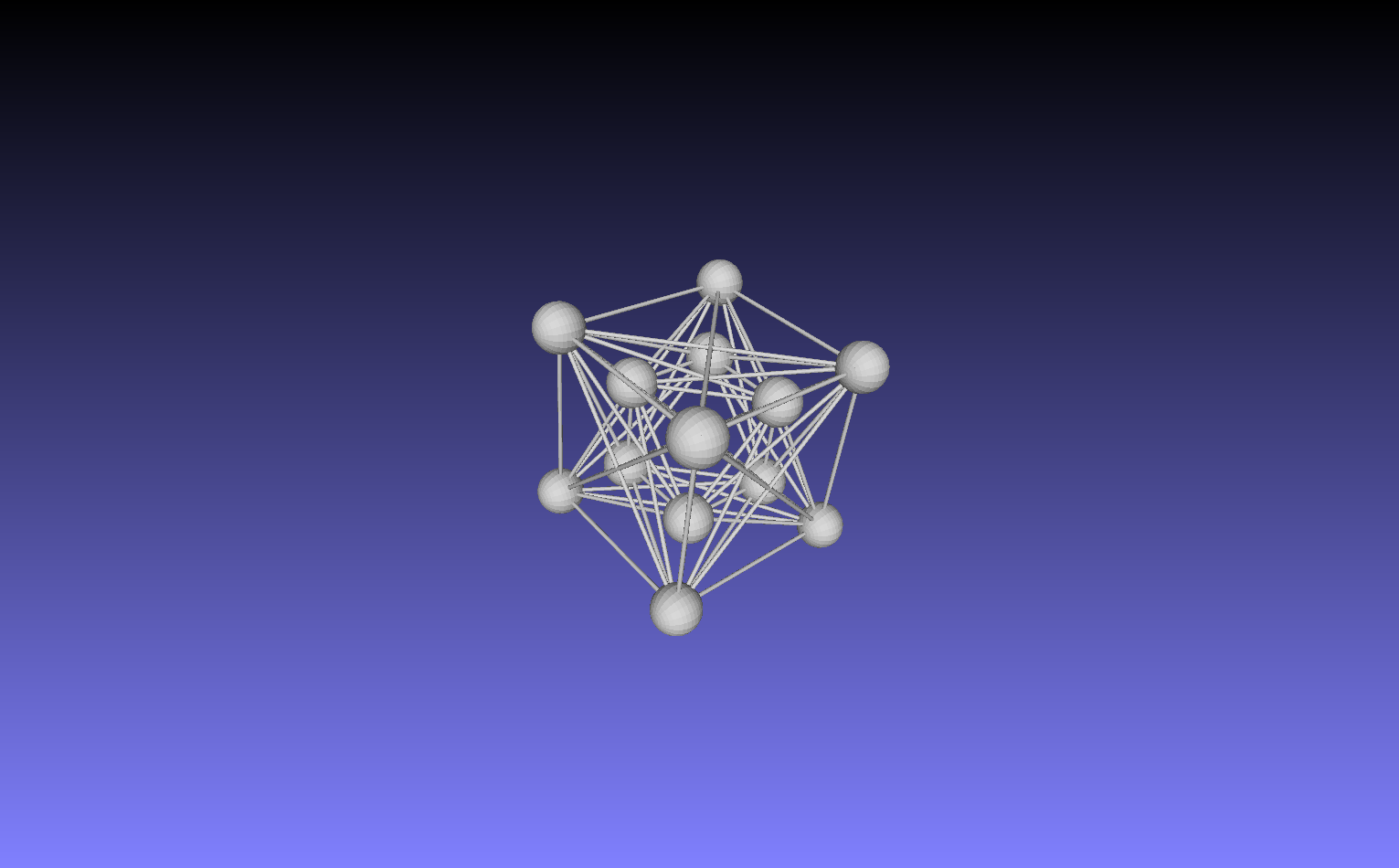
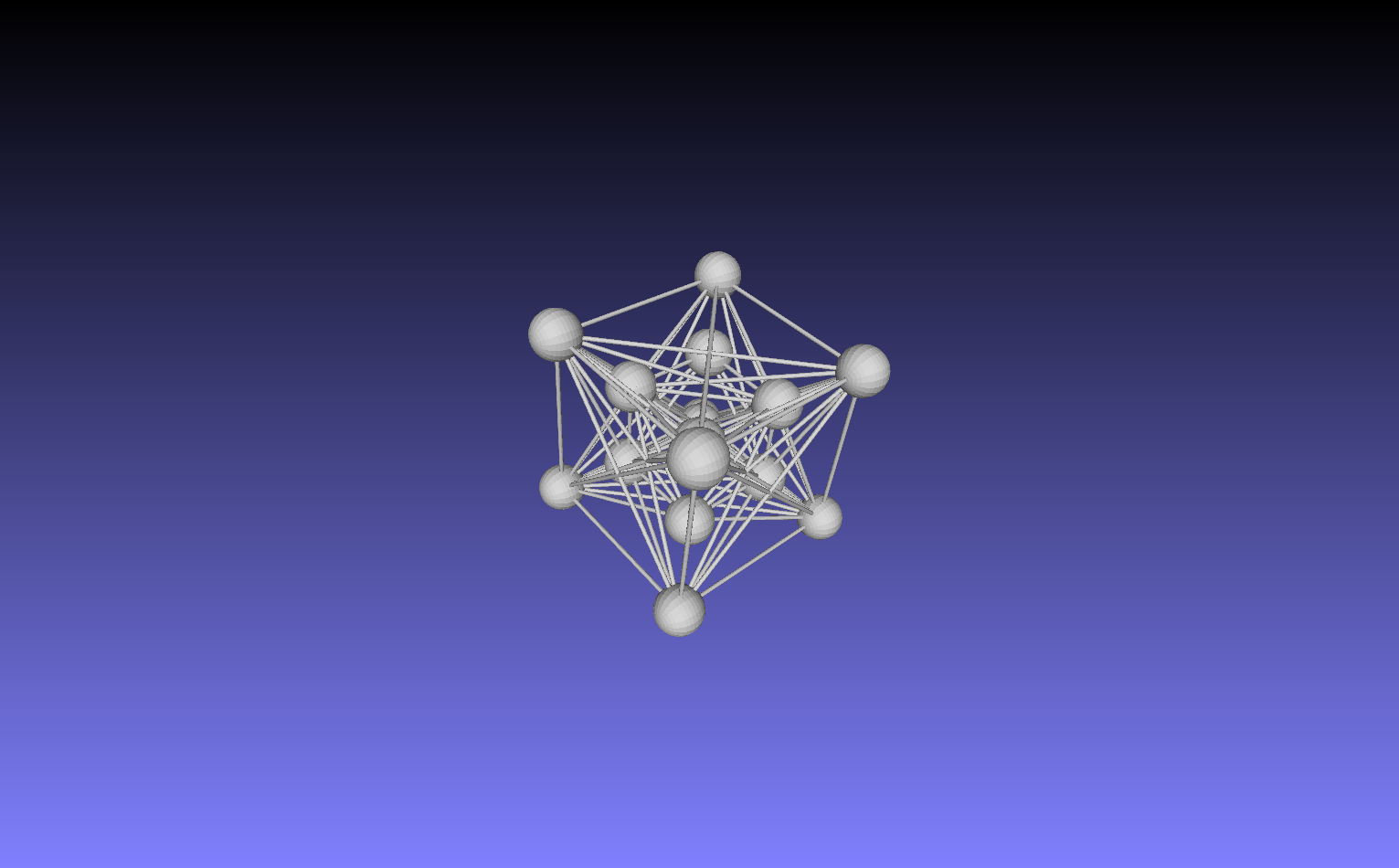
The 13 Metatron rings are (or at least can be) taken from the 16 vertices of the tesseract (a 4D geometric figure called an 8-cell) which can be visualized by projecting 4D into 3D as two concentric 3D cubes.
Three of the 16 rings are hidden behind the ring in the front center when projecting the two concentric 3D cubes to 2D (or looking at it from just the correct angle on a corner and ignoring the perspective error introduced by parallax).
There are many more lines in the Metatron cube than from the typical 32 edges of the 8-cell tesseract connecting the vertices. These come from what is called the “complete graph” of 120 edges from the 16 vertices of the 8-cell. The Platonic solids are all contained (or related by duality) within the 3D projection of this complete graph of the 8-cell with large vertex spheres.
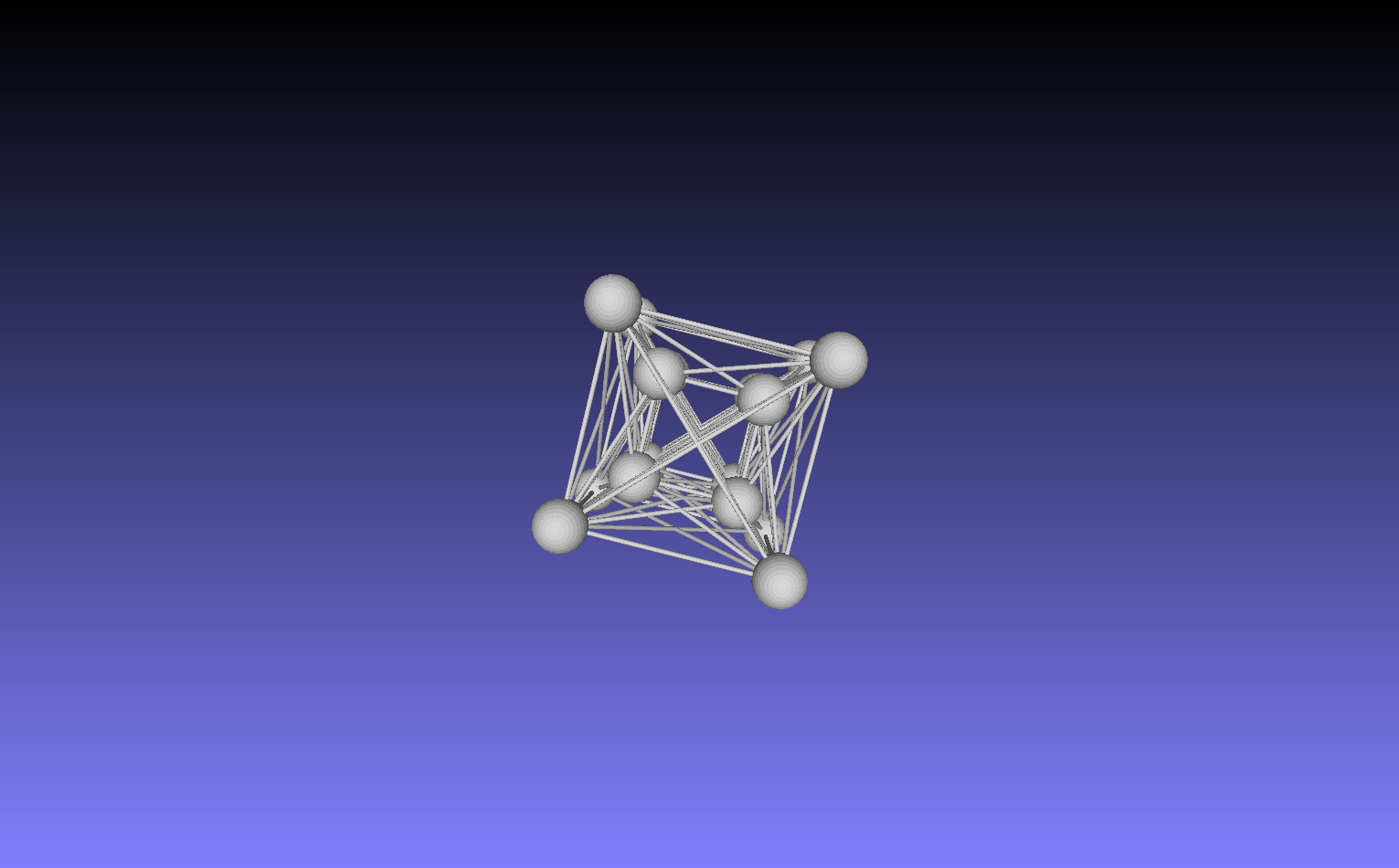
Slightly off angle (notice the 3 hidden spheres are now visible):

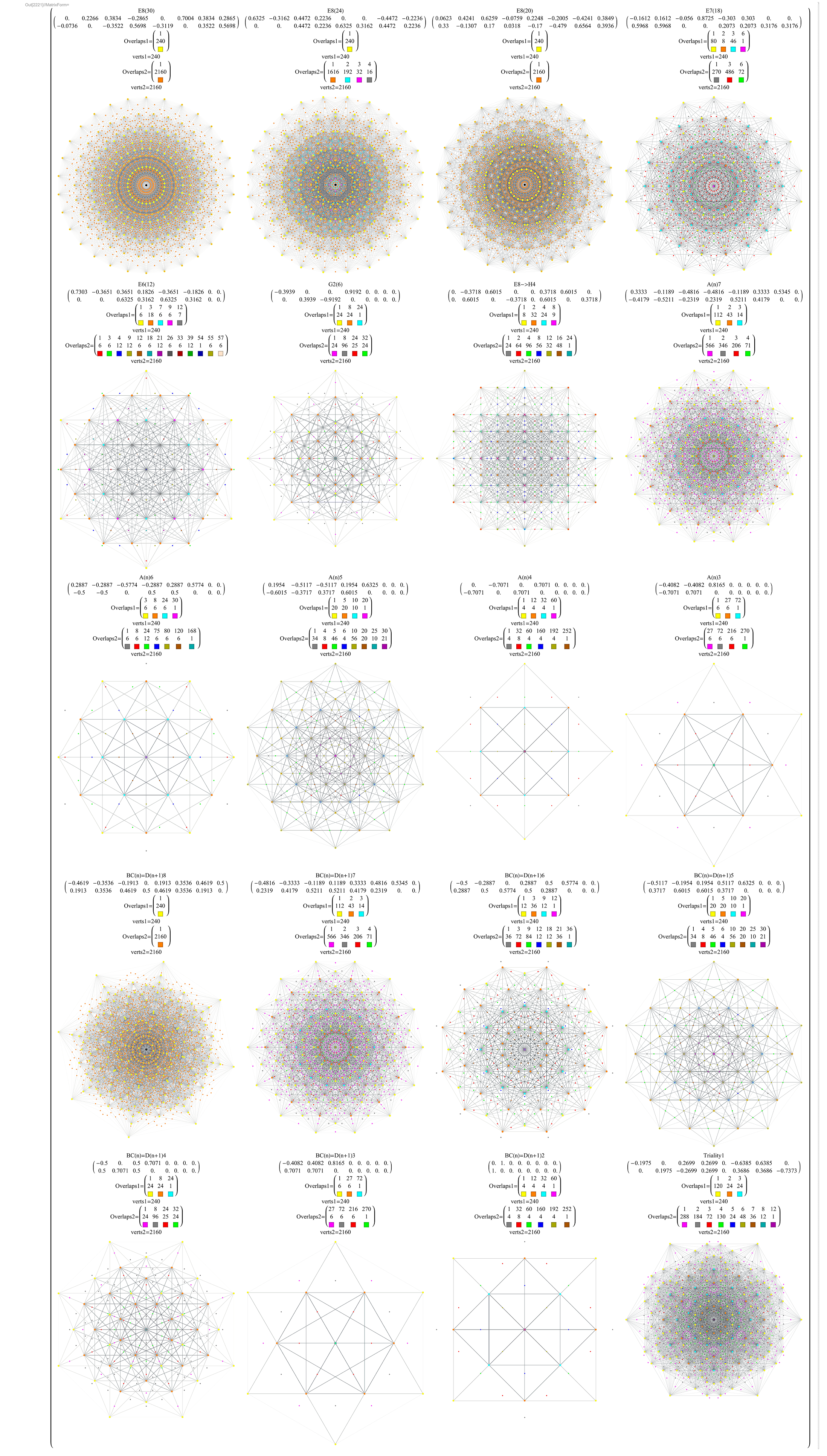
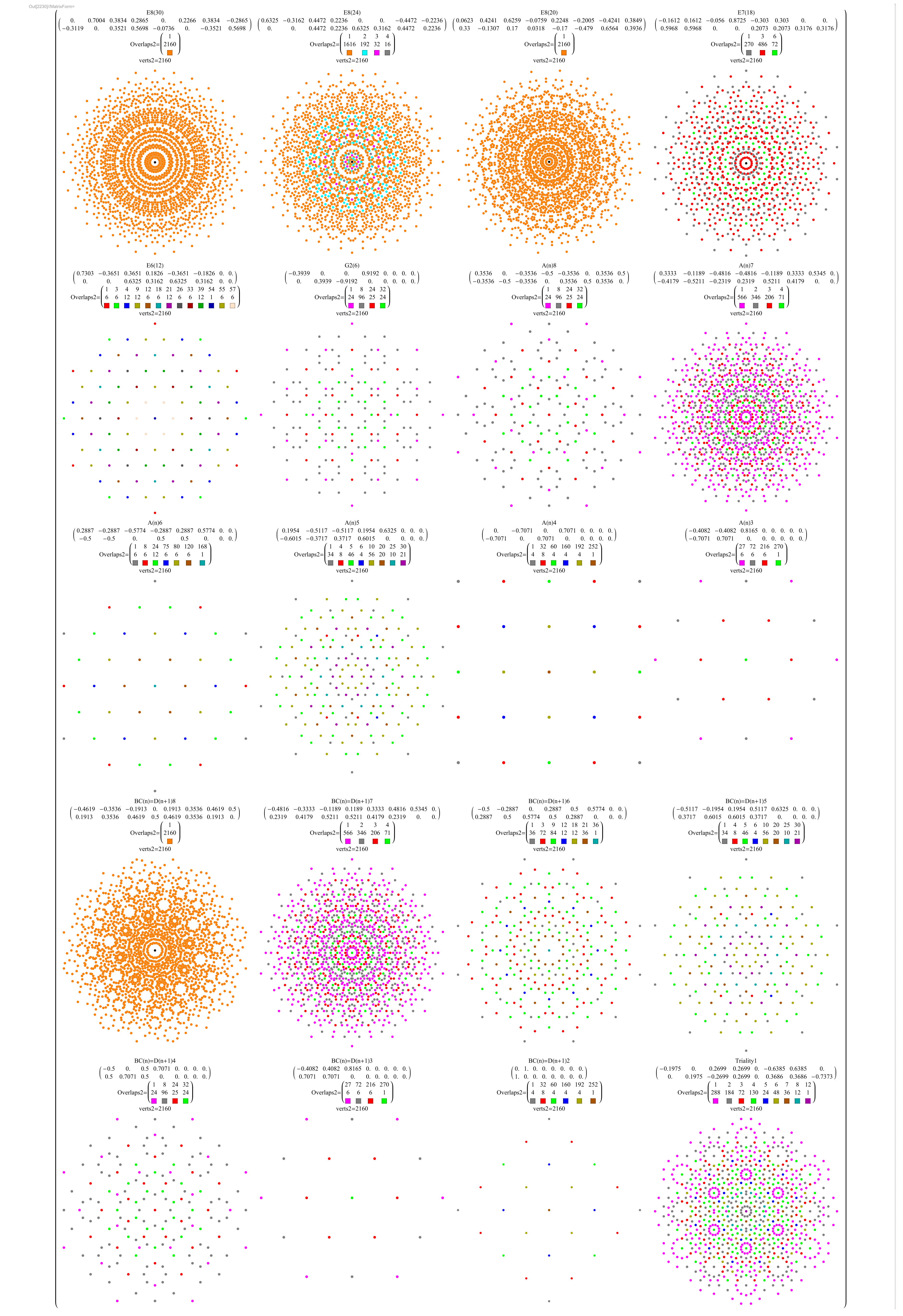
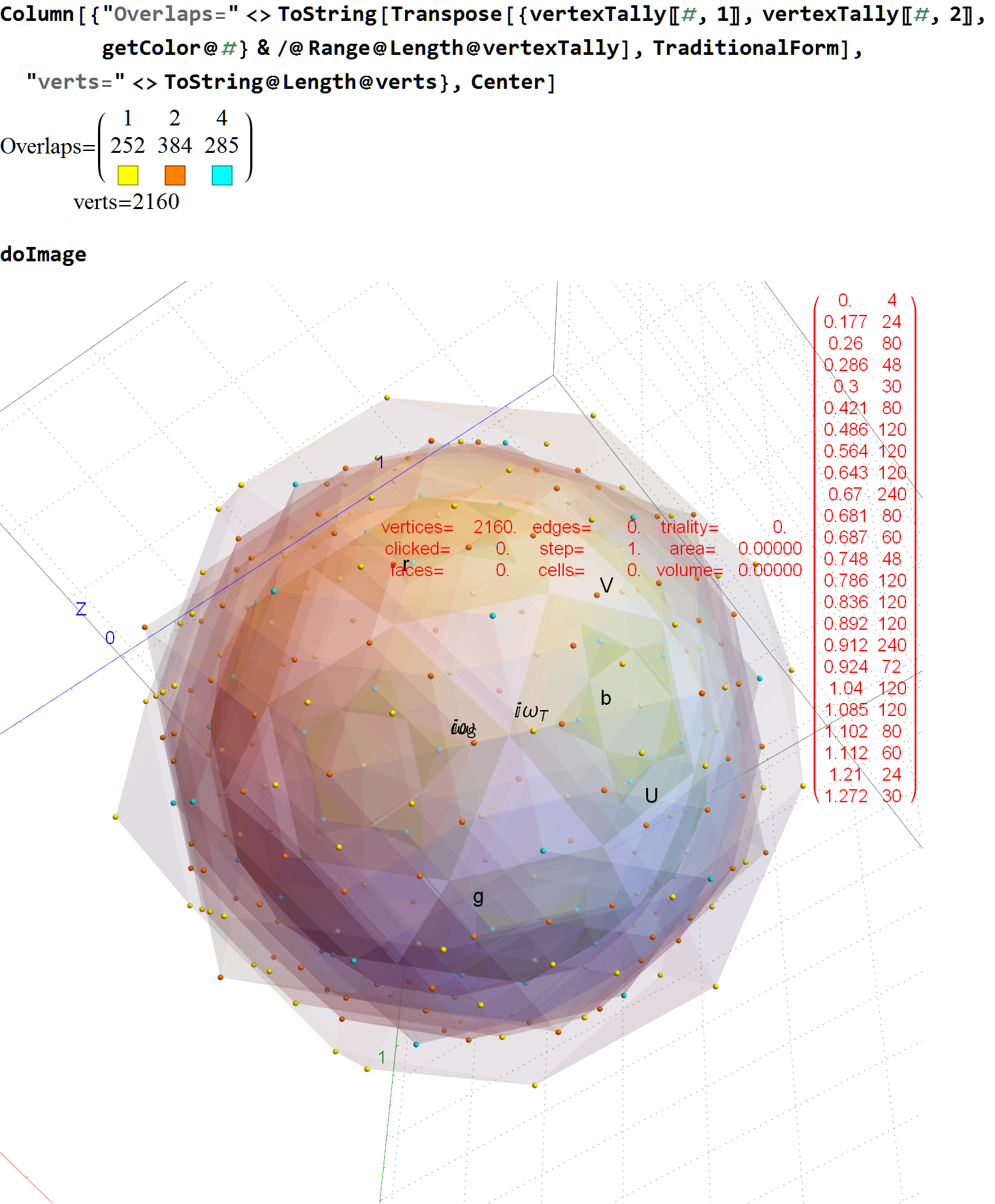
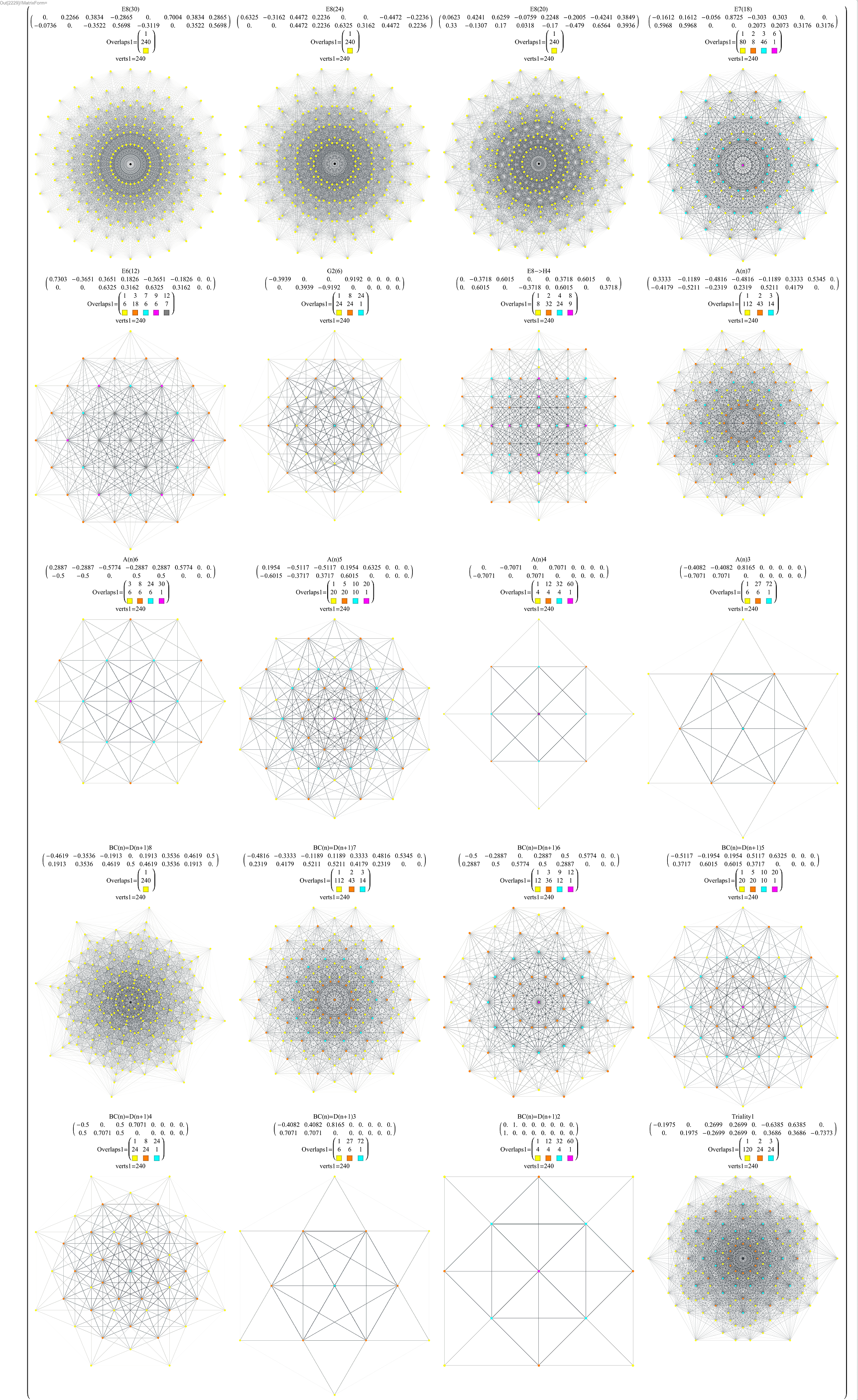

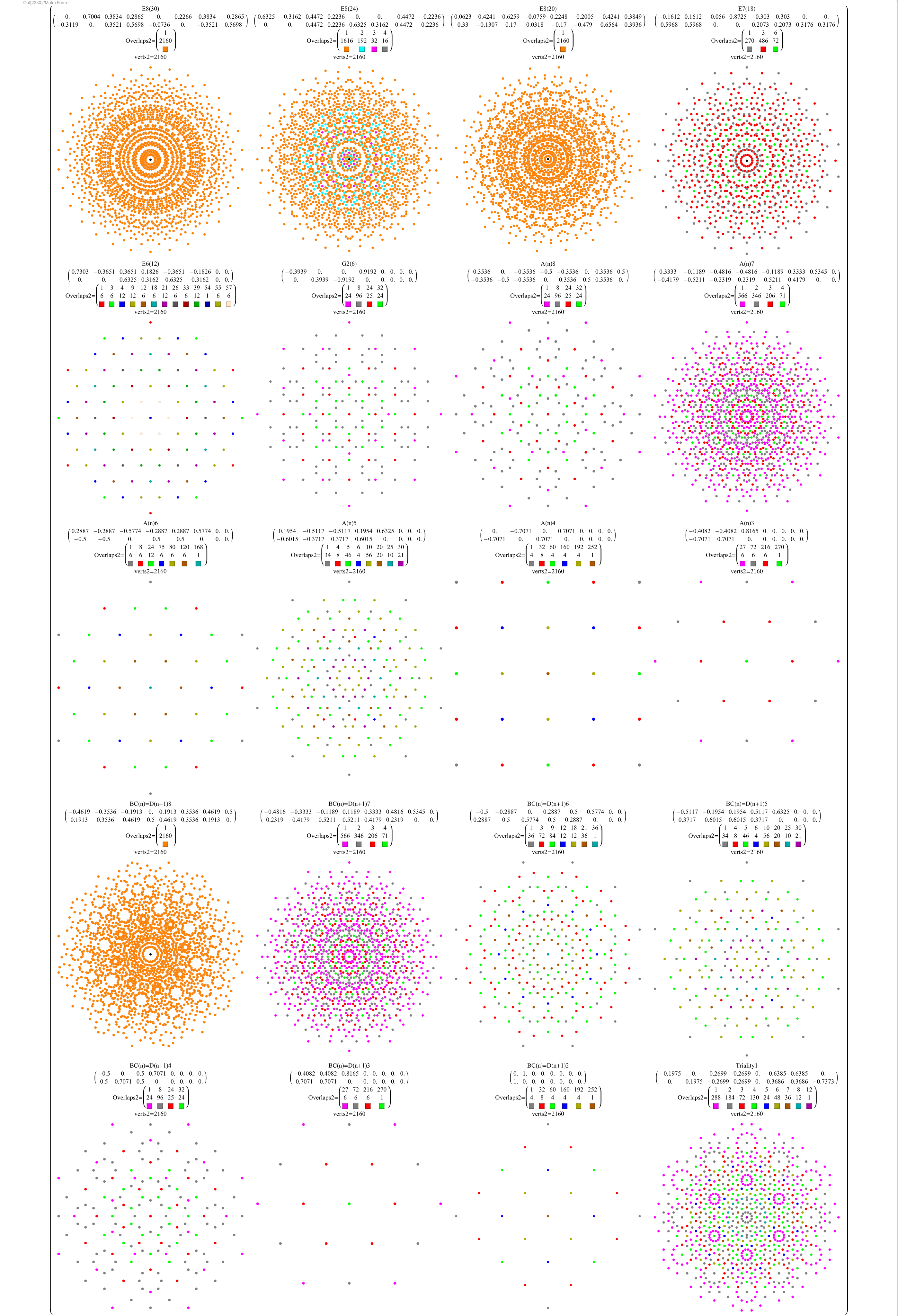
E8 (2_41, 4_21, and 1_42) projected to various Coxeter planes
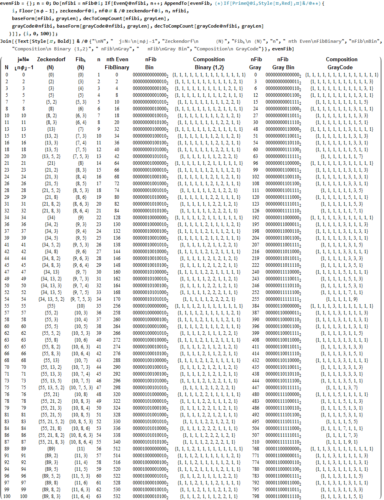
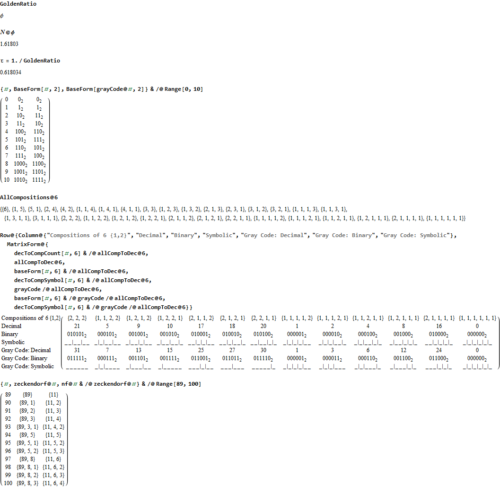
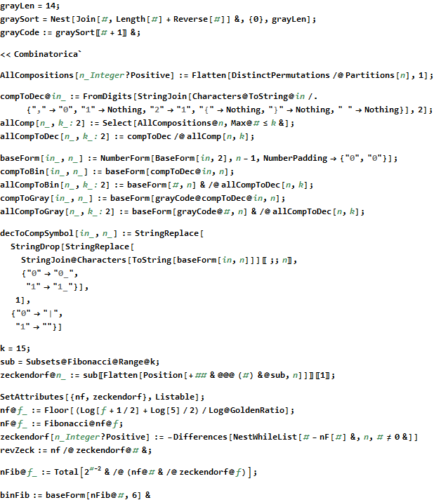
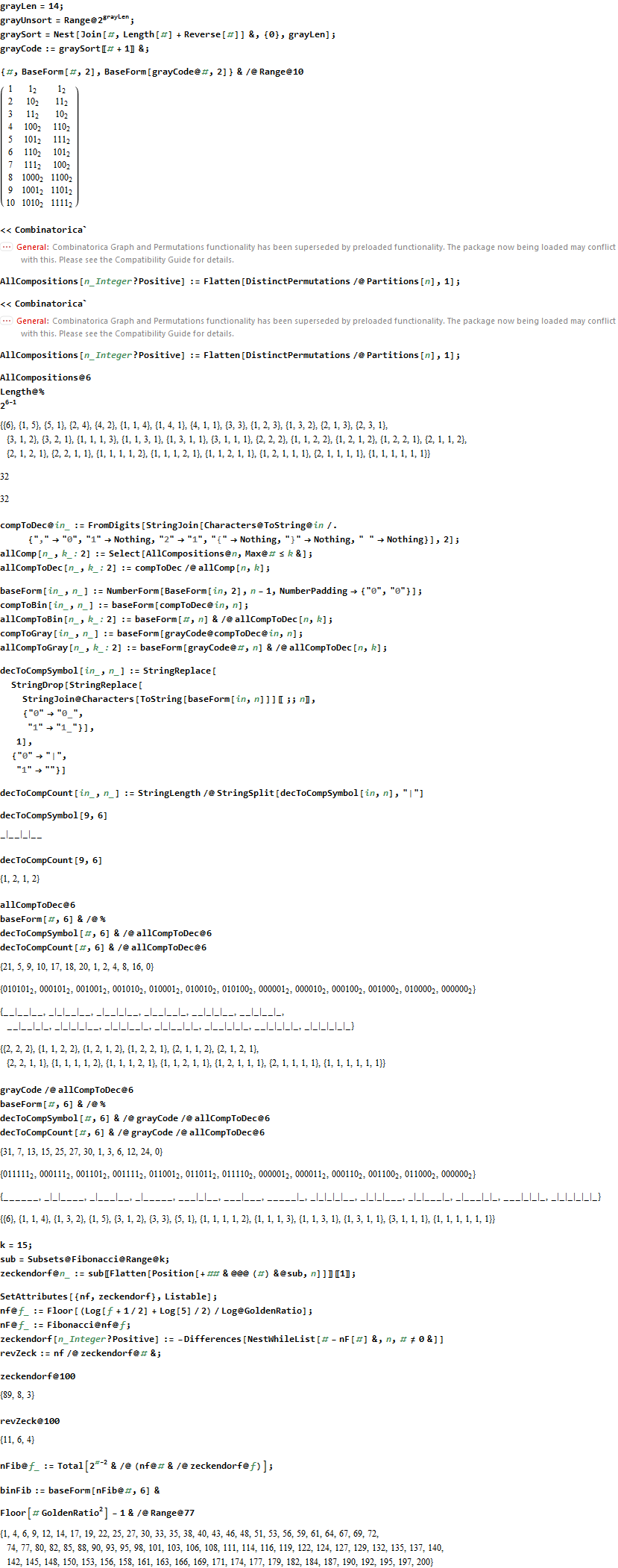
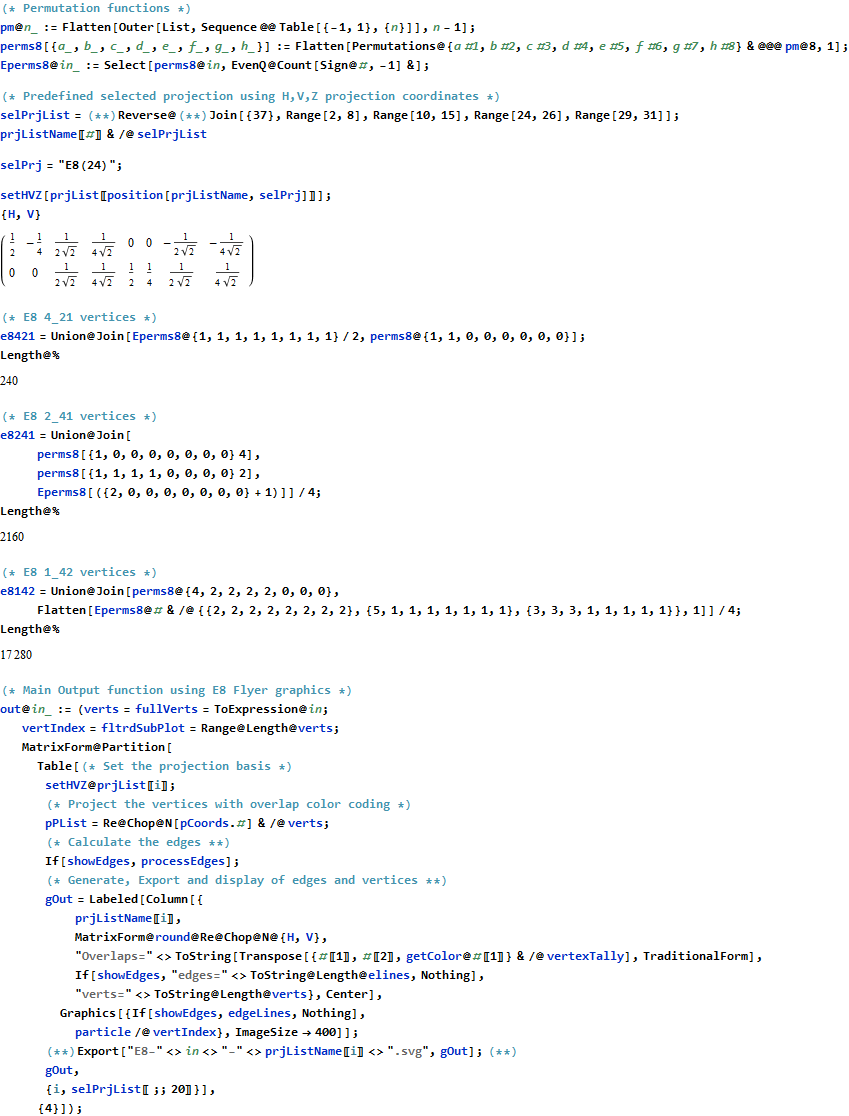
This is a shot of the relevant Mathematica code snippets that produce the images:

E8 4_21 (with projection basis, edges, vertex overlap colors & counts) (click here for very large SVG):
E8 2_41 (with projection basis, vertex overlap colors & counts) (click here for very large SVG):
E8 1_42 (with projection basis,vertex overlap colors & counts) (click here for very large SVG):
Files of the actual vertex lists:
E8-4_21.txt (240)
E8-2_41.txt (2160) (EVEN +/- signs on some vertices producing incorrect projections)
E8-1_42.txt (17280) (EVEN +/- signs on some vertices producing incorrect projections)
A new ‘more Natural’ ToE model with Covariant Emergent Gravity as a solution to the dark sector
Please take a look at my latest paper based on my original work circa 1997-2007.
JGM/010-MOND-CEG-TOE [pdf, cite]
Title: A new ‘more Natural’ ToE model with Covariant Emergent Gravity as a solution to the dark sector
Authors: J Gregory Moxness
Comments: Apr 4 2018, 4 pages.
Subjects: General Relativity and Quantum Cosmology (gr-qc); High Energy Physics – Theory (hep-th)
For citations, remove the LaTex href tag structure if you don’t use the hyperref package.
Perspective Enhanced HyperCube Projections to 3D
These objects are projected using an {x,y,z} orthonormal basis. For n={5,6,7} I add a small delta (.2) to {x,y,z} basis vectors in columns {n-2,n-1,n} in order to keep vertices from overlapping. There is an enhanced perspective applied to vertex location as well.
4Cube

4Cube 3D StereoLithography (STL) model for 3D Printing
5Cube

5Cube 3D StereoLithography (STL) model for 3D Printing
6Cube

6Cube 3D StereoLithography (STL) model for 3D Printing
7Cube
6 Demicubes Projected via H4 Folding Matrix
Taking the 32 vertex 6 Demicube with an even number of -1 elements and projecting with 3 of the 4 rows of the H4 folding matrix gives an dodecahedron hull with 12 vertices and 30 edges on the hull out of 240 edges of 6D length Sqrt[2]).
BTW – if you find this information useful, or provide any portion of it to others, PLEASE make sure you cite this post. If you feel a blog post citation would not be an acceptable form for academic research papers, I would be glad to clean it up and put it into LaTex format in order to provide it to arXiv (with your academic sponsorship) or Vixra. Just send me a note at: jgmoxness@theoryofeverthing.org.
While taking the 32 vertex 6 Demicube with odd number of -1 elements and projecting with 3 of the 4 rows of the H4 folding matrix gives the icosahedron with 20 vertices and 30 edges on the hull out of 240 edges of 6D length Sqrt[2]).
Rhombic Triacontahedron Animations
Best Viewed in HD
3D Stereoscopic
Red-Cyan Stereoscopic
BTW – if you find this information useful, or provide any portion of it to others, PLEASE make sure you cite this post. If you feel a blog post citation would not be an acceptable form for academic research papers, I would be glad to clean it up and put it into LaTex format in order to provide it to arXiv (with your academic sponsorship) or Vixra. Just send me a note at: jgmoxness@theoryofeverthing.org.
More Symmetries of E8 folding, including 5-Cube and 4-Cube (Tesseract)
The same 3 (projection basis vectors that produce the H3 Icosadodecahedron from D6 and the Rhombic Triacontahedron from the 6-Cube (or 2 sets from the 128 1/2 Integer BC8 vertices of E8) form lower dimensional objects within E8.
For more information on the above symmetries, see this post.
The 3D object identification has been confirmed by …
32 vertex 5-Cube with 80 5D Norm’d Unit Length Edges
Projection Basis Vectors {x,y,z}:

3D Rhombic 20-Hedron Outer Hull of 22 Vertices

The edge coloring on these projections are defined by which of the 6 dimensional axis the edge aligns with.
10 Interrior Vertices with 10 Edges

All Vertices in 3D
16 vertex 4-Cube with 32 4D Norm’d Unit Length Edges
Projection Basis Vectors {x,y,z}:

3D Rhombic Dodecahedron with 2 Interior Vertices
BTW – if you find this information useful, or provide any portion of it to others, PLEASE make sure you cite this post. If you feel a blog post citation would not be an acceptable form for academic research papers, I would be glad to clean it up and put it into LaTex format in order to provide it to arXiv (with your academic sponsorship) or Vixra. Just send me a note at: jgmoxness@theoryofeverthing.org.
The Rhombic Triacontahedron and E8 to H4+H4Φ folding
I was asked to clarify a particular projection of the Rhombic Triacontahedron from the 6-Cube subgroup of E8, which had I created for WikiPedia (WP) back in 2011 based on an E8 to H4+H4Φ rotation matrix I discovered in 2010.
The edge coloring on the projection above is defined by which of the 6 dimensional axis the edge aligns with.
BTW – if you find this information useful, or provide any portion of it to others, PLEASE make sure you cite this post. If you feel a blog post citation would not be an acceptable form for academic research papers, I would be glad to clean it up and put it into LaTex format in order to provide it to arXiv (with your academic sponsorship) or Vixra. Just send me a note at: jgmoxness@theoryofeverthing.org.
The following projection (basis) vectors take the 6-Cube as a subset of E8 and projects it into 3D using the following basis vectors:
Notice the last two dimensions in each vector are 0, which effectively takes the 128 8D 1/2 integer vertices of the E8 BC8 DemiCube into the 6D 6-Cube.
For the following data analysis, it is useful to reference the full list of E8 and H4+H4Φ data at the end of my blog post here.
The clarification desired was due to a conjecture that since E8 folds to H4+H4Φ (600 cells) and D6 folds to H3+H3Φ, that the 6-Cube should fold to an outer and inner rhombic triacontahedron scaled by Φ.
Below is a visualization of D6 folding into 2 concentric H3 icosadodecahedrons at a ratio of Φ using the same projection as described above. The edging displays the 480 Norm’d 6D Sqrt[2] length edges, clearly showing the outer and inner H3 polytopes.
Shown with exterior faces on edges (not a pure convex hull algorithm)…

The data below shows two sets of 30 vertices (outer on the left and inner on the right). They are sorted by the 3D Norm’d length of the vertex ray from {0,0,0}, followed by the vertex number in the E8 to H4+H4Φ list at the end of the post referenced above, along with the 6D E8 vertex that is a member of the D6 set, and the {x,y,z} projected vertex position
The last line of the data set shows that the first set of outer 30 projected vertex locations on the left is numerically equal to the second inner set after multiplication by Φ.
I did the same for the Rhombic Triacontahedron projected out of the 6-Cube.
I separated the outer and inner vertices used to make the WP projection at the top of the post. There are 64 vertices and 192 6D unit length edges forming pentagonal symmetry along specific axis (as well as hexagonal symmetries on other axis). It is clear that scaling the inner 32 vertex locations by Φ is not going to give the outer 32 vertex positions. Yet there is a similarity- they both have 12 vertices of one 3D Norm’d length and 20 of another.
Outer 32 vertices and 60 unit length Norm’d 6D edges.

The edge coloring on the projection above is defined by which of the 6 dimensional axis the edge aligns with.
Inner 32 vertices and 60 unit length Norm’d 6D edges.
The last line of the data set above shows that the outer data (left) is the same as the inner data set multiplied by a factor of Φ when the first 12 (shorter 3D Norm’d) inner vertices (right) are multiplied by an additional factor of Φ.
This explains the lack of isomorphism, but why is it not like the D6 to H3+H3Φ and E8 to H4+H4Φ in the symmetry of Φ scaling?
The best explanation I can give involves the pattern of left vs. right 3 digits in the 6-Cube E8 vertices. This is due to the left right symmetry of the basis vectors applied to binary pattern of half integer vertices in the 6-Cube.
All vertices have a consistent pattern that differentiates the 20 longer Norm’d vertices from the 12 shorter ones. Specifically, the shorter 12 that have the inner ones needing the added factor of Φ always show that:
- the right inner vertices all have an even number in 6 +/- elements but not always evenly split across the left and right
- the left outer vertices all have an odd number of in 6 +/- elements always unevenly split across the left and right
Whereas, the longer 20 that match the Φ scaling reverse the pattern where:
- the right inner vertices all have an odd number in 6 of +/- elements always unevenly split across the left and right
- the left outer vertices all have an even number in 6 of +/- elements but not always evenly split across the left and right
Another related fact in the folding pattern of the 6-Cube emerges when we note that since E8 contains 128 1/2 integer BC8 (the 8 Demi-Cube). In addition, we note that the 6D complement of BC8 and the 6-Cube is the same set of vertices. This means we get the same projection using all 128 vertices of the 6D trimmed BC8 as we do with the 64 of the 6-Cube, except now there are 768 6D Norm’d unit length edges rather than 192. Interestingly, that means that similar to E8 containing simultaneous copies of 4 600-Cells (a left and right pair scaled at Φ), E8 contains 4 simultaneous copies of the rhombic triacontahedron after adding the Φ scaling on the two sets of 12 inner BC8 vertices).
Wow – that is nice! Remember, you heard it here first!
If we try this idea with the complement of the integer elements of E8, namely the 112 6D trimmed D8 vertices complemented with 60 D6 vertices, the 6D trimmed 52 vertex complement contains 4 identical copies of the excluded 16 generator vertices of E8 {+/-1,0,0,0,0,0,0,0} permutations (plus 4 {0,0,0,0,0,0,0,0} vertices).
As you can see, the folding of the integer elements of E8 do not fold the same as the 1/2 integer elements, and in retrospect, we probably should not expect them to.