 See:
See:
http://theoryofeverything.org/TOE/JGM/ToE_Demonstration.cdf
Of course, it requires the free Mathematica CDF plugin.
Tag Archives: Math
E8 to 4D (3D+T)
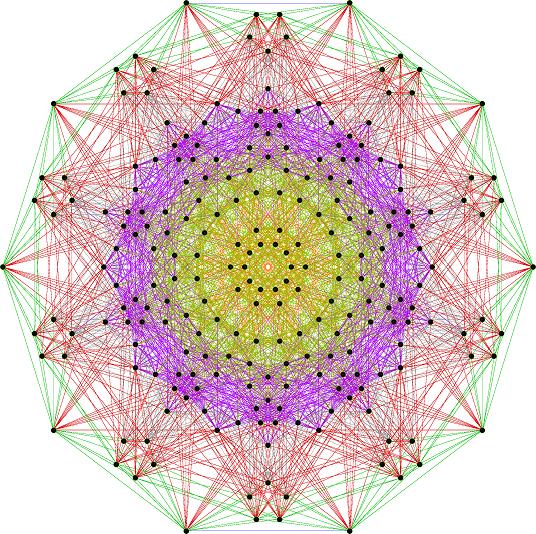
Shown in this animation are the 240 vertices of E8 with shape, size, and color assigned based on theoretical physics of an extended Standard Model (eSM). It is made up of three sets of 120 frames, each with a different algorithm for calculating perspective and orthogonal, rotational and translational 8D flight paths. It is interesting to note that it is the 8D camera that is moving through 8D space and the vertices remain in their same 8D position.
The 30 blue triangles represent E8 triality relationships using an 8D rotation matrix based on 2Pi/3 (or 120 degrees). Each vertex in a blue triangle is transformed into an adjacent one by the dot product with the matrix. A second transformation transforms it to the next, while the third recovers the original vertex.
The 28 red and green triangles are created from a subset of the 6720 (shortest) edges of 8D norm’d length Sqrt(2). These are filtered to represent the particle sums (linked by a red line) for a common (clicked) vertex (linked by 2 green lines). It is interesting to note that all sums for a given vertex are only found in adjacent vertices.
Higher definition (2 sets 60 frames each):
Particle Generator Published
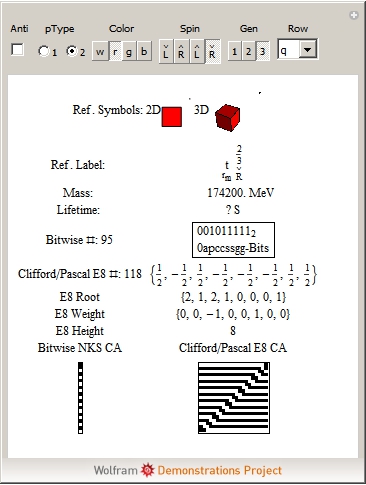 Just got my second in a series of 3 demonstrations published on Wolfram http://demonstrations.wolfram.com/ParticleGeneratorBasedOnTheE8LieAlgebra/
Dynkin demonstration published
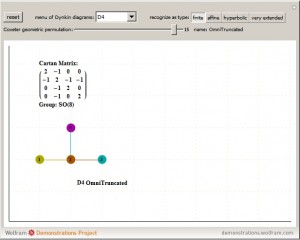
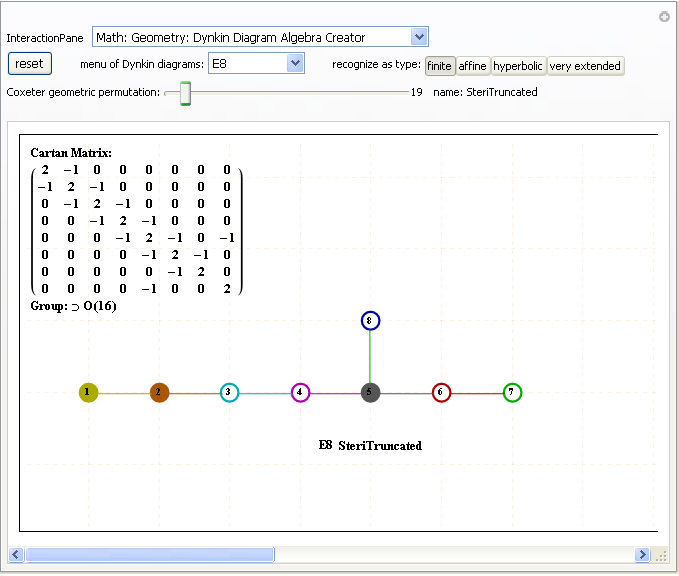
After significant peer review, my Dynkin Diagram Visualizer was published at Wolfram Demonstrations. Please see http://demonstrations.wolfram.com/DynkinDiagrams/
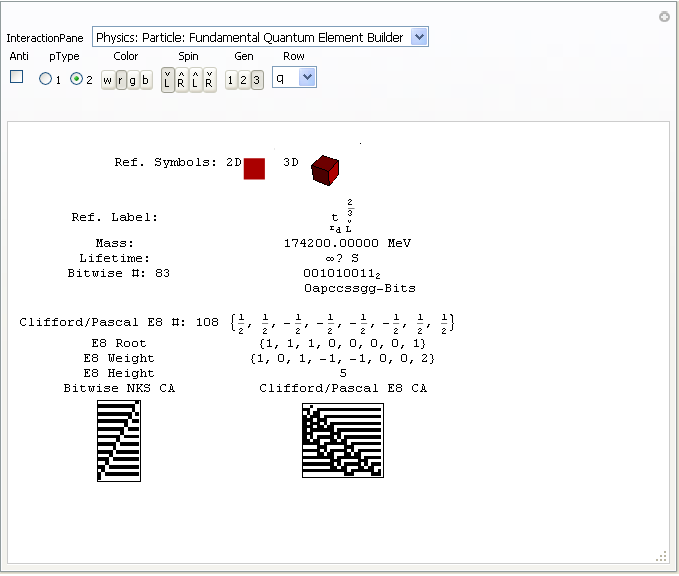
A Free Interactive Visual ToE Demonstration
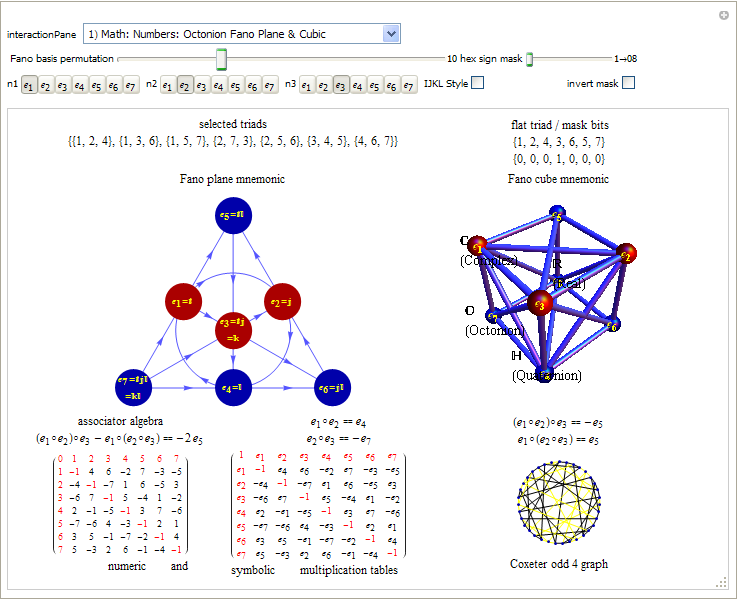
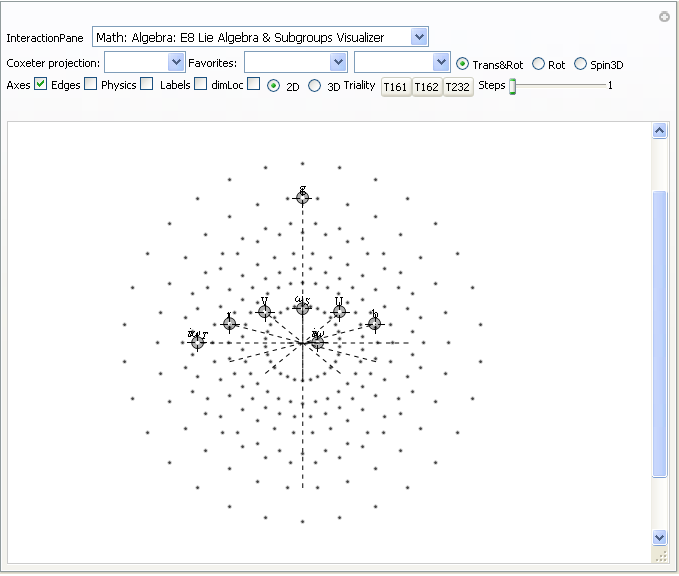
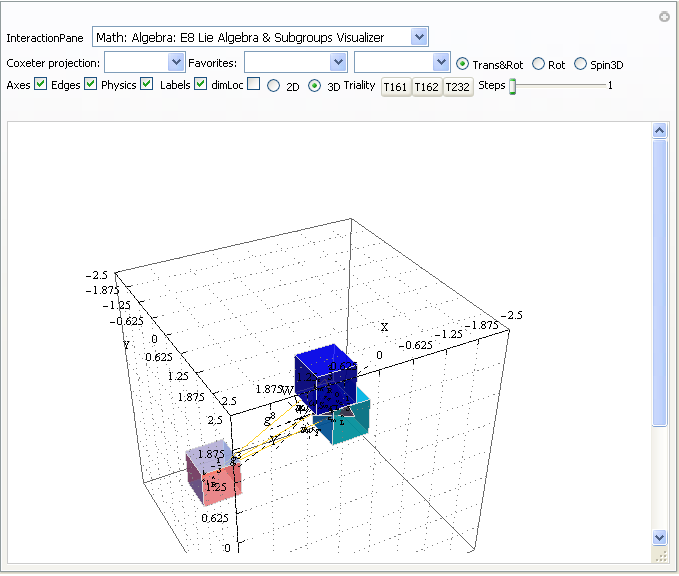
This free Mathematica Computable Document Format (.CDF) demonstration takes you on an integrated visual journey from the abstract elements of geometry, algebra, particle and nuclear physics, and on to the atomic elements of chemistry. http://theoryofeverything.org/TOE/JGM/ToE_Demonstration.cdf (0.5Mb)
It requires the free Mathematica CDF plugin.
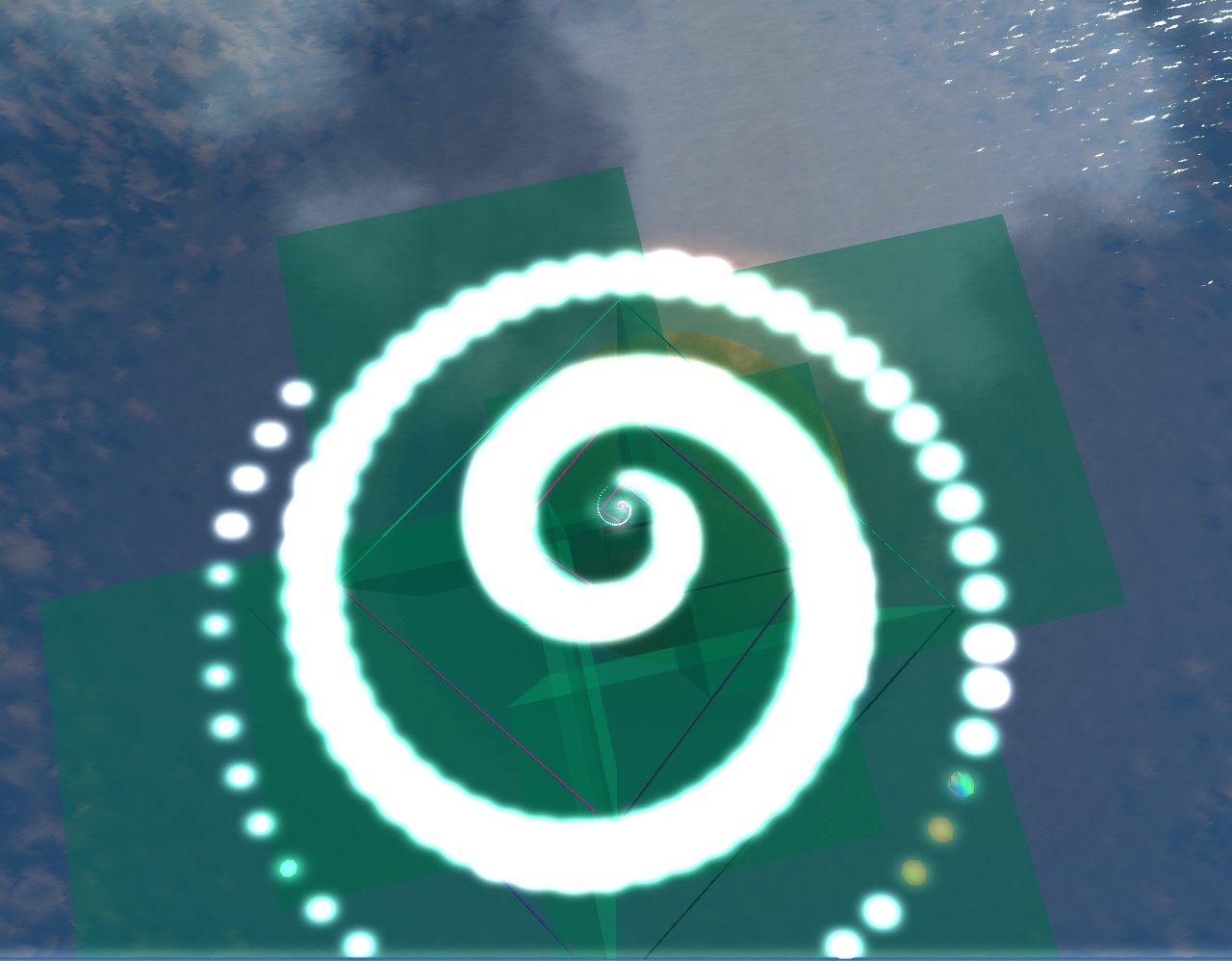
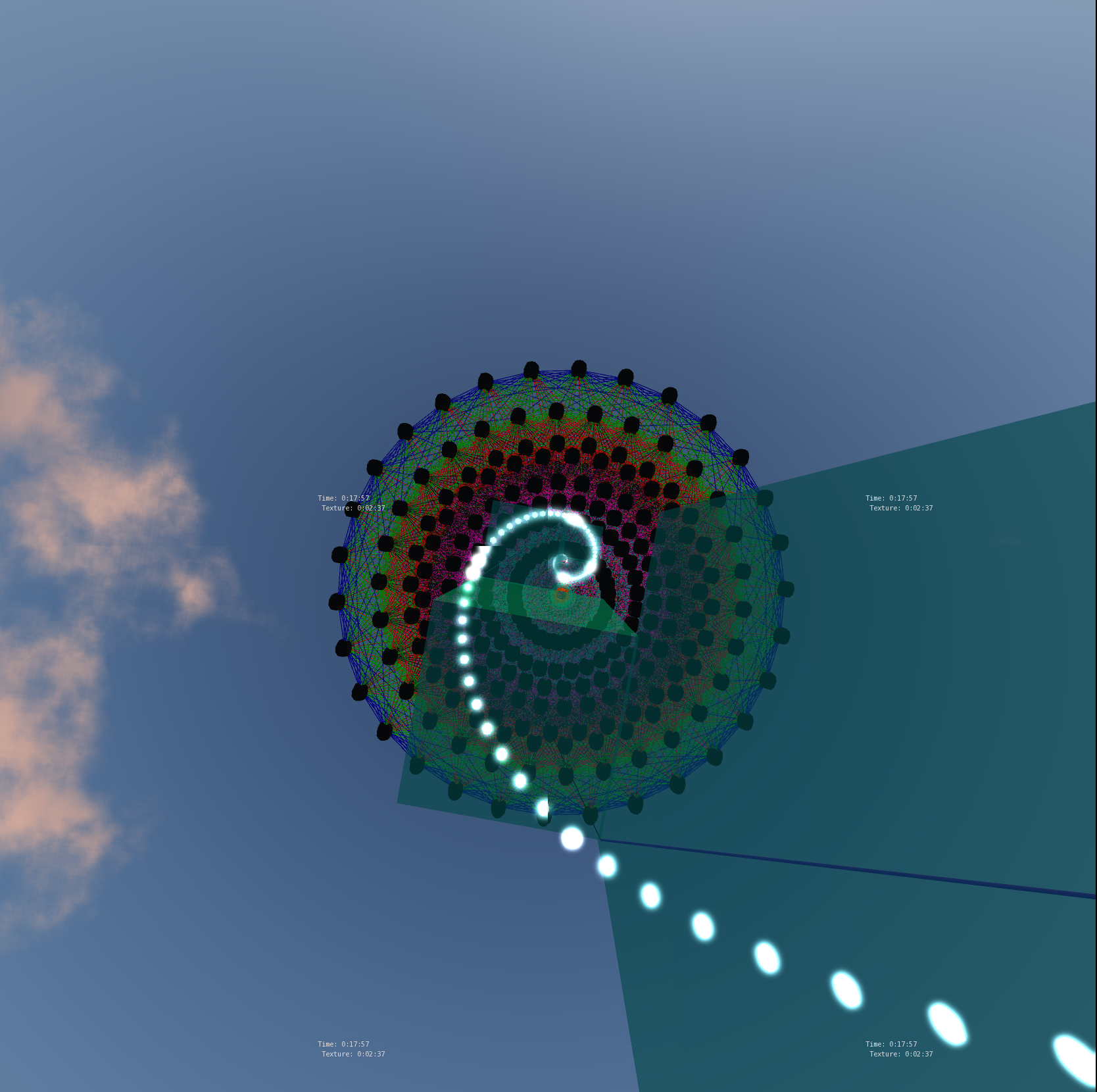
A few new 3D Virtual World pics


Ho-Mg-Zn QuasiCrystal Electron Diffraction with E8 5Cube Projection
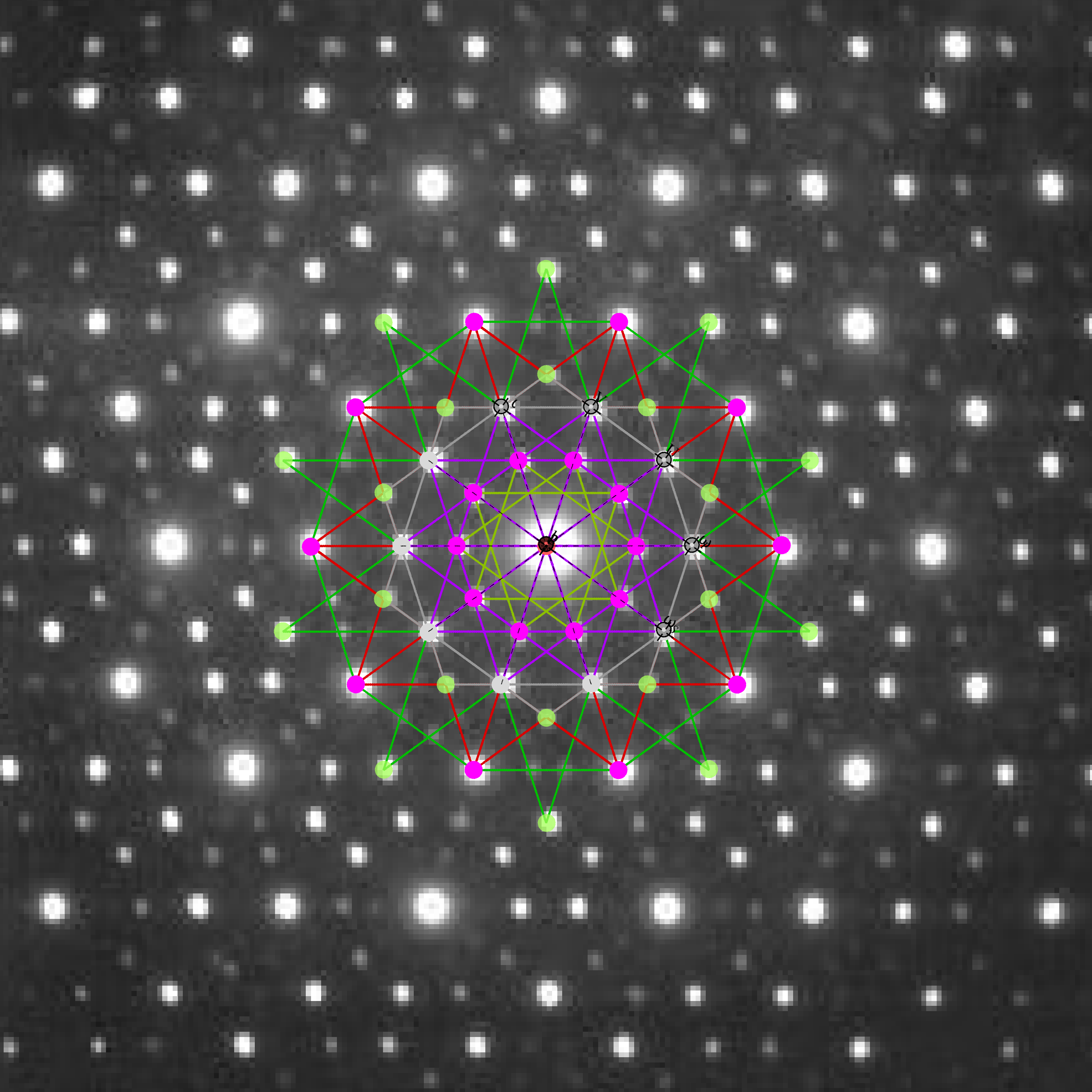
This is an image of the electron diffraction pattern of an icosahedral Zn-Mg-Ho quasicrystal with an overlay of a 5-Cube projection from the 240 vertices of the split real even E8 Lie Group.

The basis vectors for the E8 projection are shown (1:1 with the ring of gray vertices with the last 3 of 8 dimensions 0).
There are 2480 overlapping edge lines from the 240 E8 vertices. They have norm’d unit length calculated from the 5 non-zero projected dimensions of E8. Of these, 32 inner vertices and 80 edges belong to the 5D 5-Cube (Penteract) proper. Edges are shown with colors assigned based on origin vertex distance from the outer perimeter.
The vertex colors of the 5-Cube projection represent E8 vertex overlaps. These are:
InView vertices={color{overlap,count},…}Total
{LightGreen{1,20},Pink{5,20},Gray{10,10},Orange{20,1}}51
All vertices={color{overlap,count},…}Total
{LightGreen{1,20},Pink{5,100},Gray{10,100},Orange{20,20}}240
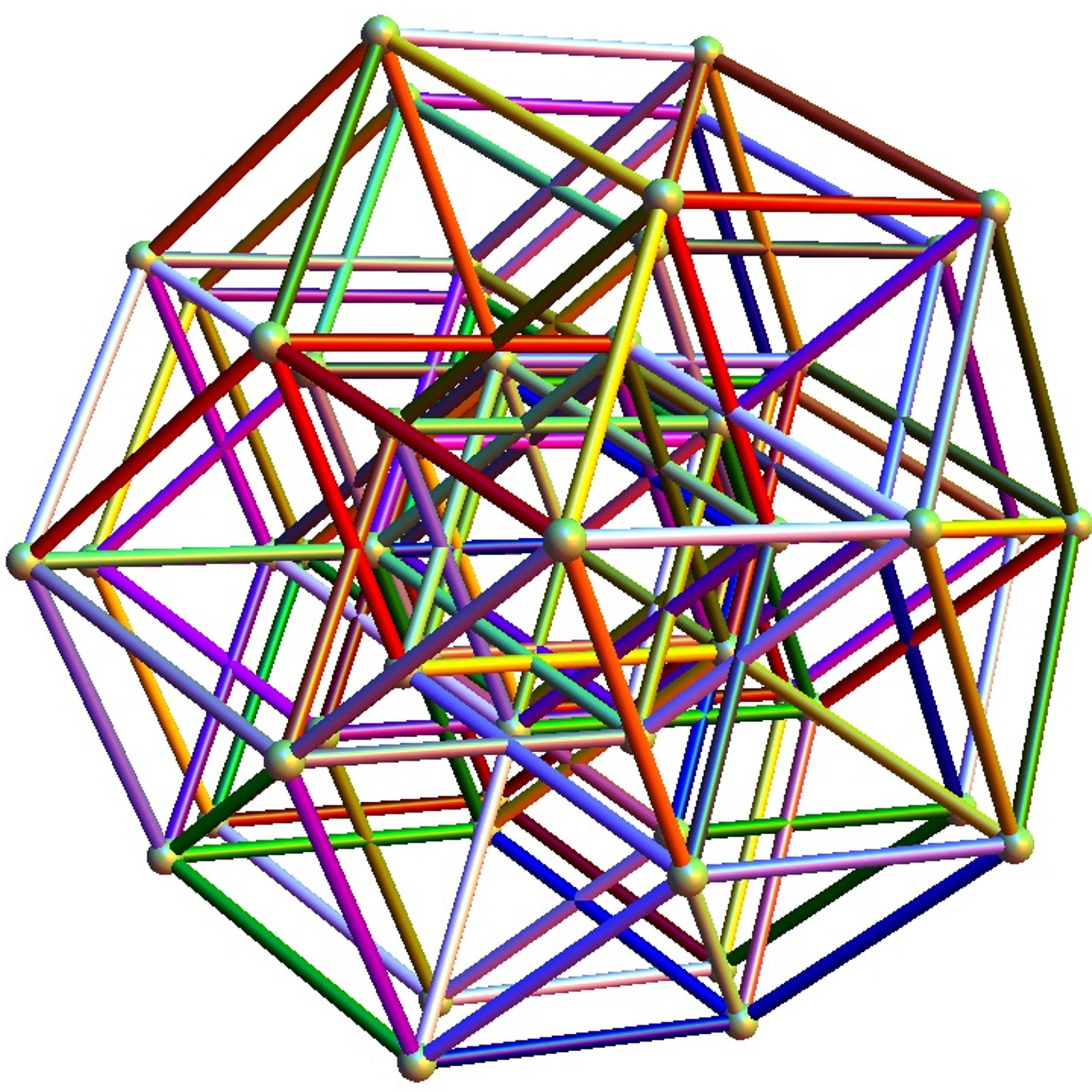
A related projection of a 6D 6-Cube (Hexeract) into a perspective 3D object using the Golden Ratio [Phi]. This particular projection is used to understand the structure of QuasiCrystals. The specific basis vectors are:
x = {1, [Phi], 0, -1, [Phi], 0}
y = {[Phi], 0, 1, [Phi], 0, -1}
z = {0, 1, [Phi], 0, -1, [Phi]}
There are 64 vertices and 192 unit length edges forming pentagonal symmetry along specific axis (as well as hexagonal symmetries on other axis).
SM particle reduction: 240->8
I’ve just posted a new paper on using the simple roots of E8 to reduce the particle count of the Lisi model from 240 to 8. See DynkinParticleReductions.pdf
The 3rd (Z) basis vector for Bathsheba & Wizzy’s 600 Cell
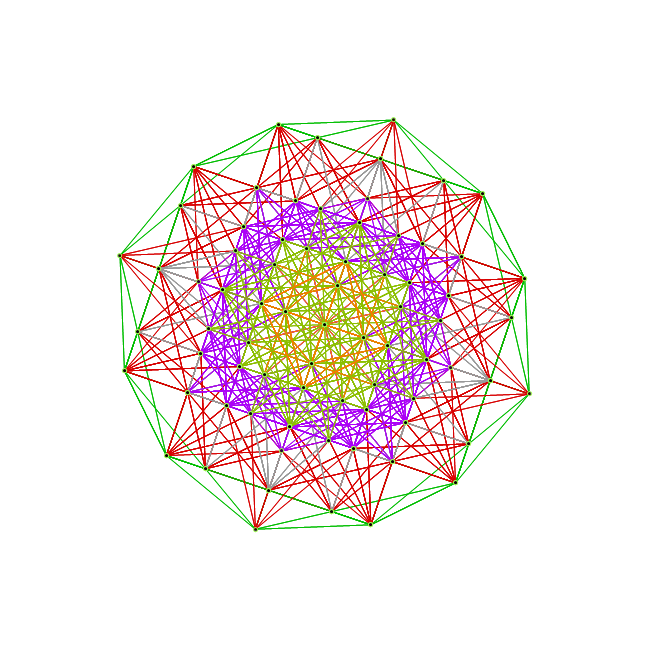 While the 3D model I used to create the 2D Van Oss projection isomorphic to E8 Petrie (and a beautiful pentagonal view), it was not the same as what was being used by Richter in his 3D “pre-Van-Oss” construction. Given my H (or x) and V (or y), the 3rd basis vector for this projections is most likely:
Z={0, -0.0801064, 0, 0.236818, 0, 0.0801064, 0, -0.236818}
which reproduces the Richter, Bathsheba and Wizzy’s 3D models. Interestingly, it produces one face (shown above) that is the same as all the orthonormal faces of 2 concentric 600 Cells (at the Golden Ratio). The 3rd unique face is:
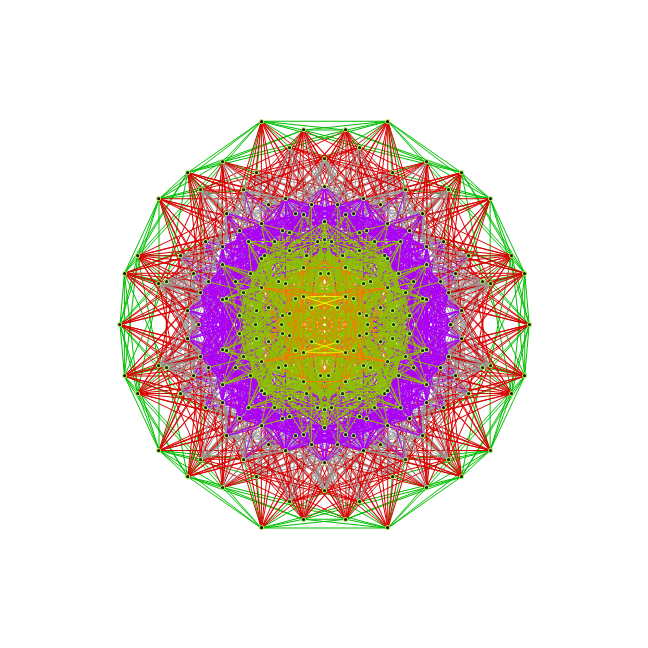
I replaced the 3D spin movie of this on my main page with this new projection.