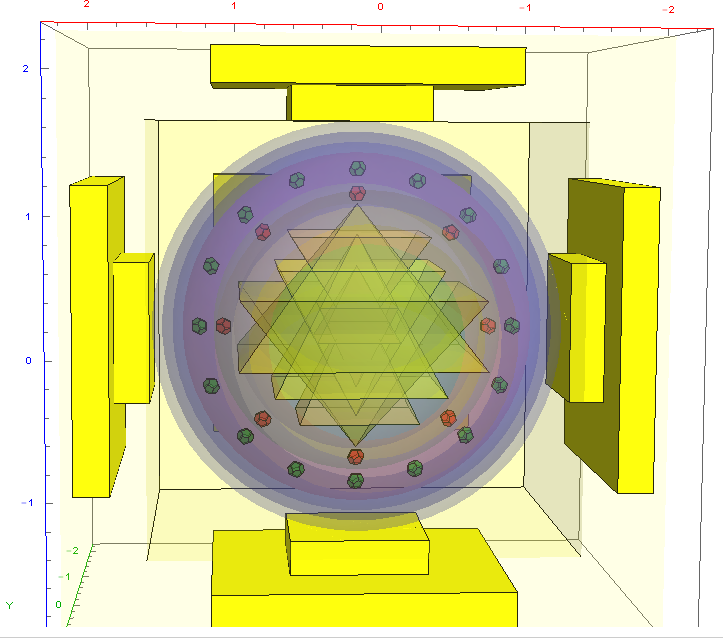
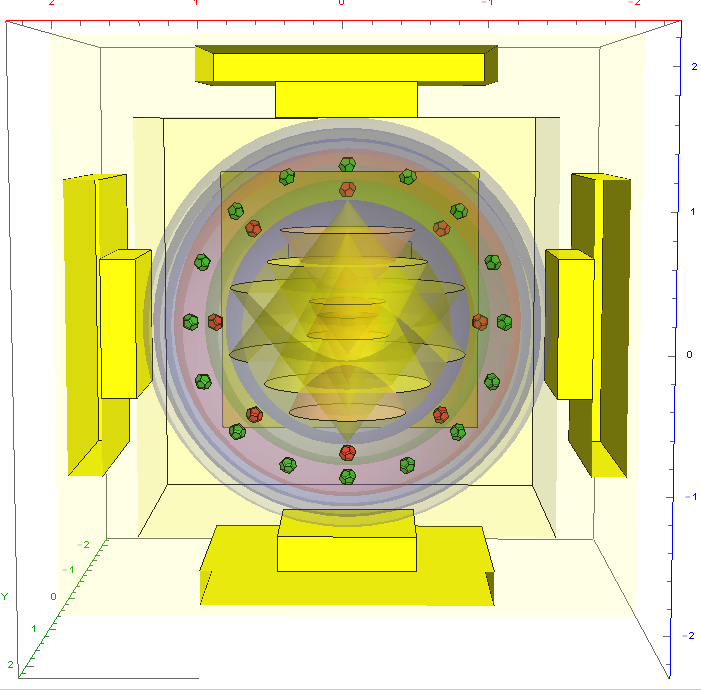
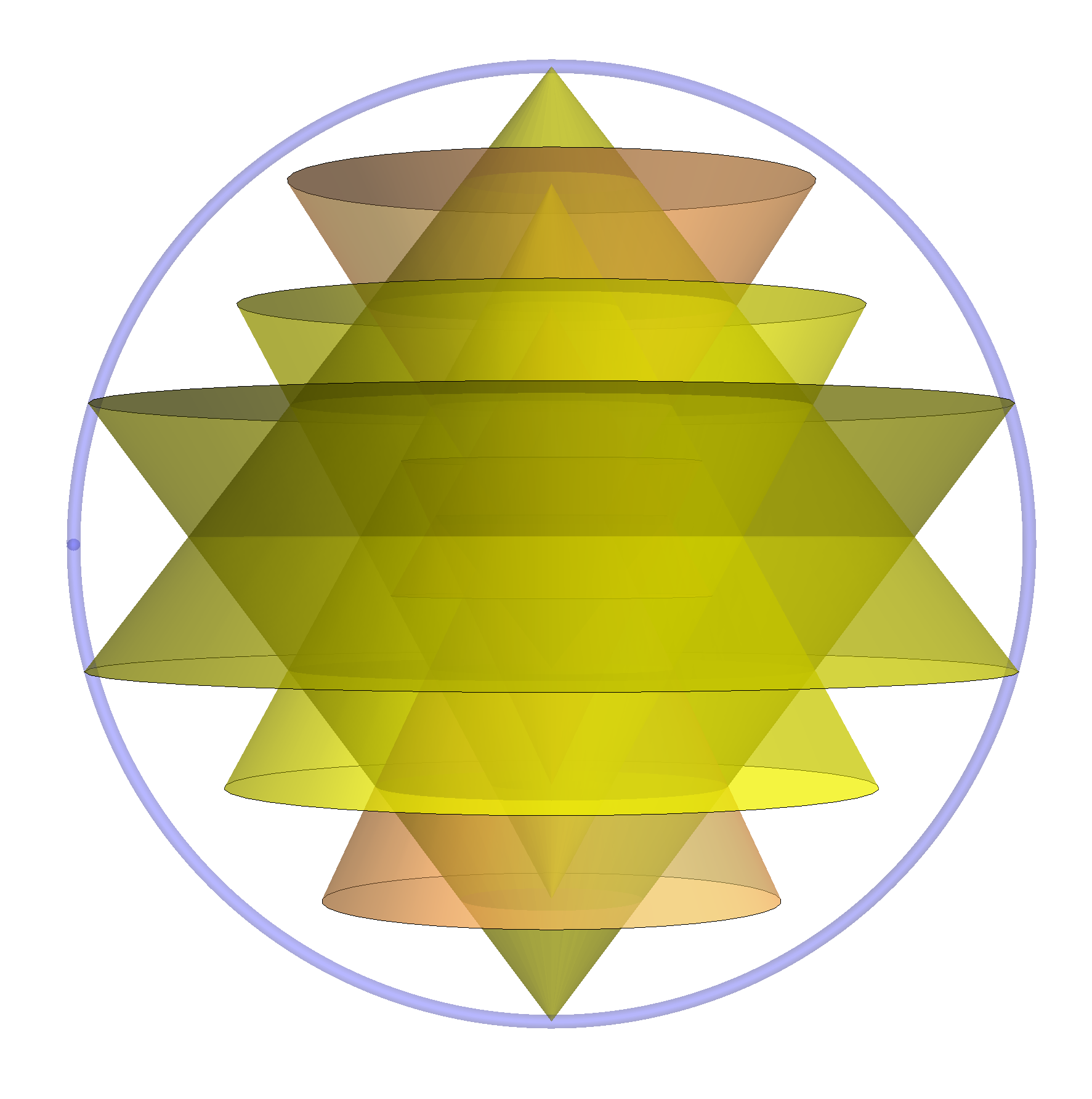
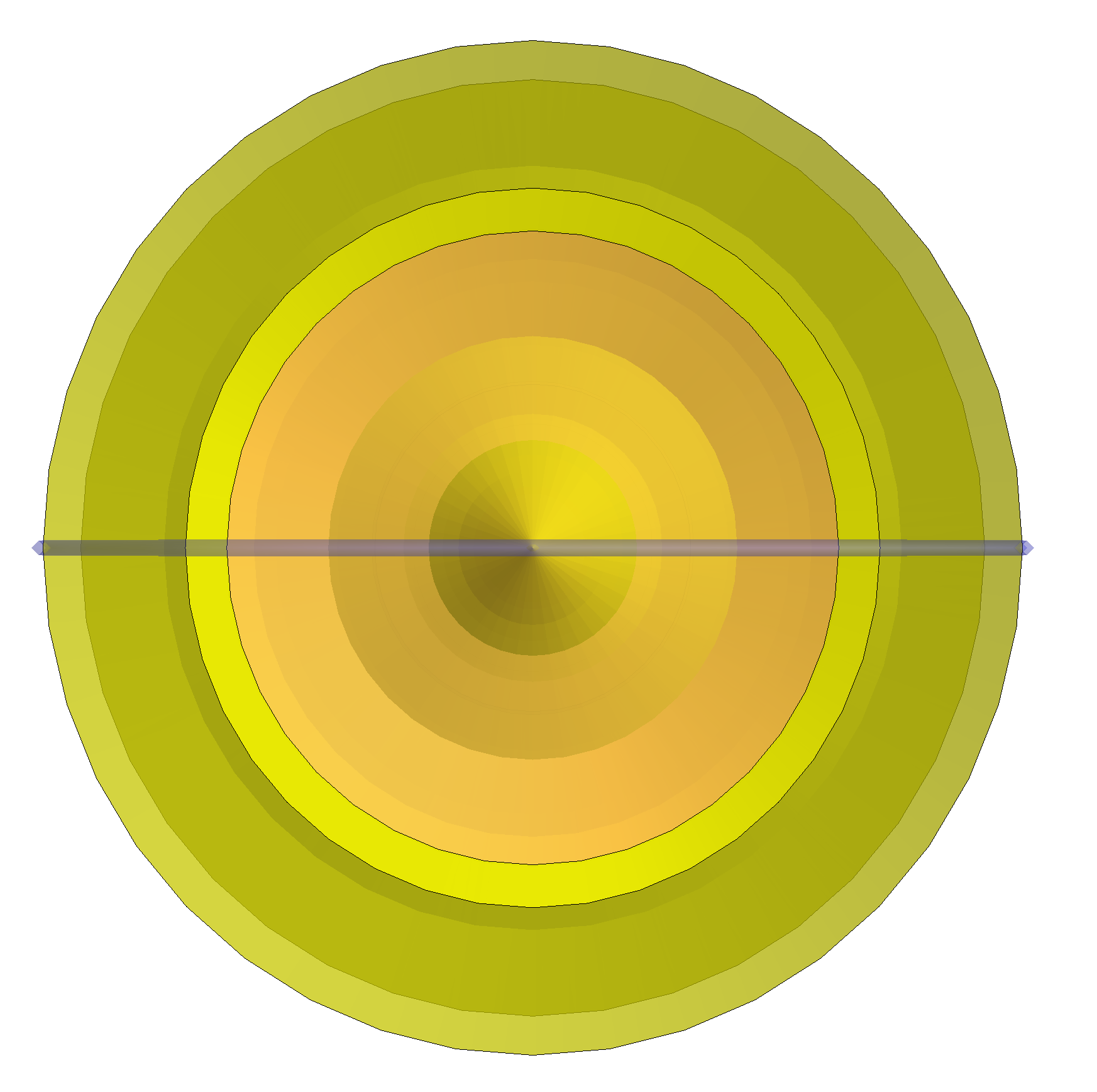
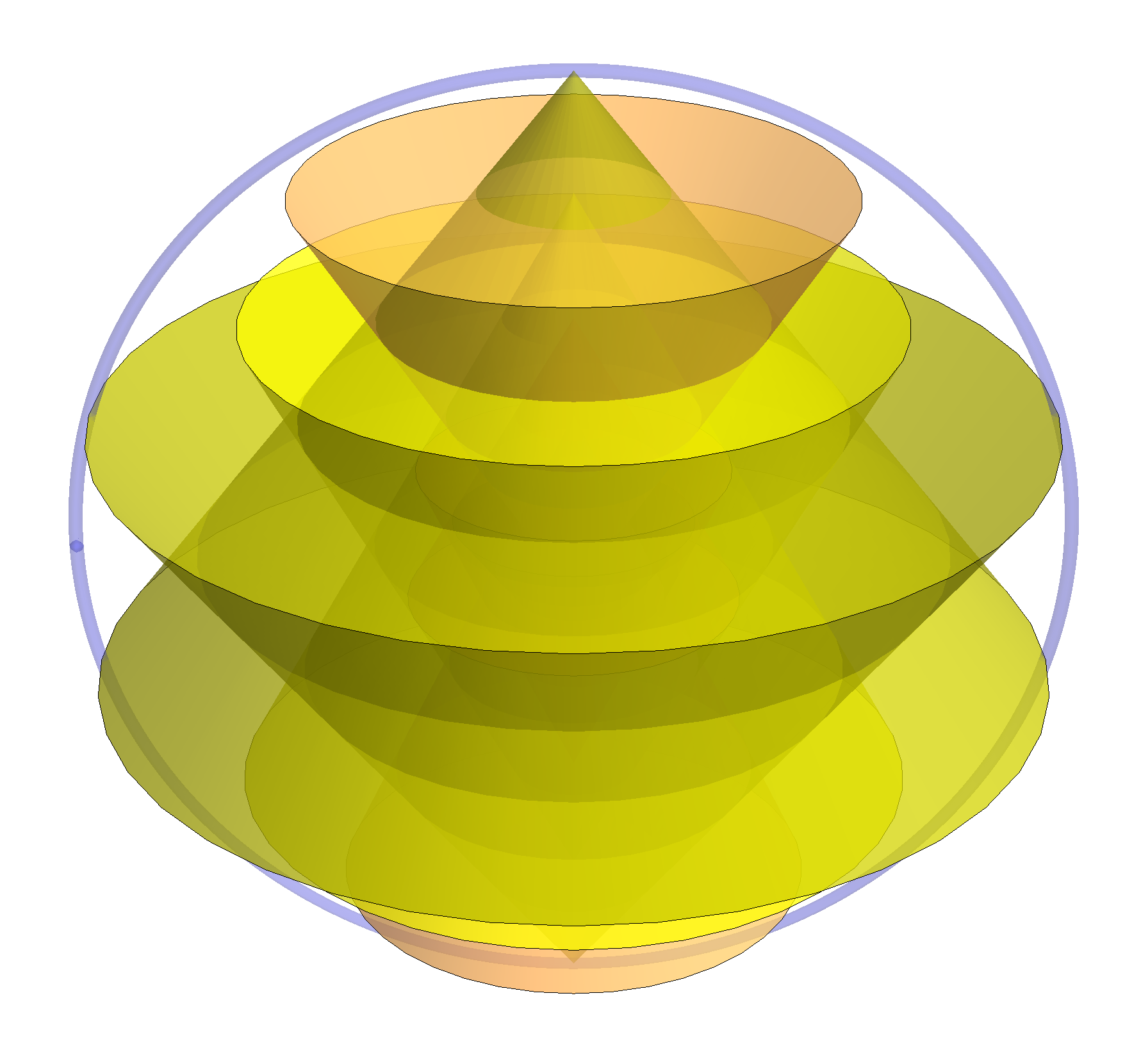
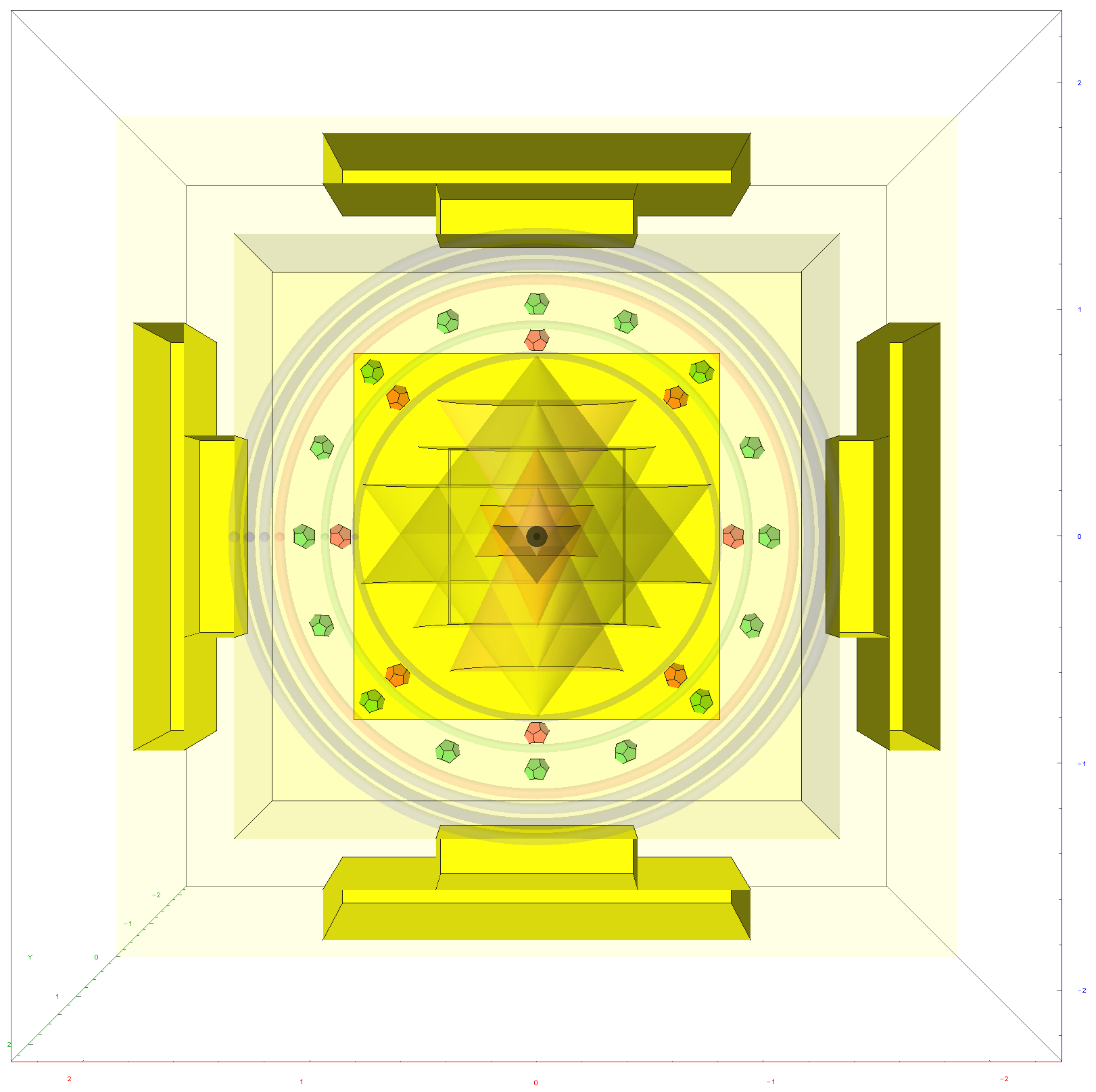
Interesting stuff as it relates to QuasiCrystals and non-Crystallographic analysis.
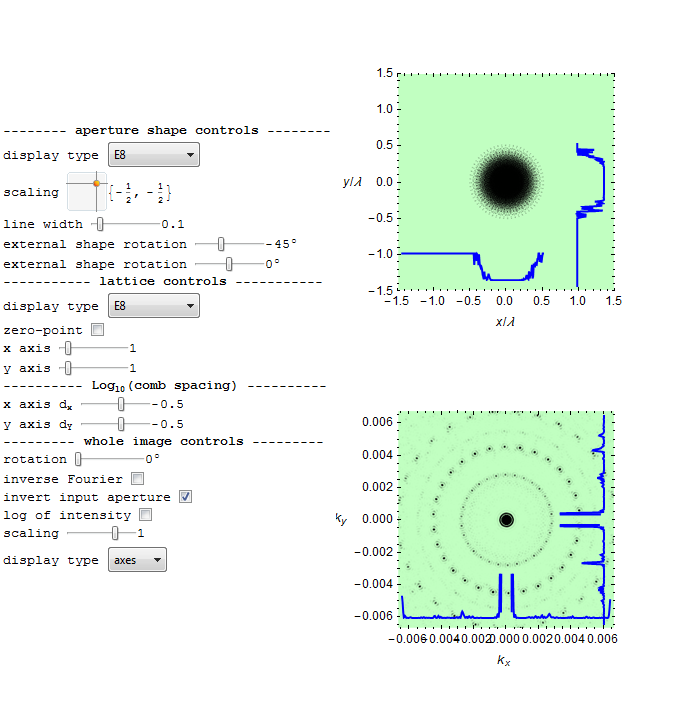
Original source demonstration from John Holland modified and integrated into my VisibLie_E8 viewer…Cool!
Interesting stuff as it relates to QuasiCrystals and non-Crystallographic analysis.
Original source demonstration from John Holland modified and integrated into my VisibLie_E8 viewer…Cool!
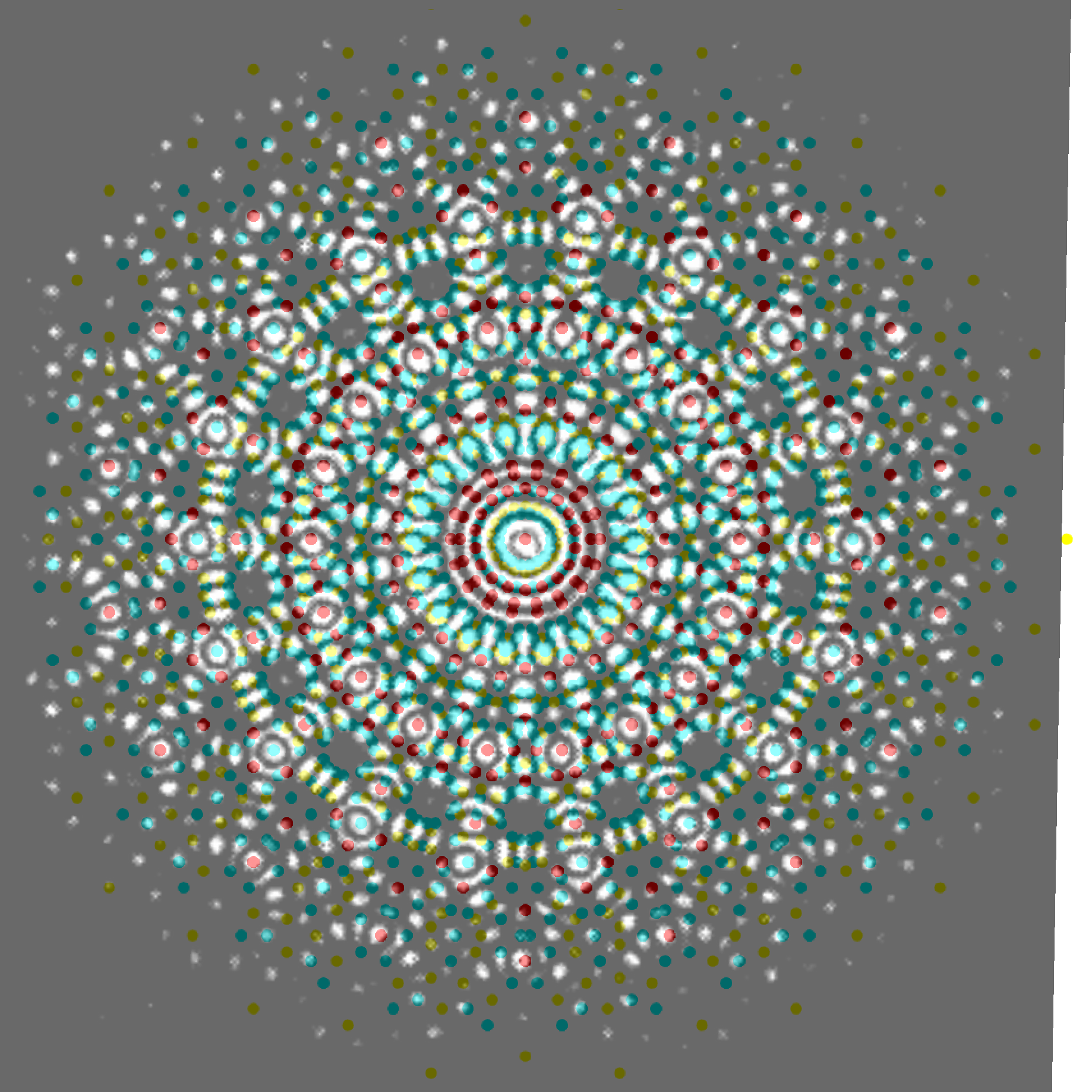
I found a 1995 book (PDF online) “QuasiCrystals and Geometry” by Marjorie Senechal. There were some very nice diffraction patterns that match rectified 4_21 E8 Polytope 12,18, and 30-gon projections. See my overlays below:
12-gon Rectified E8
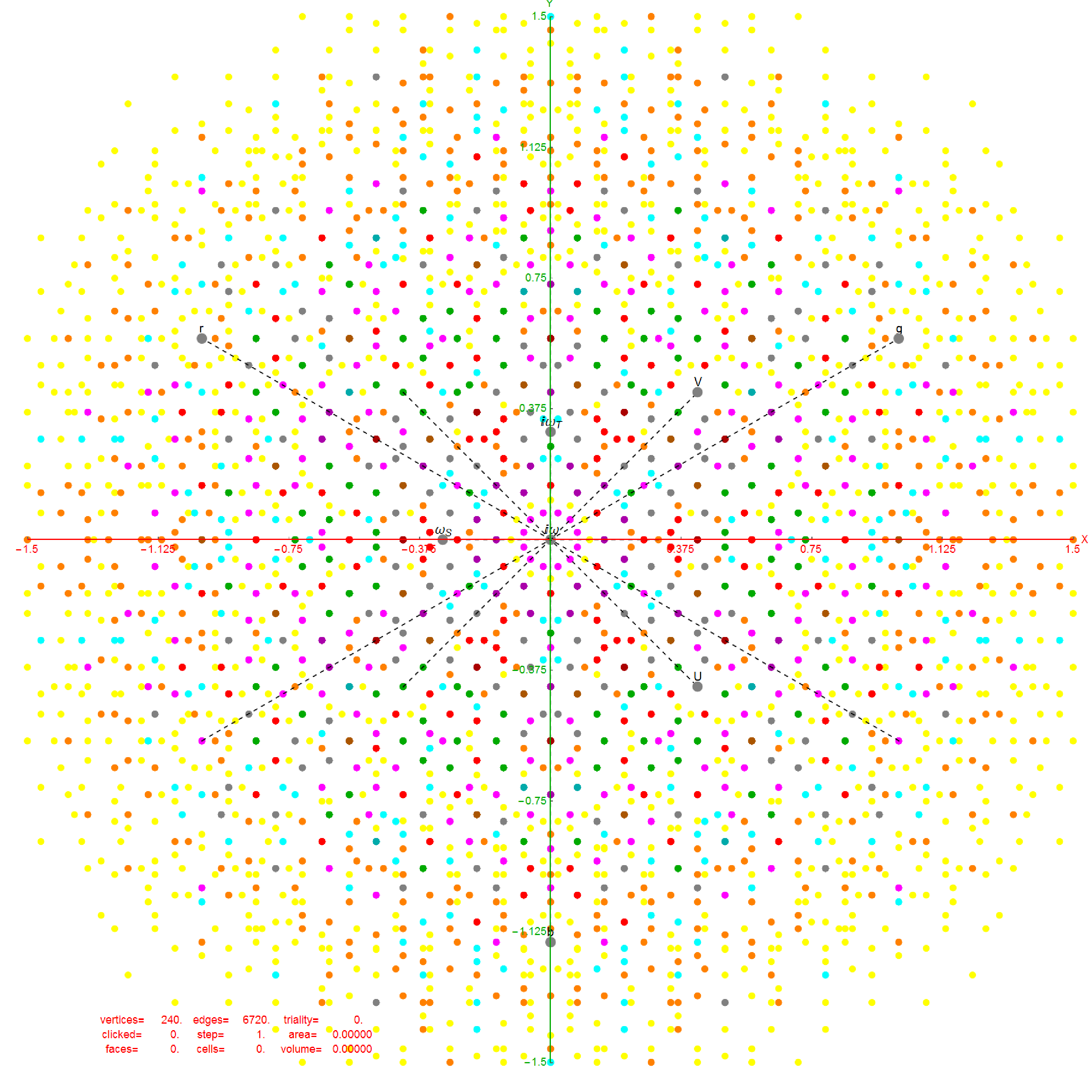
Diffraction
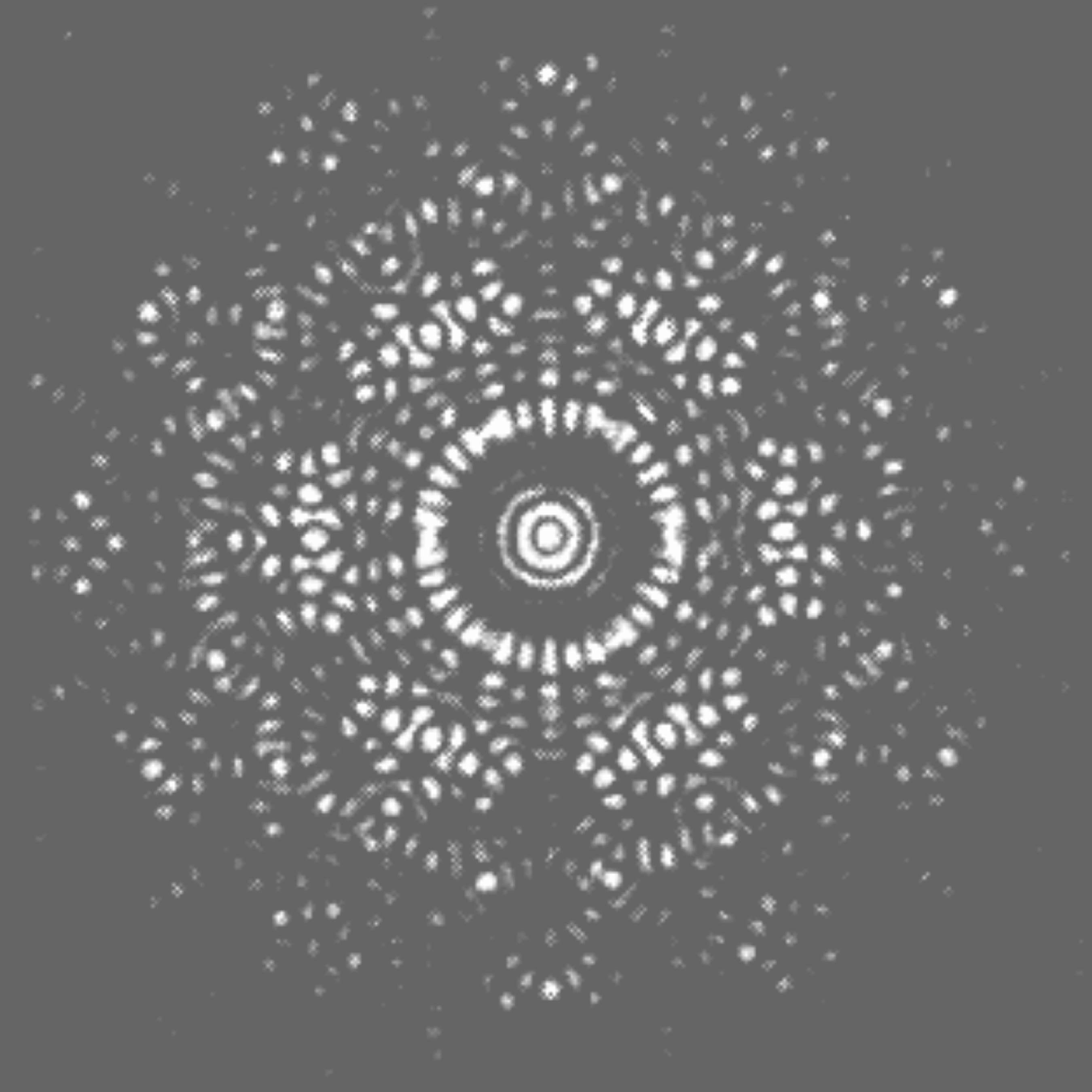
Overlay
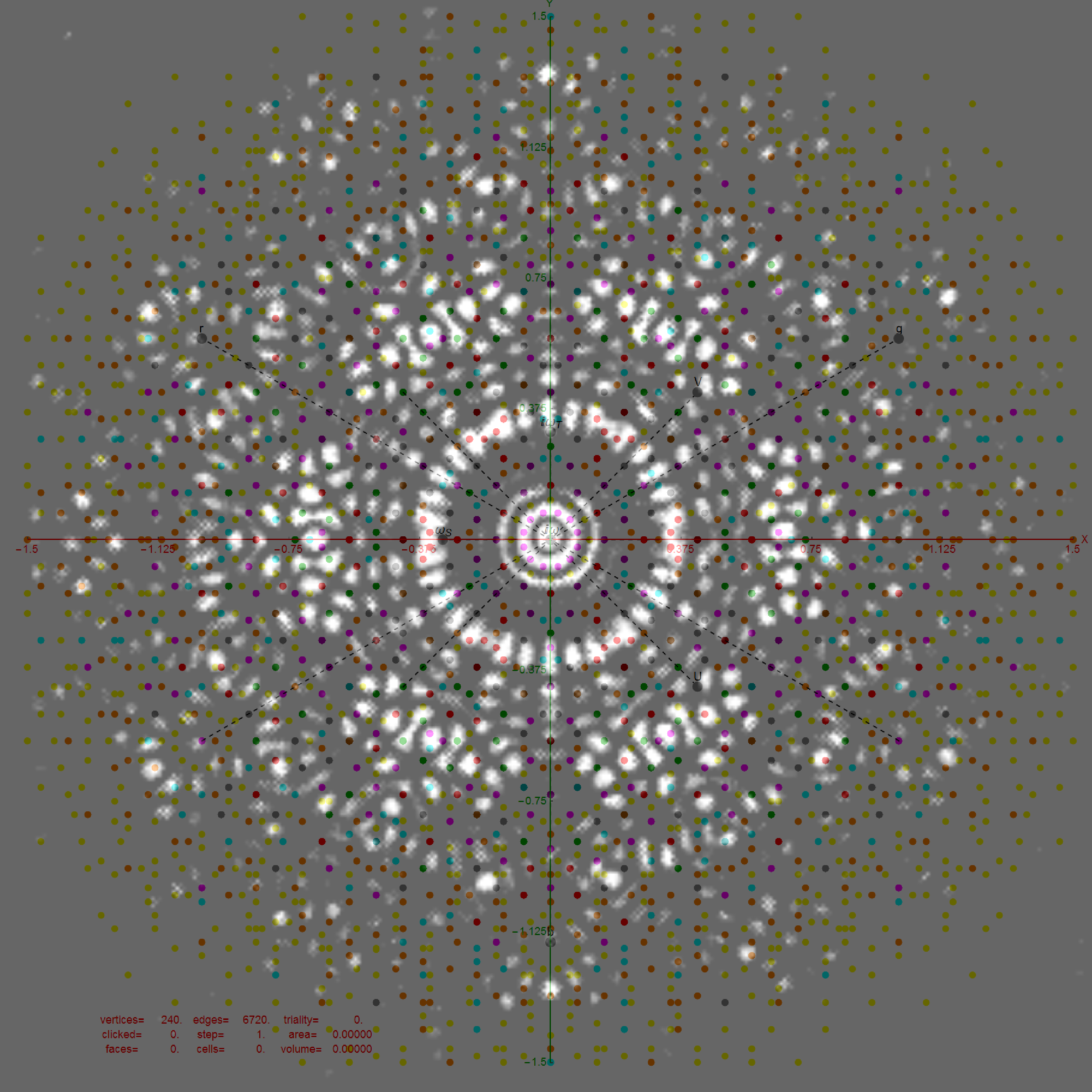
18-gon Rectified E8
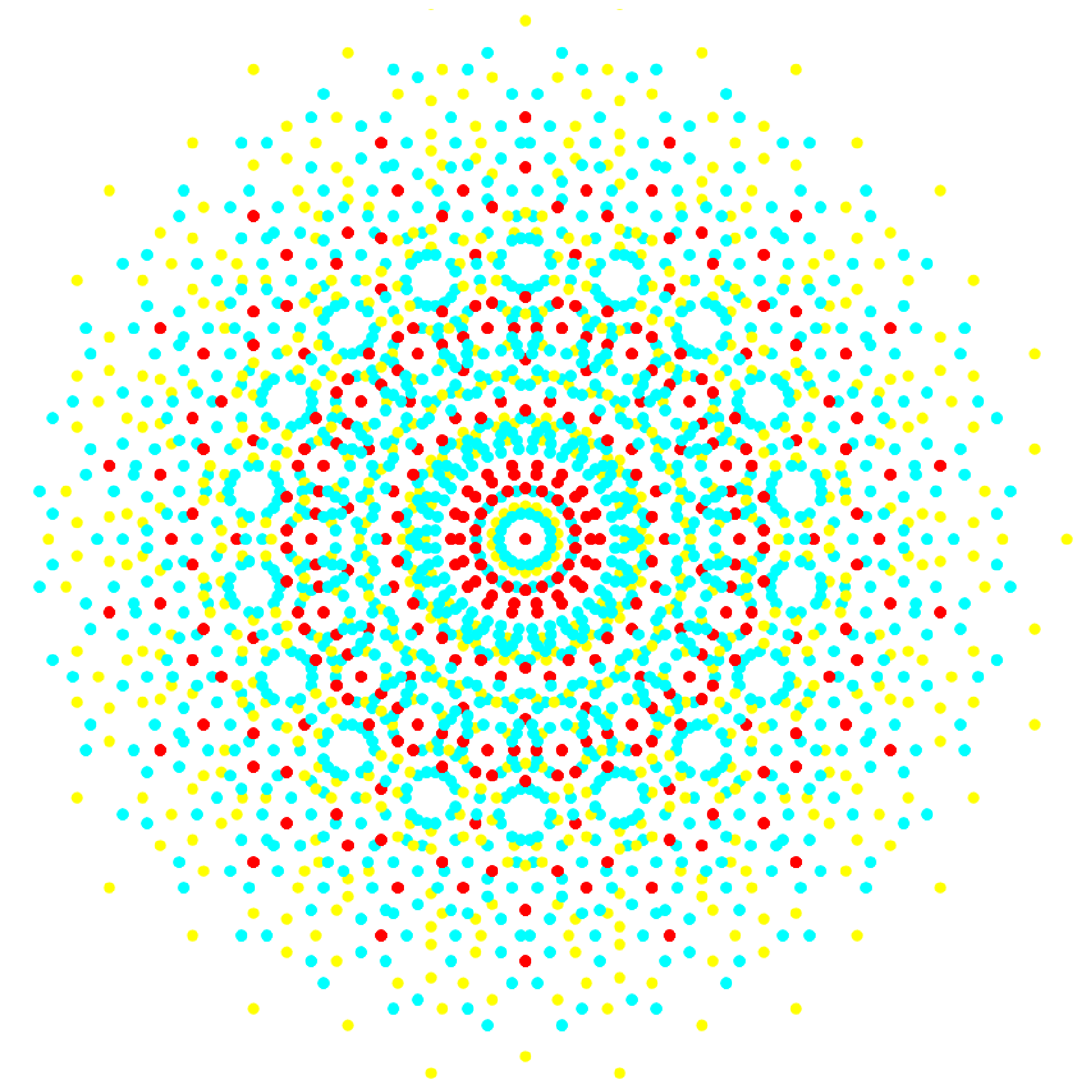
Diffraction
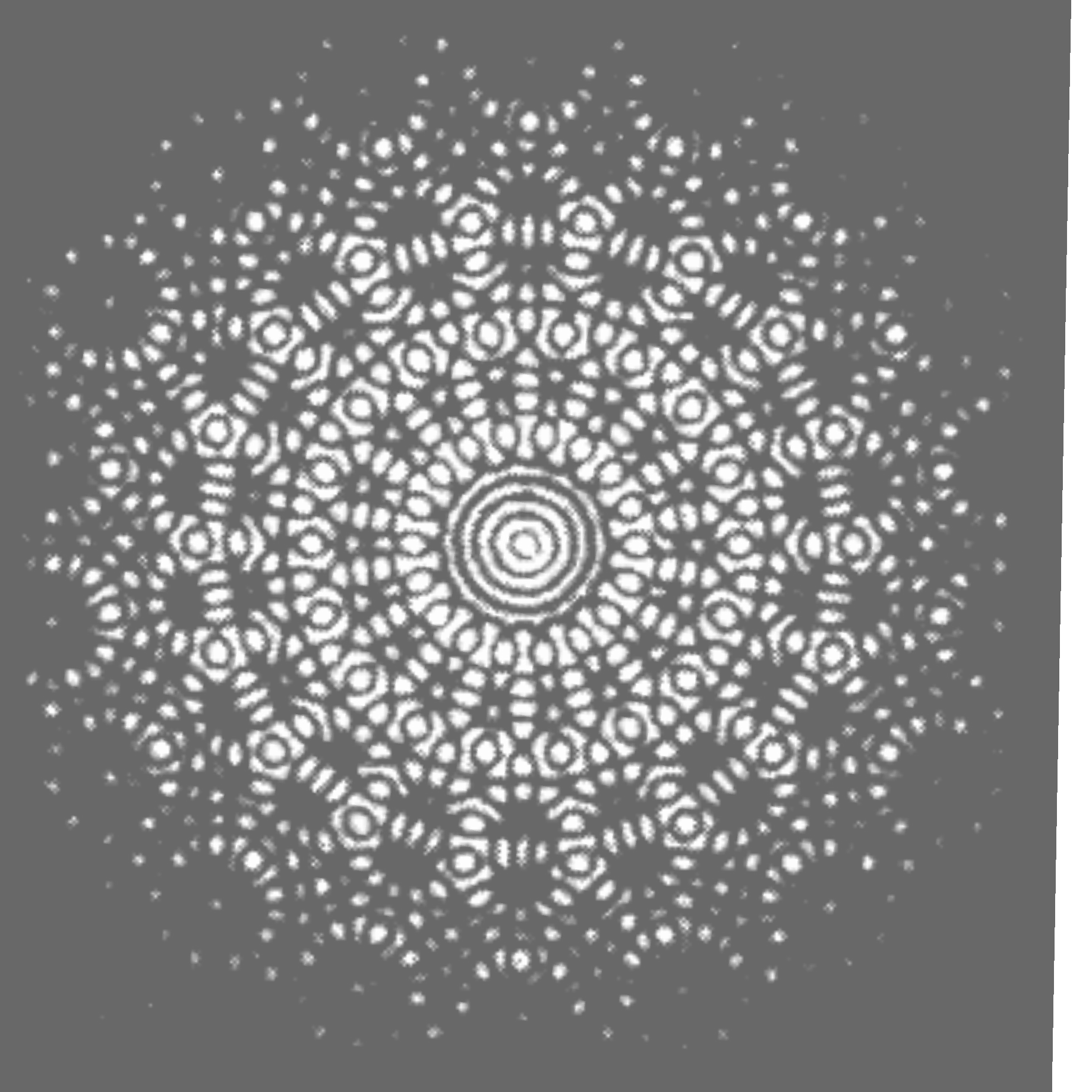
Overlay
30-gon Rectified E8
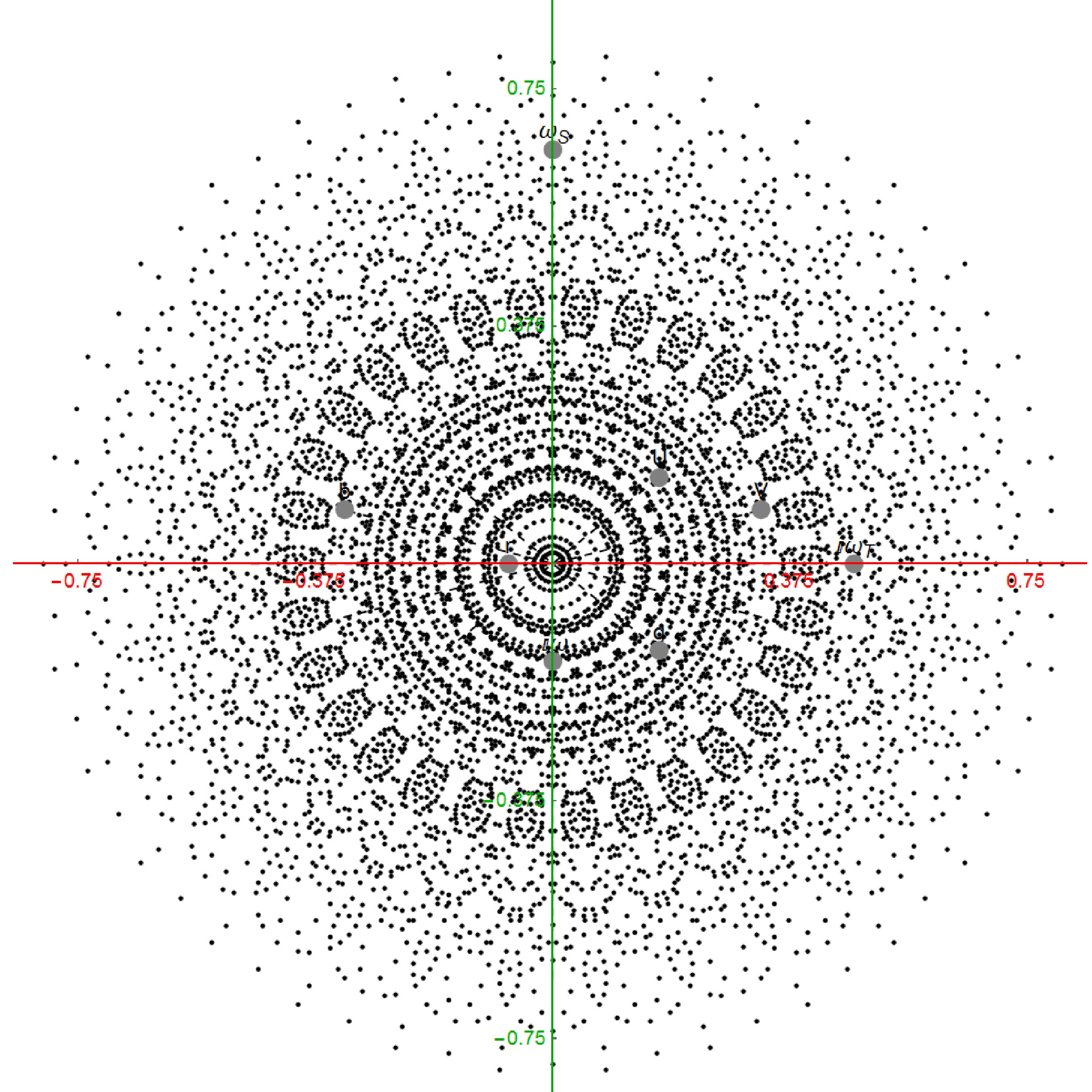
Diffraction
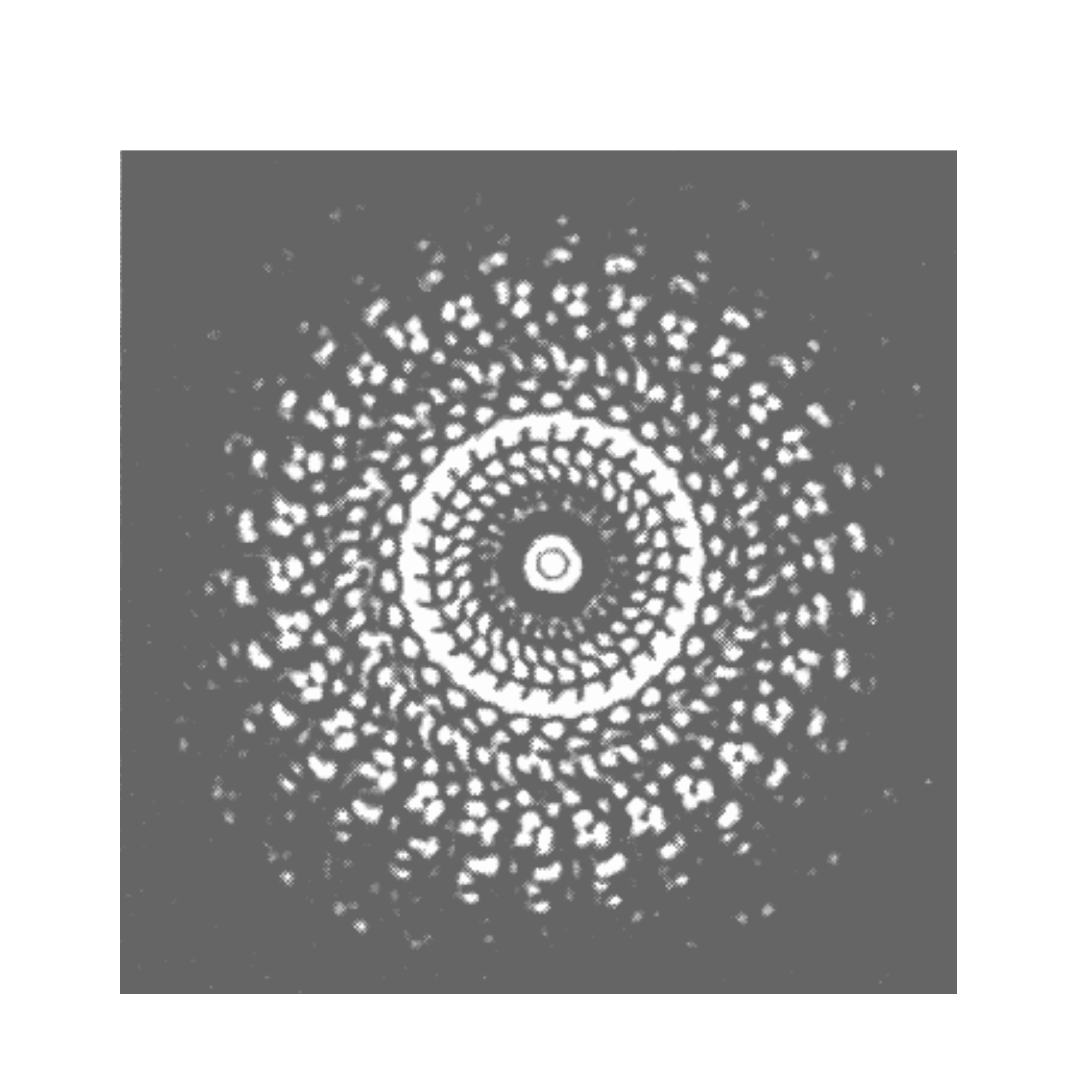
Overlay
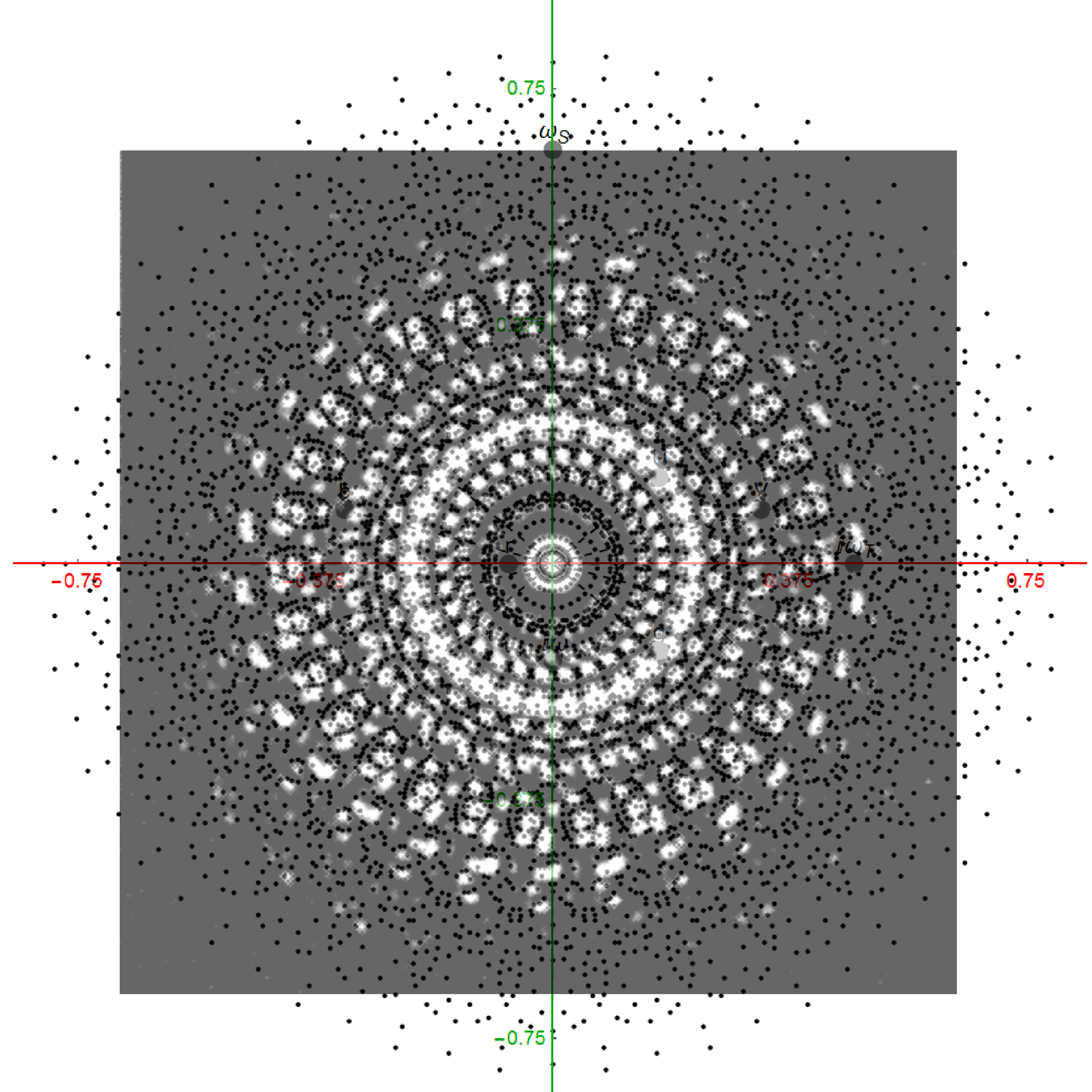
and another 12-gon rectified E8 pattern overlay from M. & N. Koca’s in “12-fold Symmetric Quasicrystallography from affine E6, B6, and F4”:
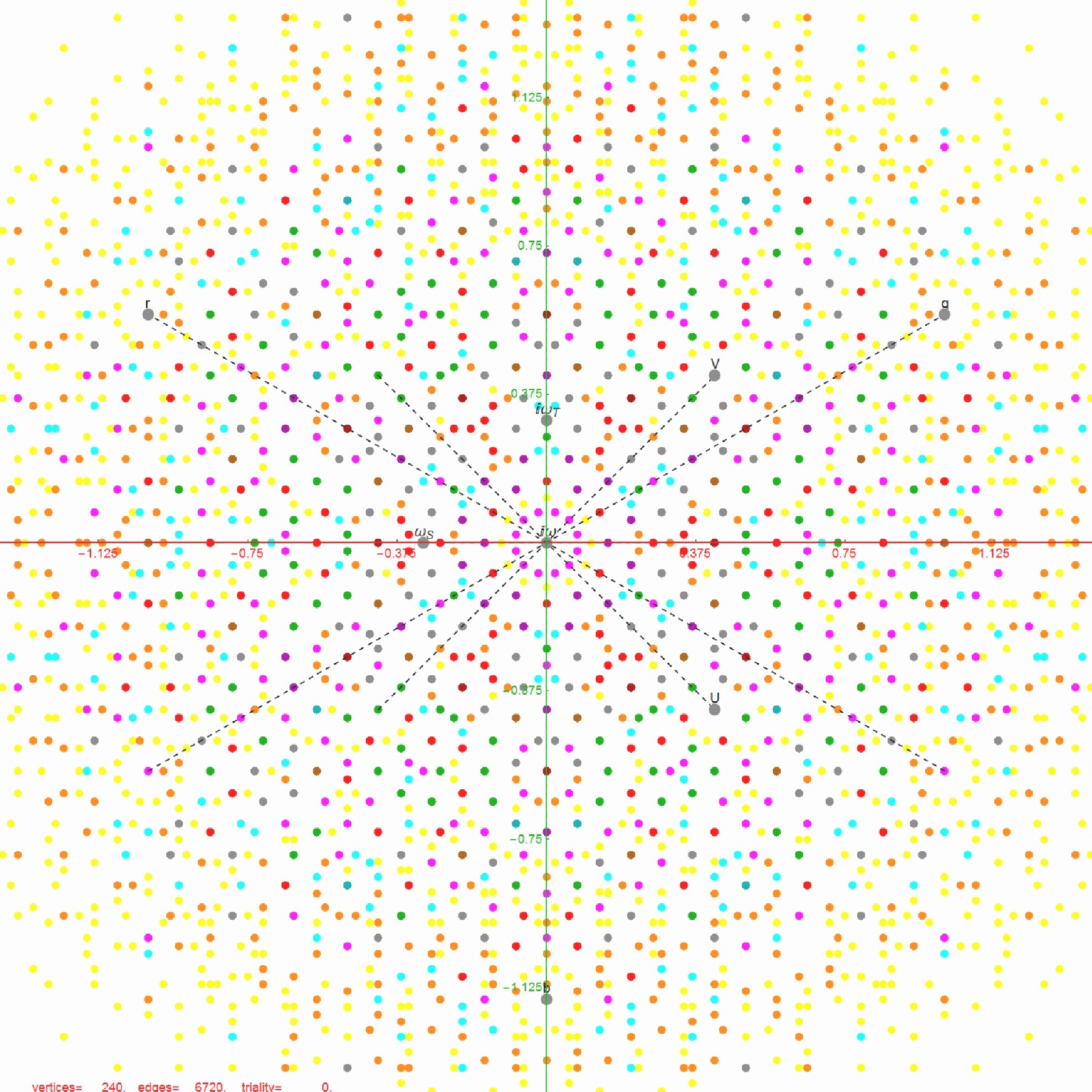
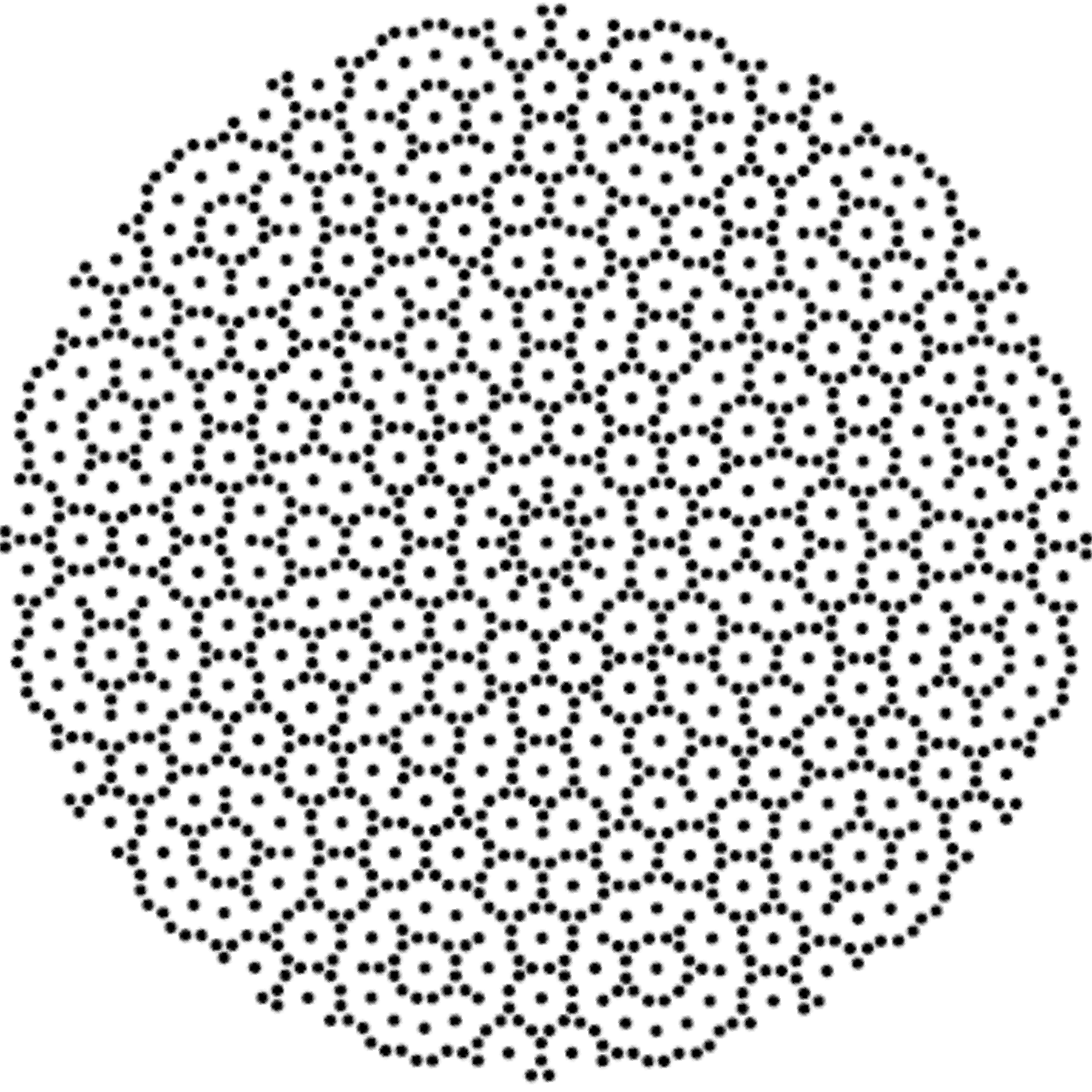
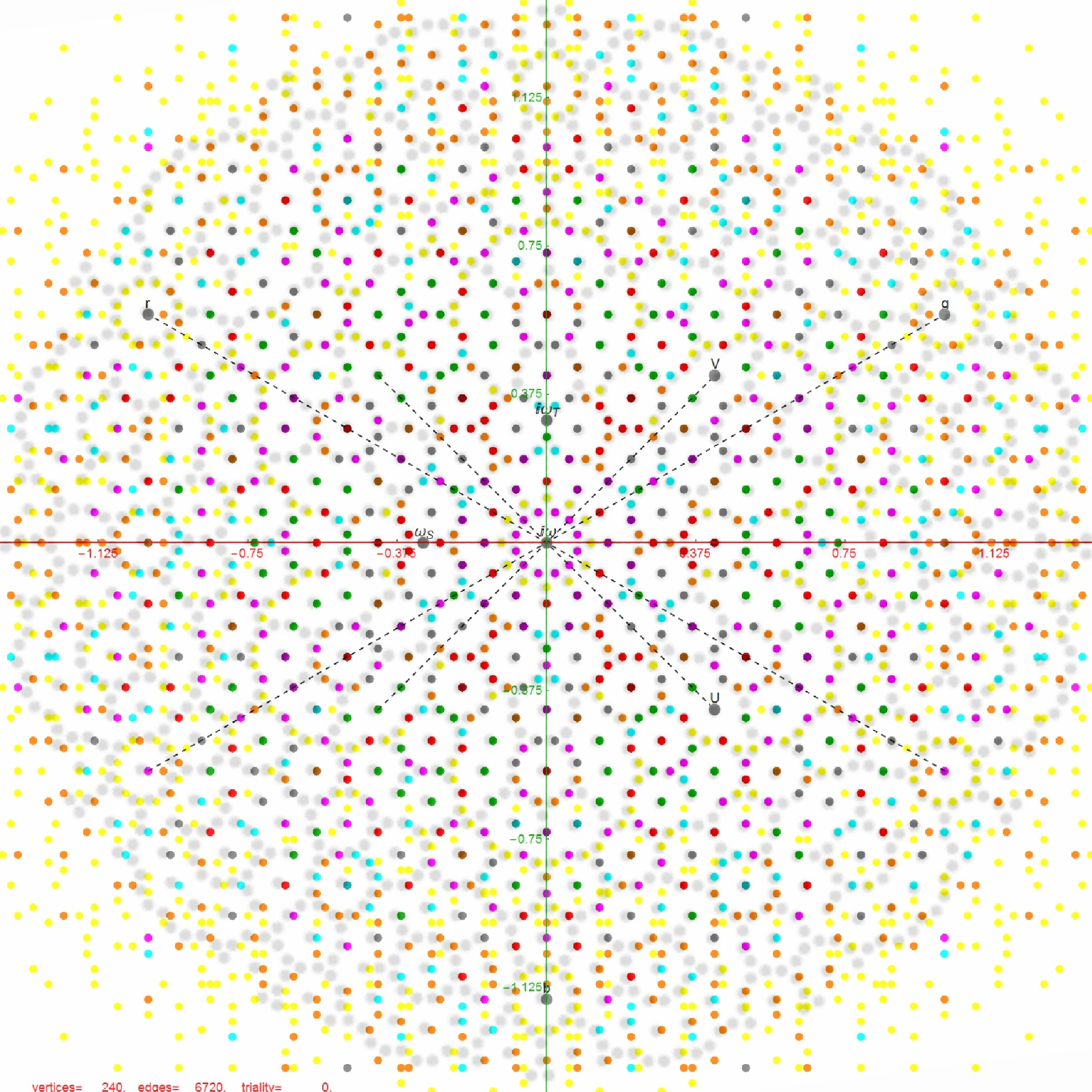
I’ve been following an interesting paper titled “Nested polytopes with non-crystallographic symmetry as projected orbits of extended Coxeter groups” which has used my E8 to H4 folding matrix as a basis for not only understanding Lie Algebras/Groups and hyper-dimensional geometry, but also the genetic protein / viral structures of life (very cool)!
The Nested Polytopes paper was first put into Arxiv in Nov of 2014 at about the same time I submitted my related paper on E8 to H4 folding to Vixra. I created this paper in response to discovering that my Rhombic Triacontahedron / QuasiCrystal (D6 projected to 3D using the E8 to H4 Folding Matrix to E8 to H4 folding) work on Wikipedia and this website was being used by Pierre-Philippe Dechant, John Baez and Greg Egan.
The Nested Polytopes paper has since undergone 4 revisions. The first three seemed to be typical (even minor) tweaks, but with a different author list/order in each. Yet, the latest (V4) seems to have a massive change, different author list and a completely different title “Orbits of crystallographic embedding of non-crystallographic groups and applications to virology”.
While I KNOW they were aware of my work, I wasn’t really surprised they never referenced it – as it isn’t published in academic press. I AM a bit surprised by the extensive changes to a single paper on arxiv. They have removed some of the E8 /H4 references (ref: Koca) and added completely different sources. Makes you wonder what’s up with that?
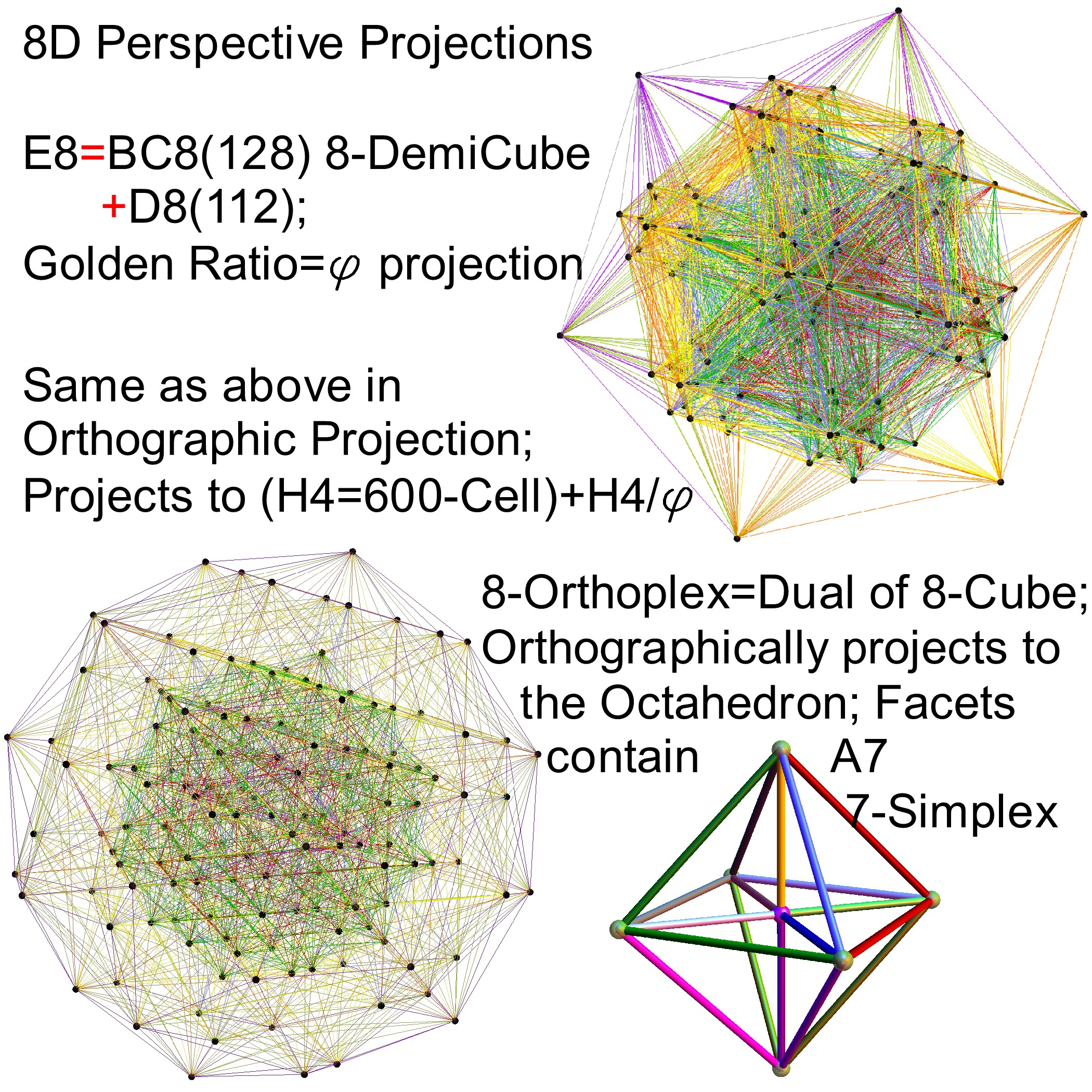
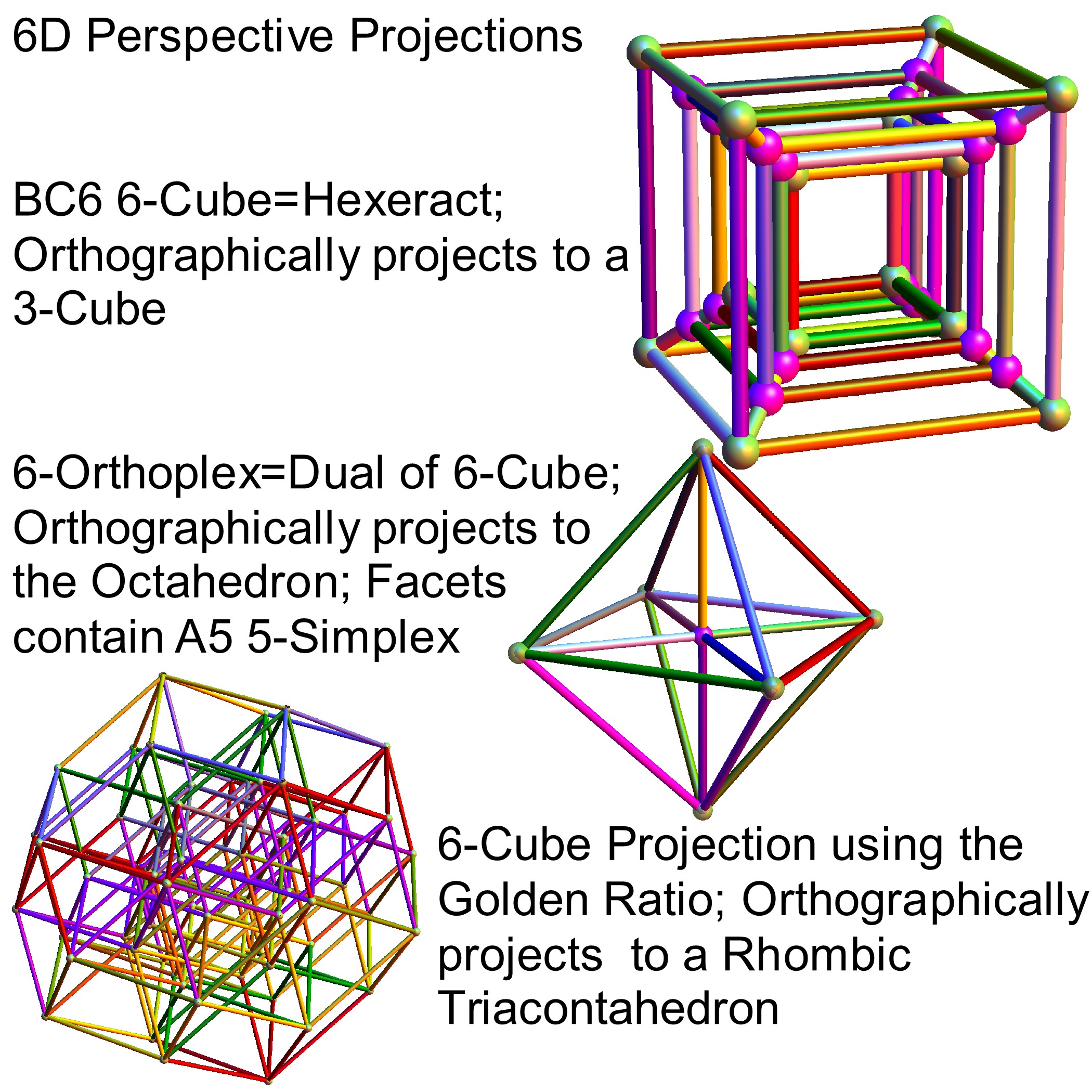
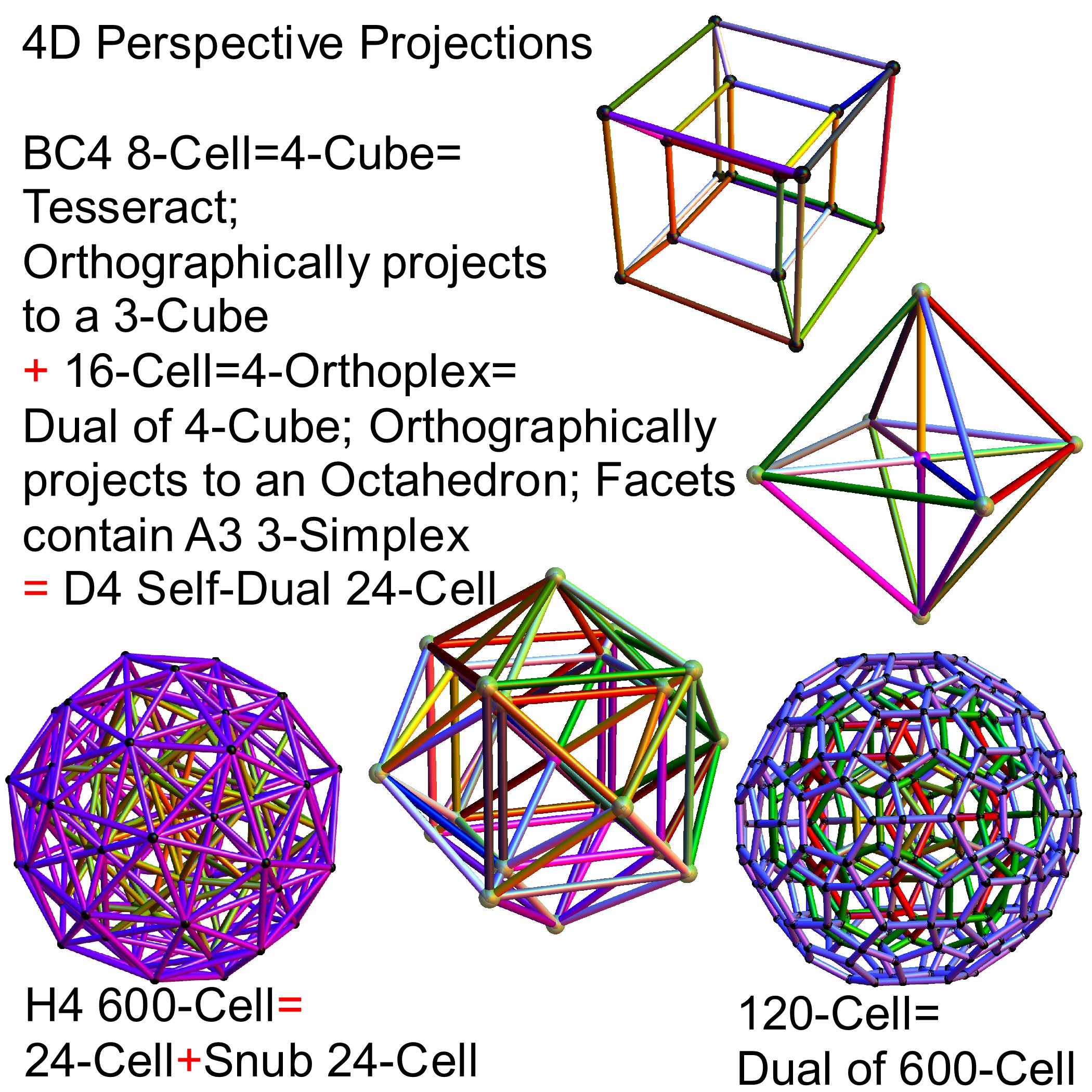
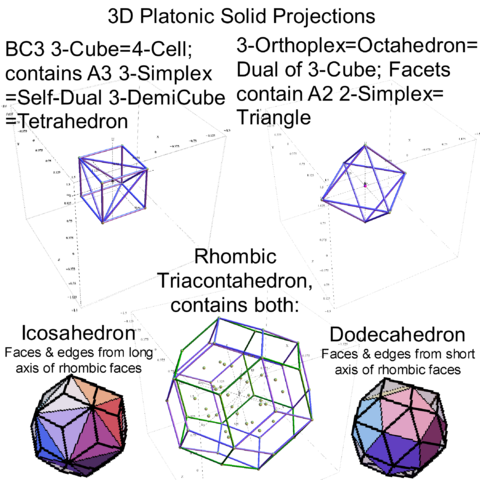
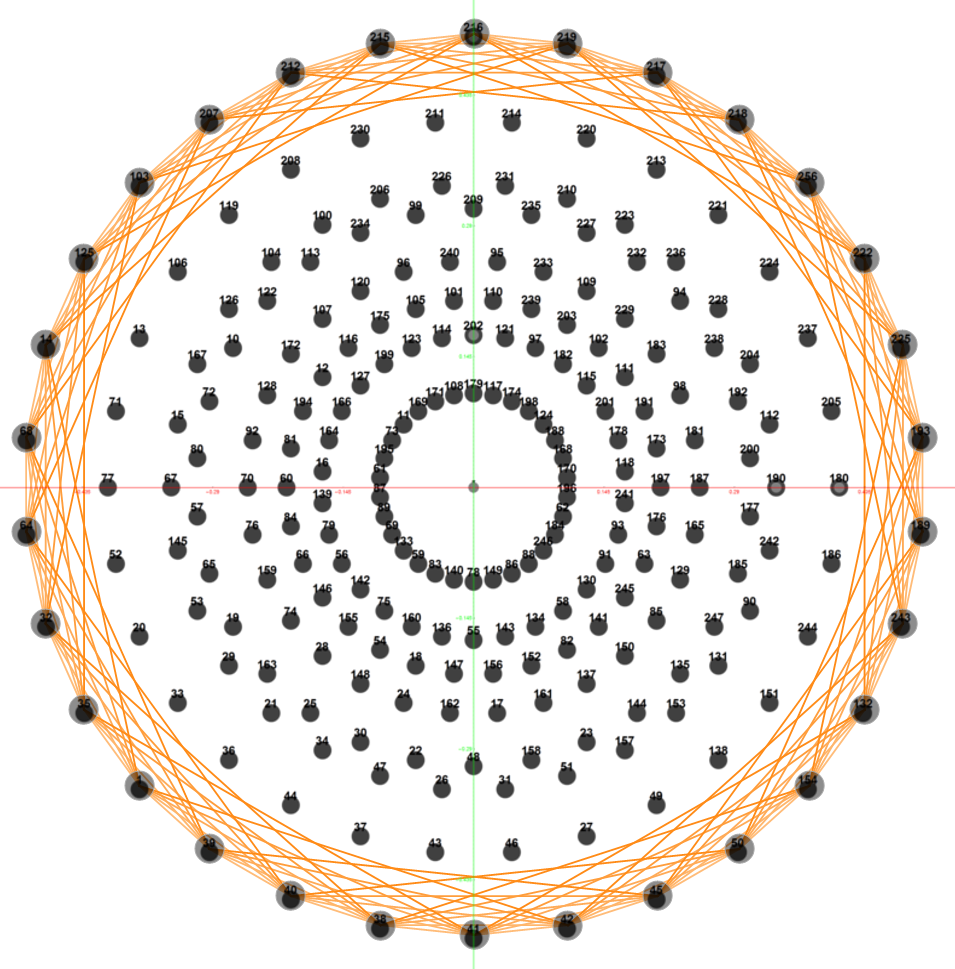
In reference to a G+ post by Baez (w/Greg Egan), it’s interesting to note the link to E8’s outer ring of the Petrie projection of a split real even E8, which creates a Beordijk-Coxeter helix.
Beordijk-Coxeter helix in 2D
Beordijk-Coxeter helix in 3D
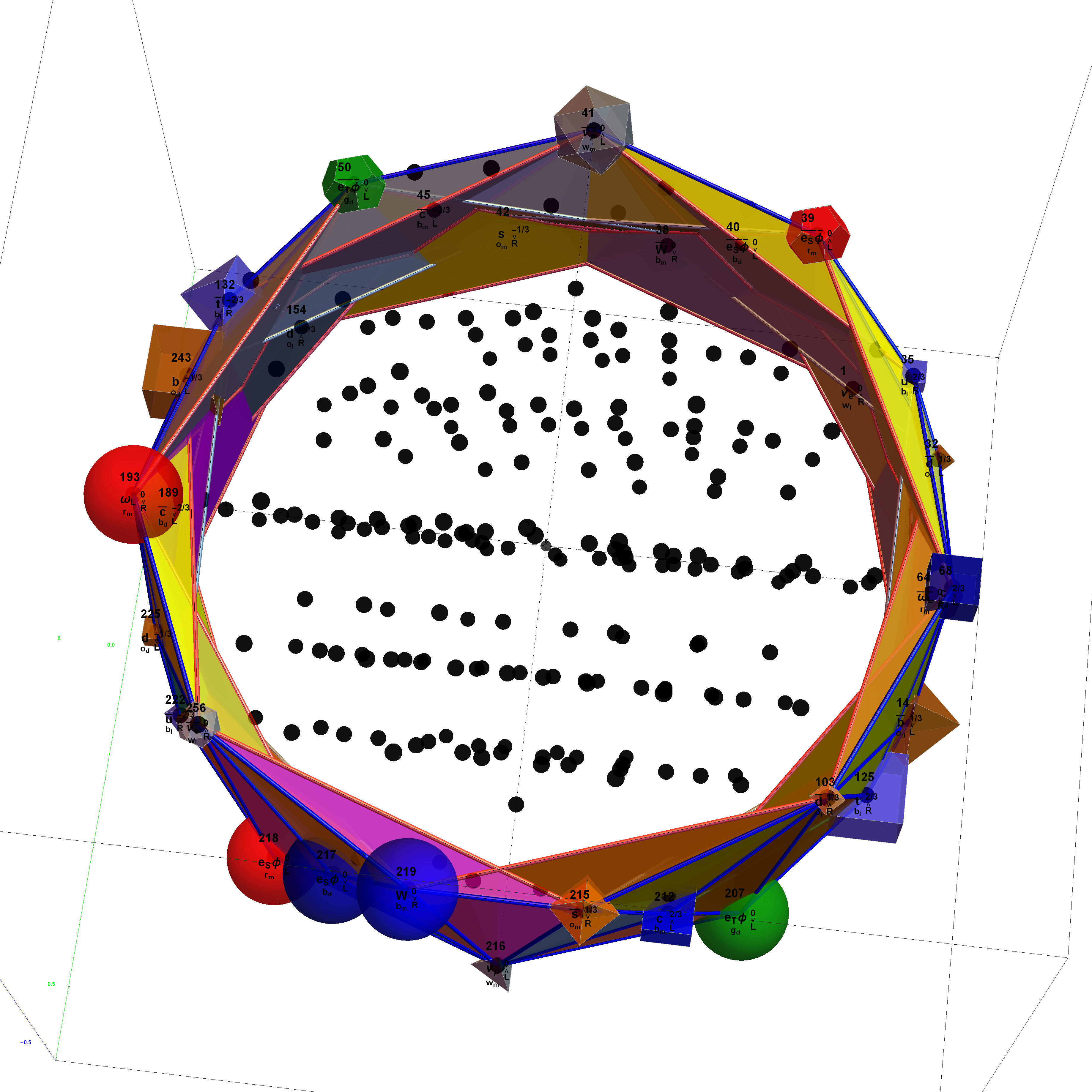
The Beordijk-Coxeter helix connects the nearest 6 vertices on the outer ring. The Tutte-Coxeter graph is created in 3 (blk,grn,red) sets of edges by taking the (outer) ring and skipping (6,8,12) or counting (7,9,13) vertices. It shows there are 2 perfect pentagons and 1 pentagram (with different radii due to the difference in distance between the sets of vertices used).
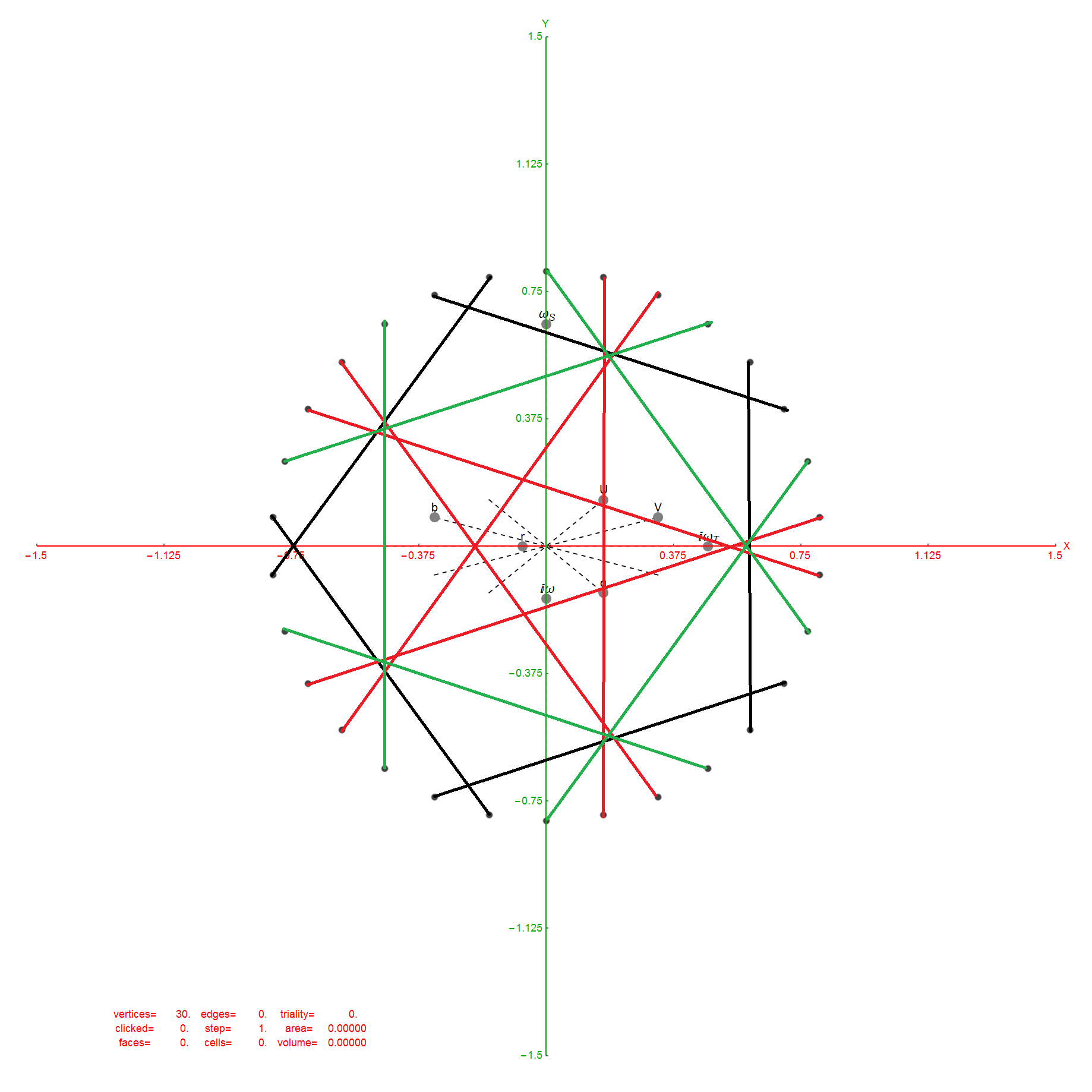
Of course, the crystallographic E8 is manifestly related to the 5 fold symmetry of the pentagon, with its integral relationship to the non-crystallographic H4 group (and its Coxeter-Dynkin diagram) through E8 to H4 folding using the Golden ratio Phi.
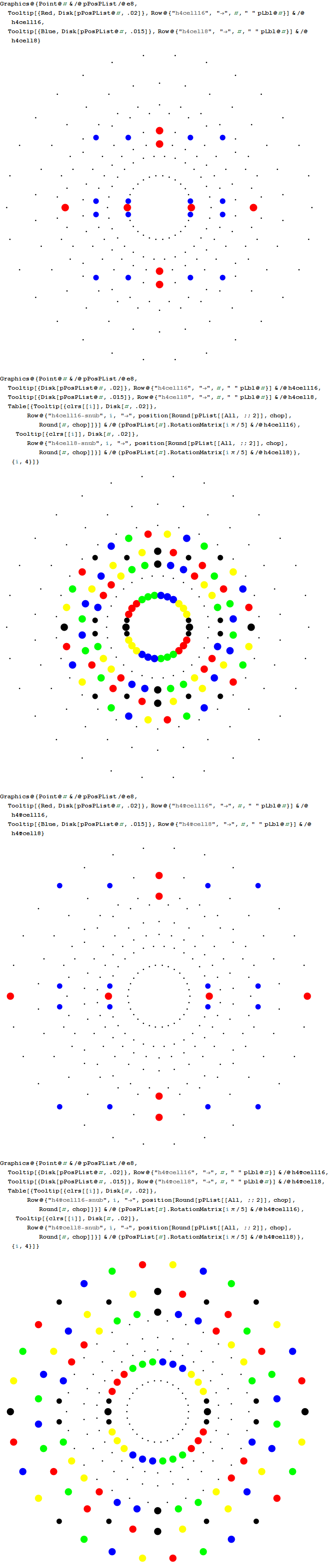
It is interesting to note that the skipping of 5+(1,3,7) vertices is similar to the creation of the 120 (240) vertex positions of H4 (E8) Petrie projection by adding to the 24 vertices of the 8-cell and 16-cell (which make up the self-dual 24-cell) the 96 vertices of the Snub 24-cell. This is done through 4 rotations skipping 5 vertices.
Also notice the (1,3,7) are the number of the imaginary parts of Complex, Quaternion, and Octonion numbers, also integrally related to E8.
Projected from E8 to 6-Cube and then to Rhombic Triacontahedron using 3 of 4 rows of the E8-to-H4 folding matrix.
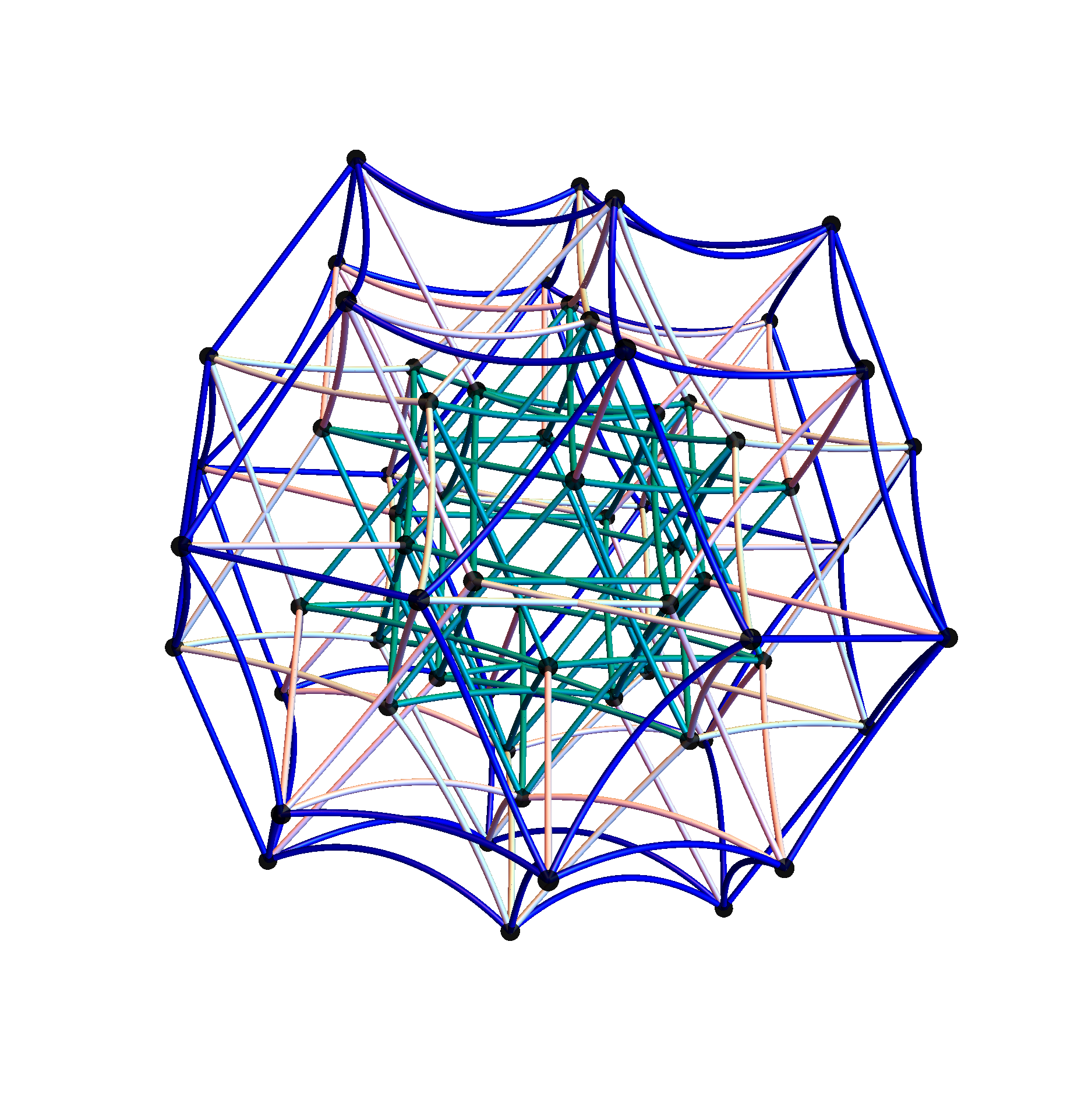
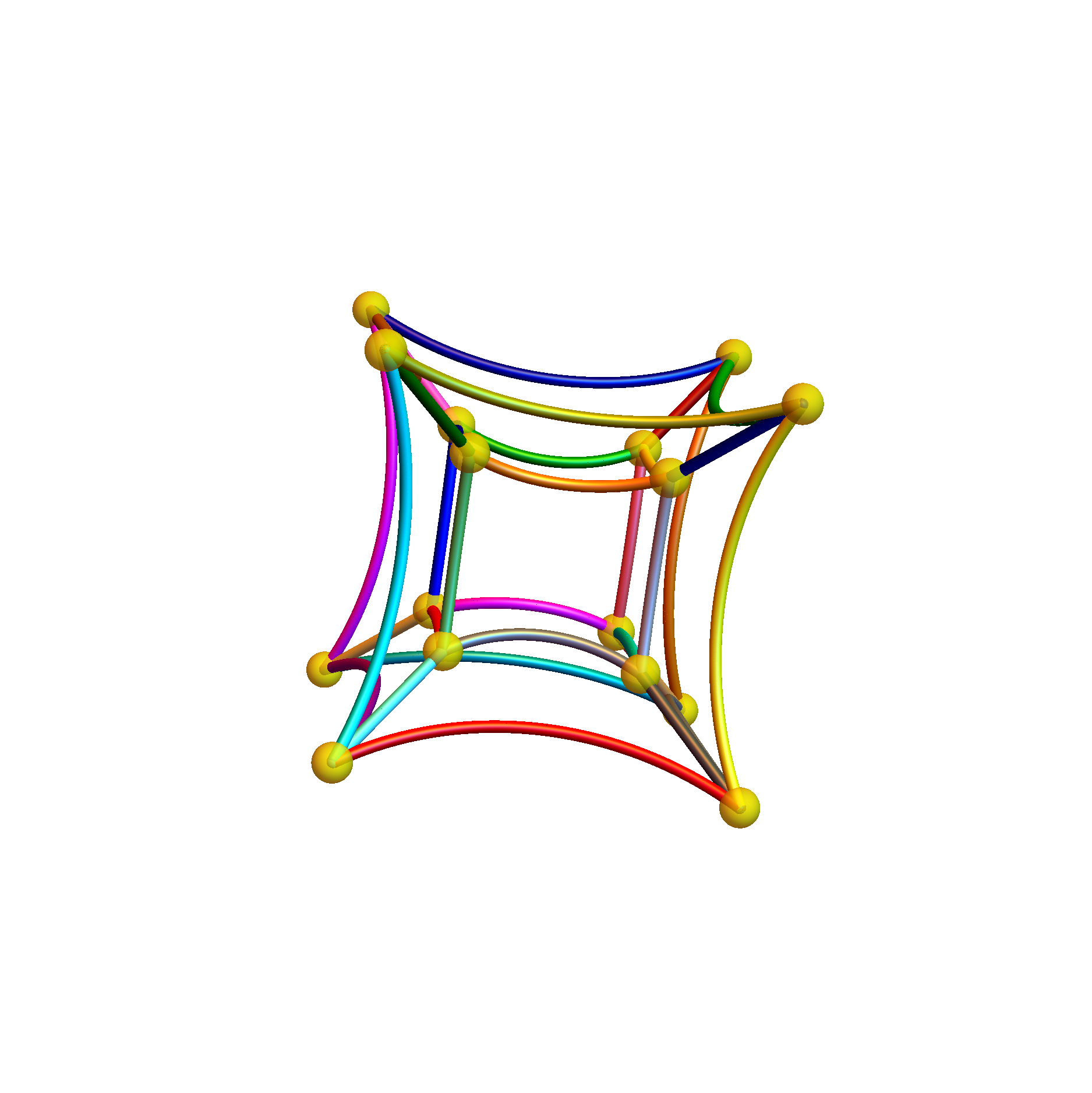
and a Tesseract for good measure…
The recent announcement for the potential LHC realization of composite particle resonance of the pentaquark (or meson-baryon molecule) is interesting. This, along with a prior confirmation of the dimeson tetraquark Z(4430), and prognostications for hexaquarks (or dibaryons), expand the “zoo” of composite particles now numbering in the thousands.
If by chance we can use these new discoveries to discern the mathematical pattern (symmetry) well enough to predict the particle masses, lifetimes, branching ratios and CKM (quark) PMNS (neutrino) mixing matrix ratios – that would be COOL!
Yet, given the current size of this zoo of particles, it seems that adding a few more bags of quarks to the mix may not do the trick, but I am always hopeful.
IMNSHO (In My Not So Humble Opinion ;-)… it is more a task of “naming the animals”.
or in Ernest Rutherford’s words:
“All science is either physics or stamp collecting.”
“The pentaquark search may be physics’ version of ‘stamp collecting'”. JGM
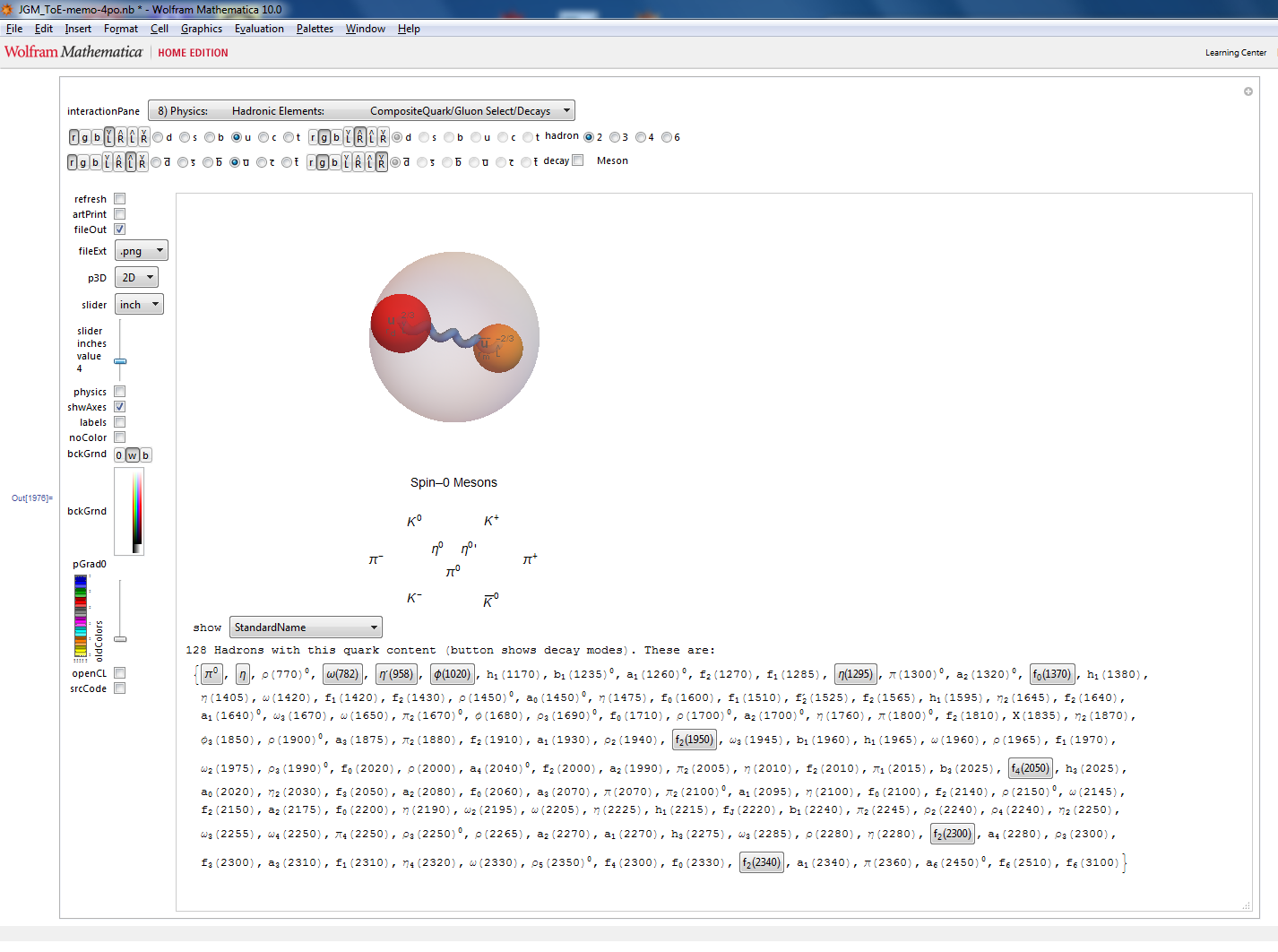
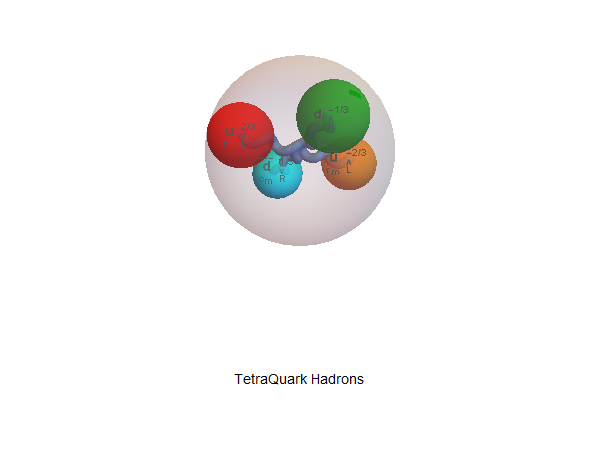
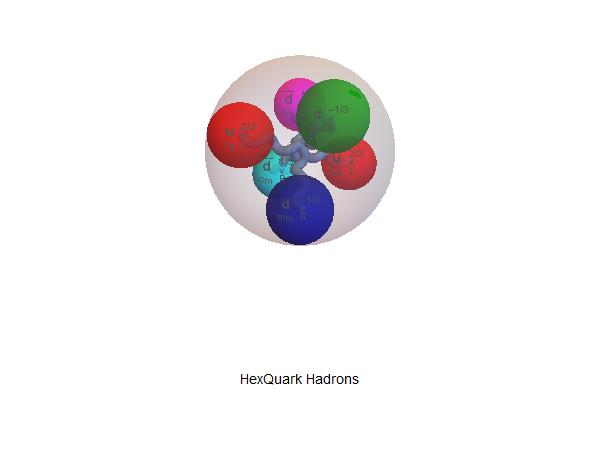
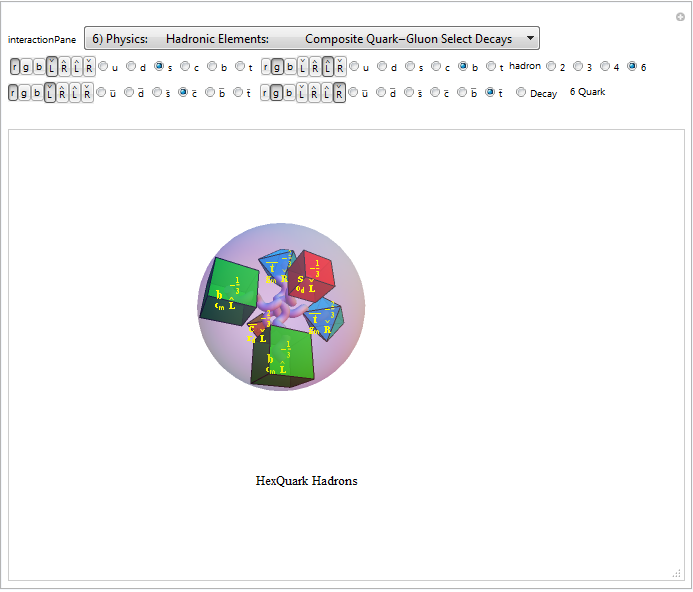
Hexaqark with “Physics” shapes:
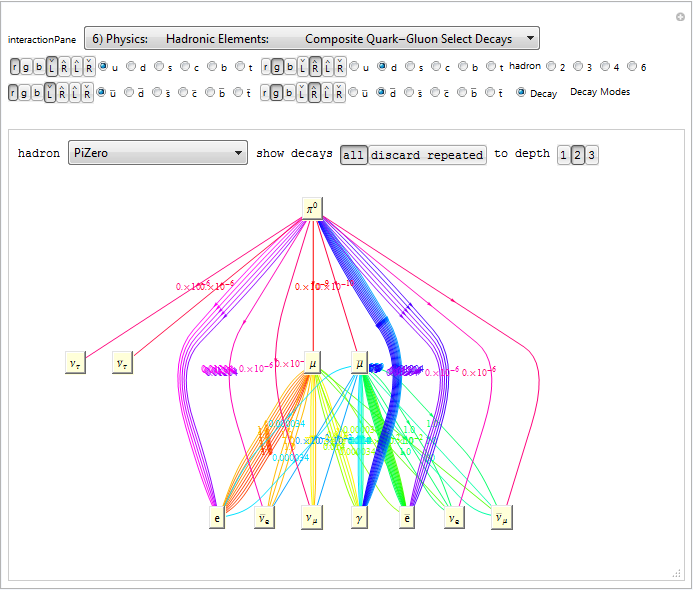
Decays:
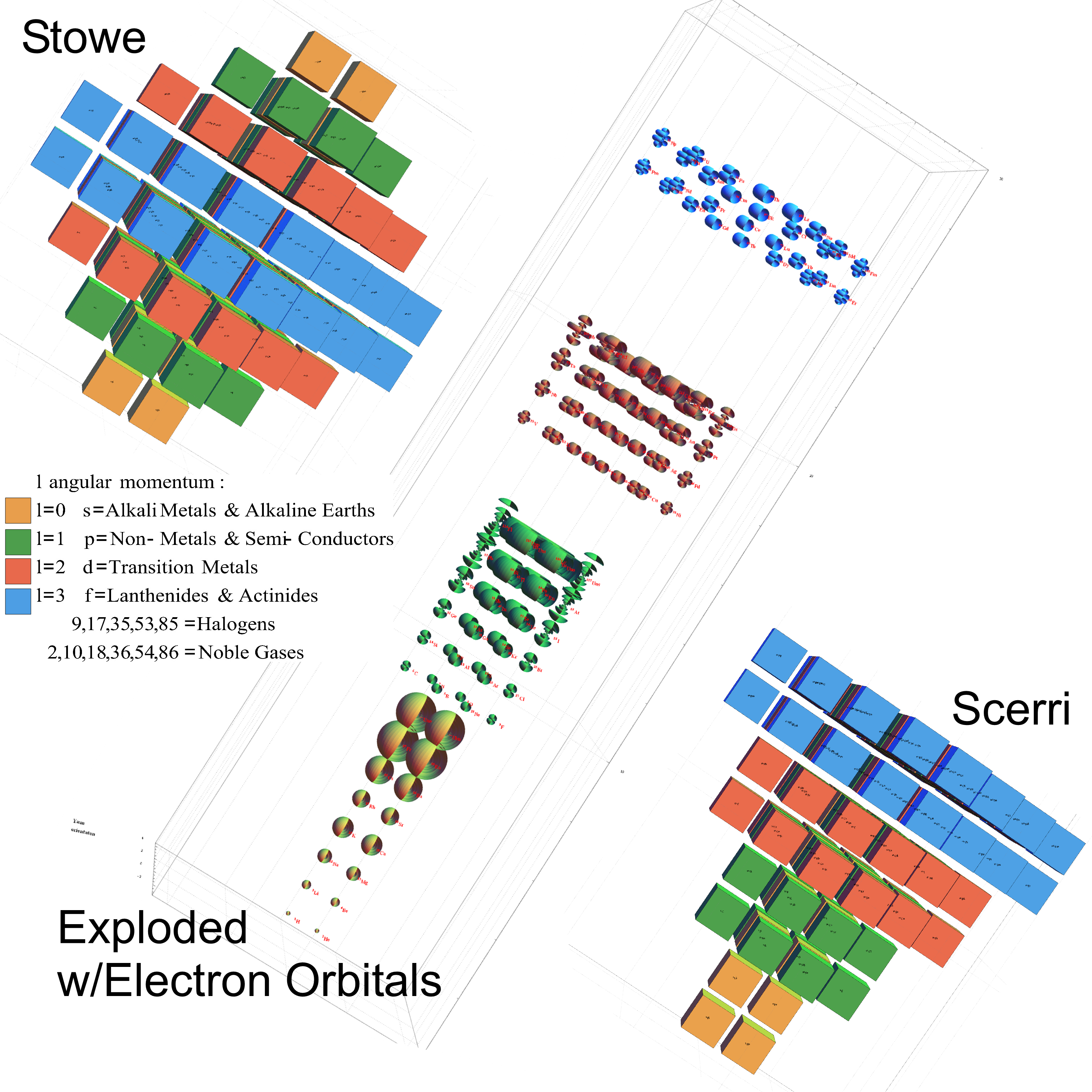
My attempt to organize the stamp collection of chemistry into a 4D periodic table:
Please note, this is about the GEOMETRY used in what has come to be called “Sacred Geometry”. Upon further investigation, along with the Kabbalah’s “Tree of Life”, it seems even the Jewish “Star of David” (Solomon) is medieval and may not be sourced in authentic ancient Abrahamic theology.
As it stands, the so-called “sacred” origin of these, including the pentagon that shows up in the icosahedral/dodecahedral Platonic solids due to the Sqrt(5) Golden Ratio (Phi) relationship within my E8 to H4 folding, is likely medieval and mostly pagan. I am merely pointing out that E8 contains the geometry that many find “interesting” for whatever reason, and am not promoting the underlying cults that use them.
Video (Best in HD):
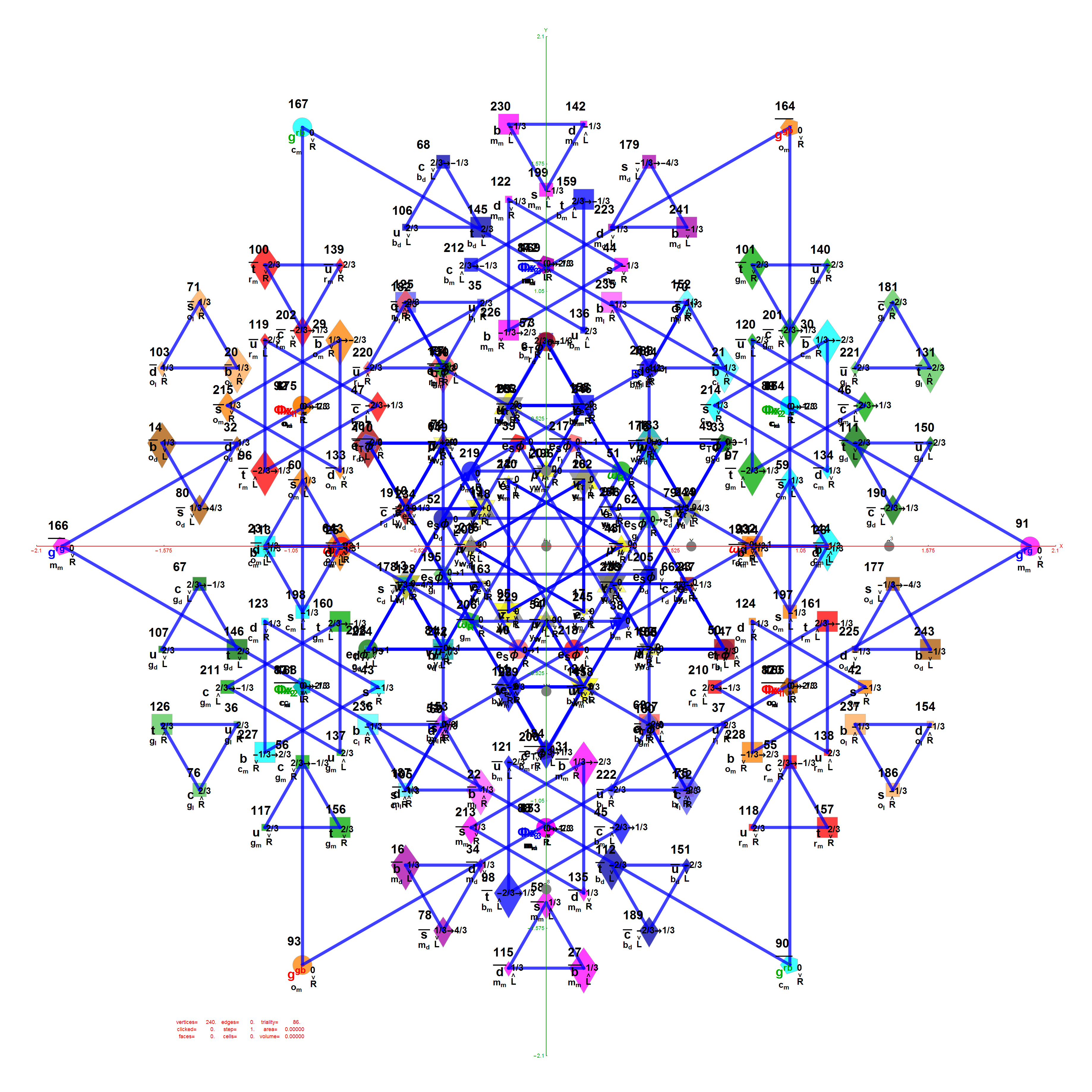
My E8 F4 projection w/blue triality edges and physics particle assignments:
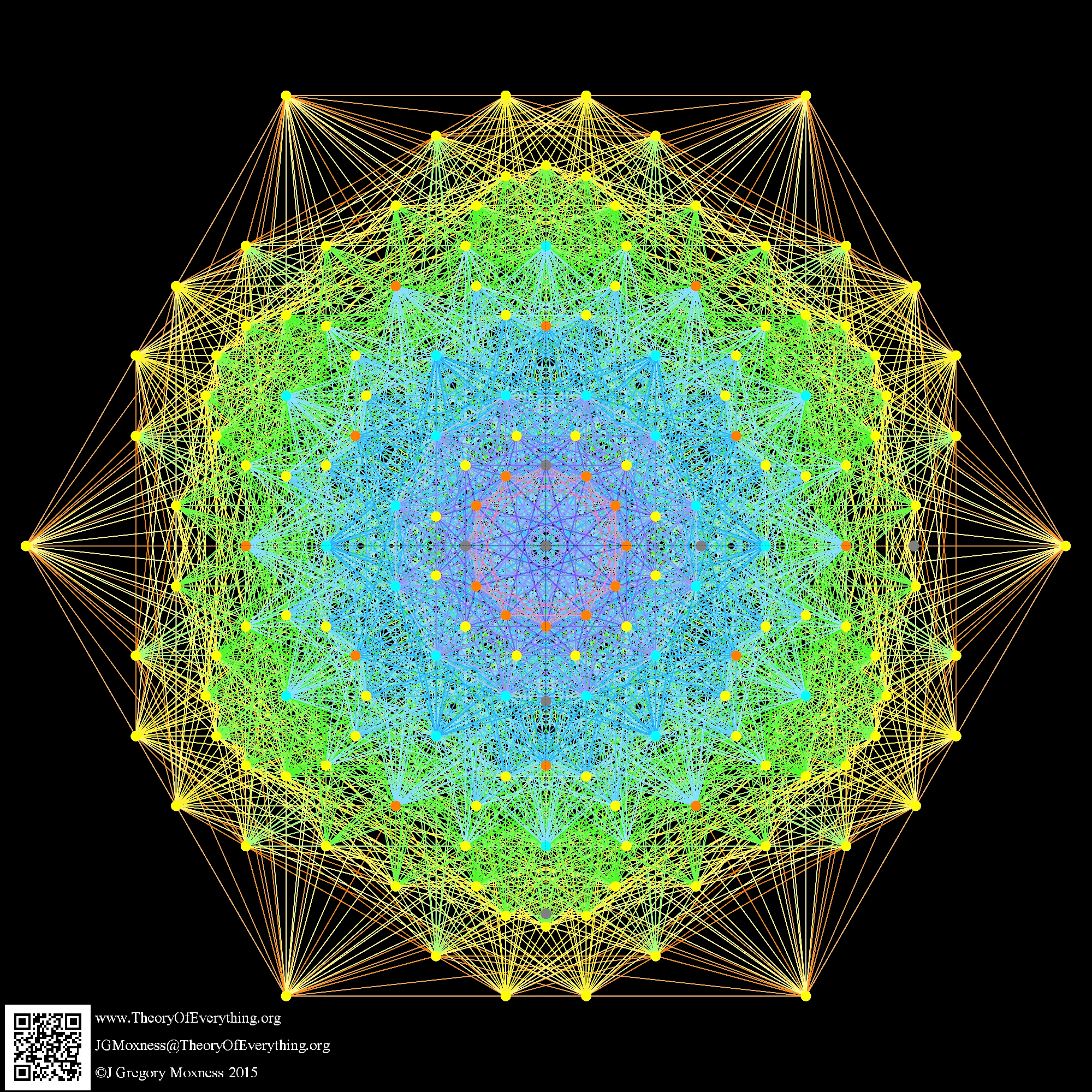
My E8 F4 projection with 6720 edge lines:
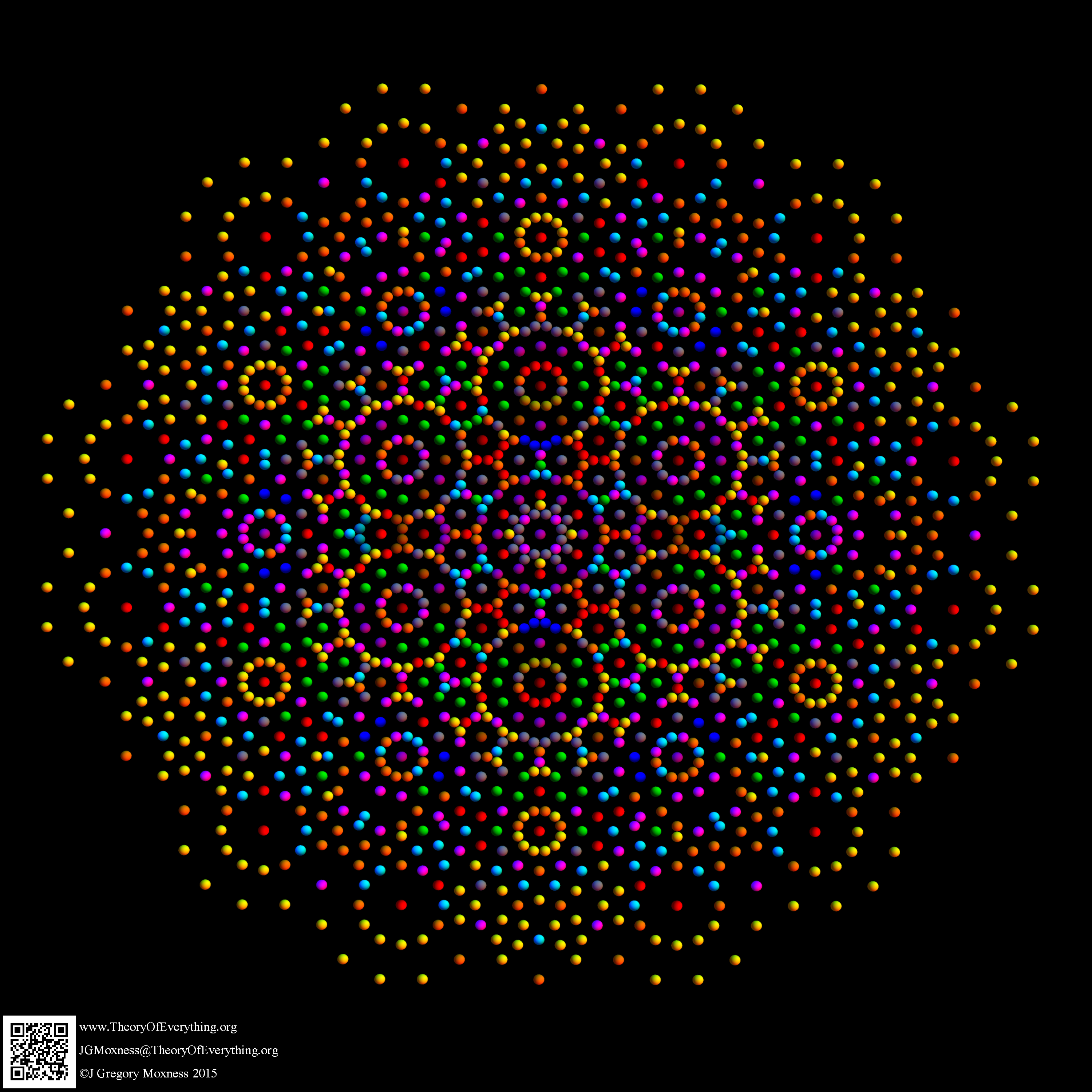
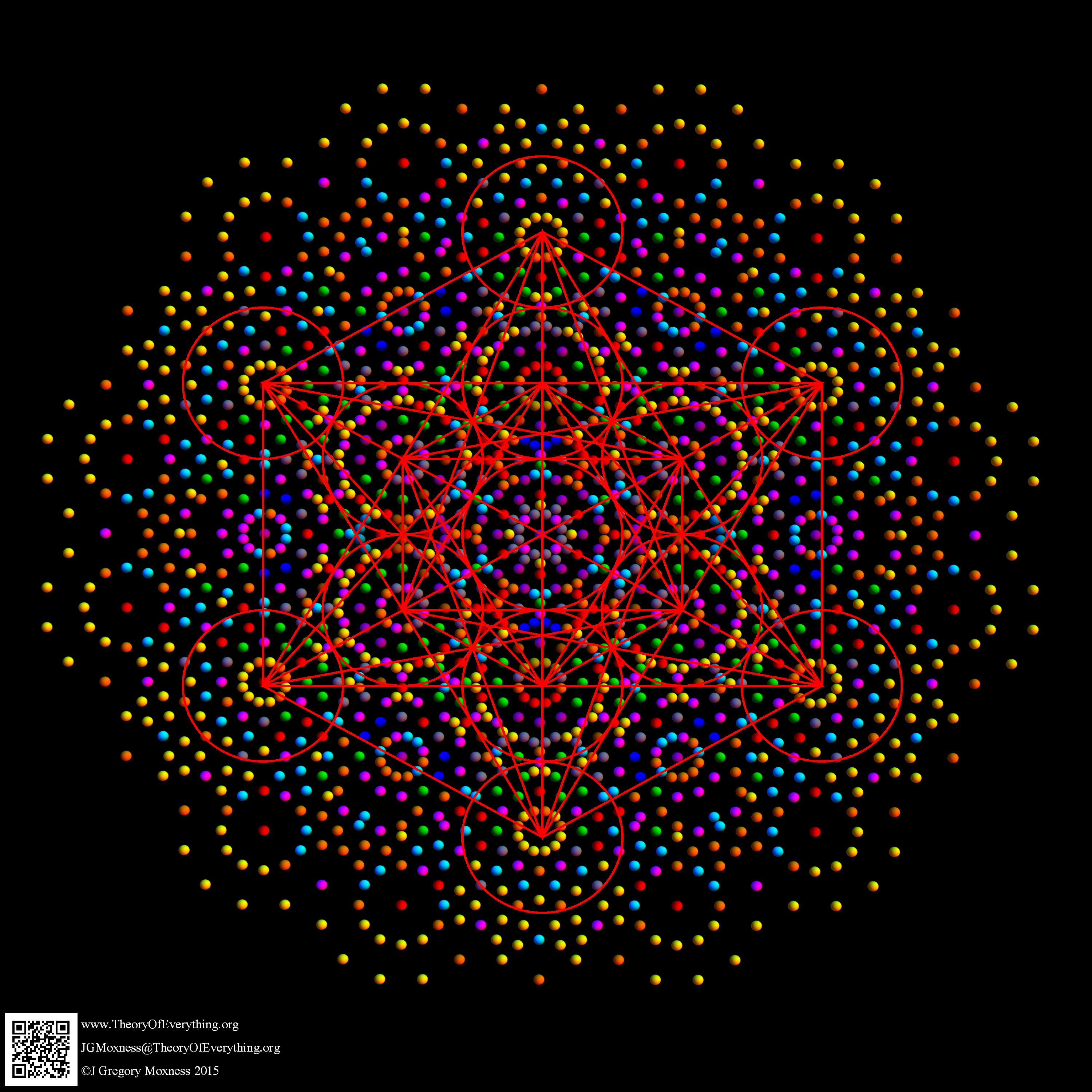
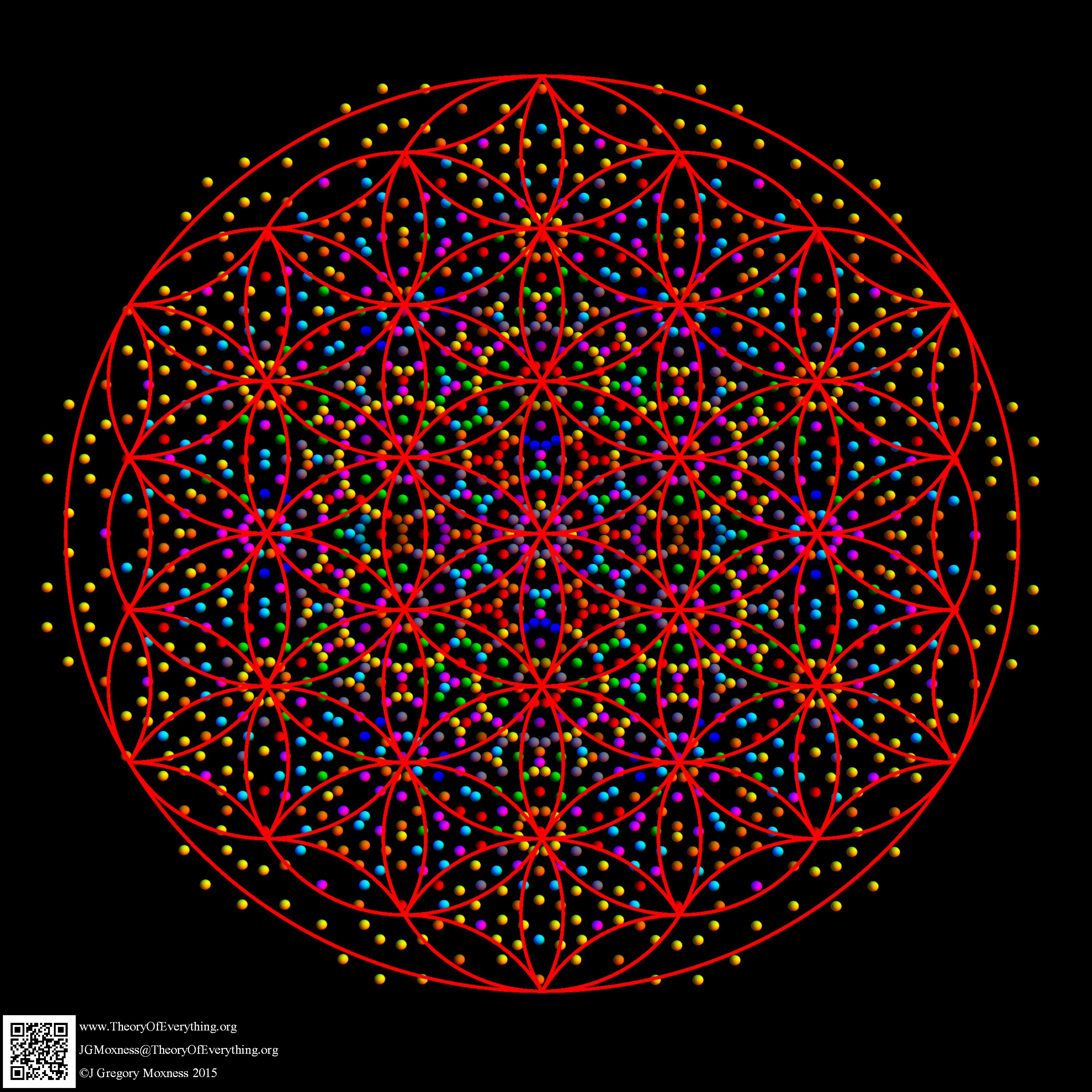
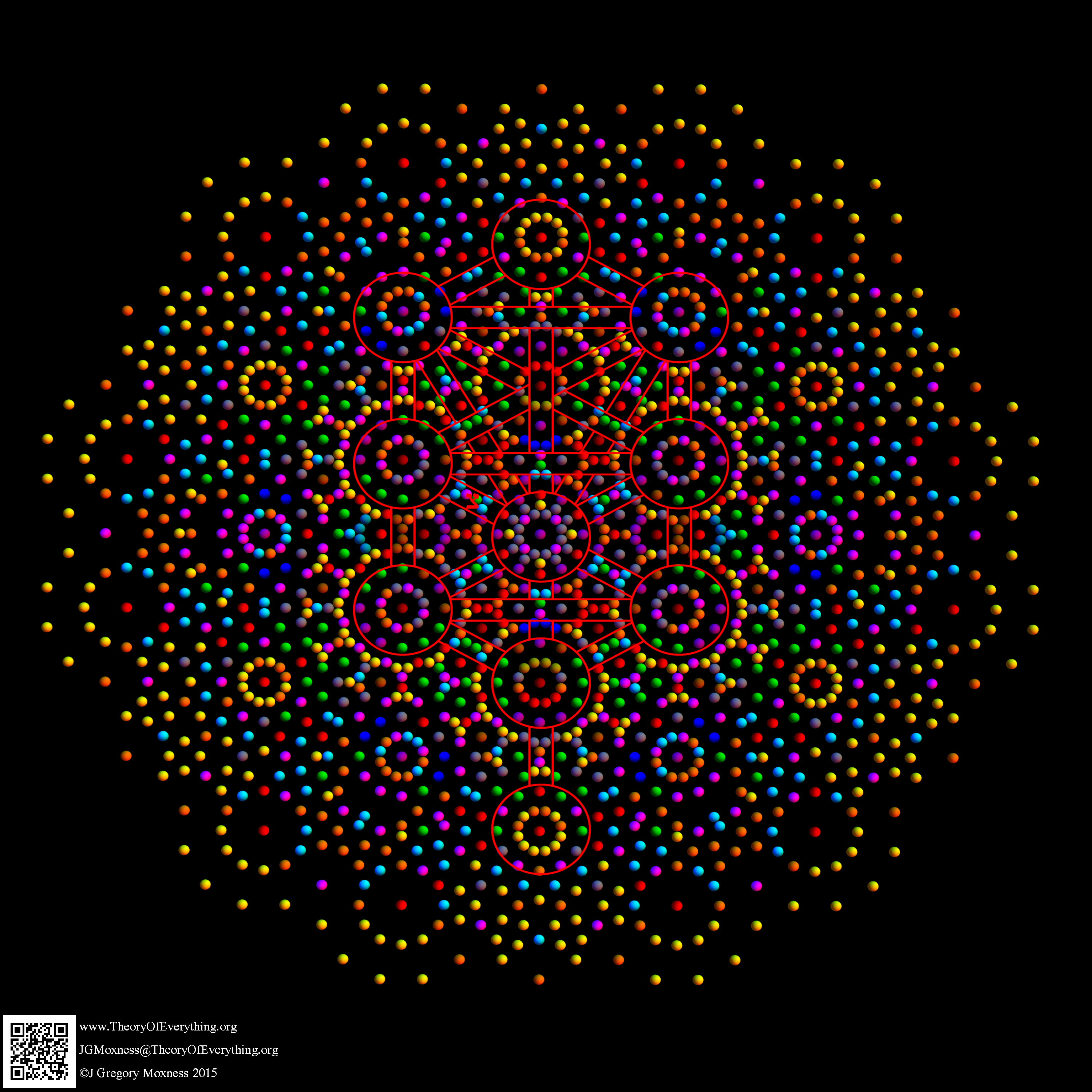
My E8 F4 projection rectified:
Star Of David Overlay:
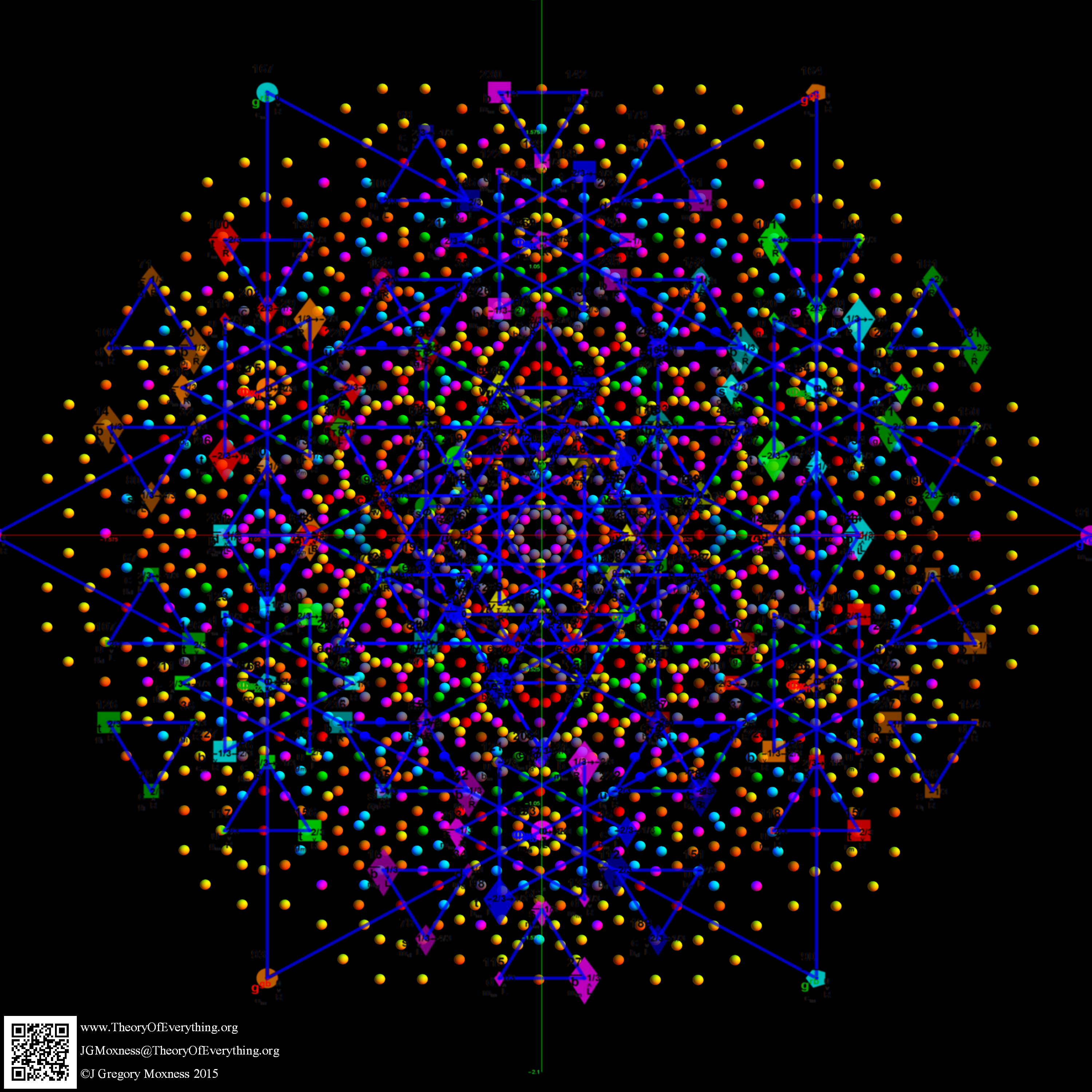
Metatron’s Cube Overlay:
Flower of Life Overlay:
Kabbalah Tree of Life Overlay:
Copyright J Gregory Moxness 2015
Rectified E8 and F4 Triality (Original Work)
WikiMedia Commons source images:
Metatron’s Cube (User:Barfly2001)
Flower of Life (User:Life_of_Riley)
Tree of Life (User:AnonMoos)
For Lisi’s latest ideas on a “Lie Group Cosmology (LGC)” ToE, see http://arxiv.org/abs/1506.08073.
Be warned, it is over 40 heavy pages.
He also posted a new projection on FB.
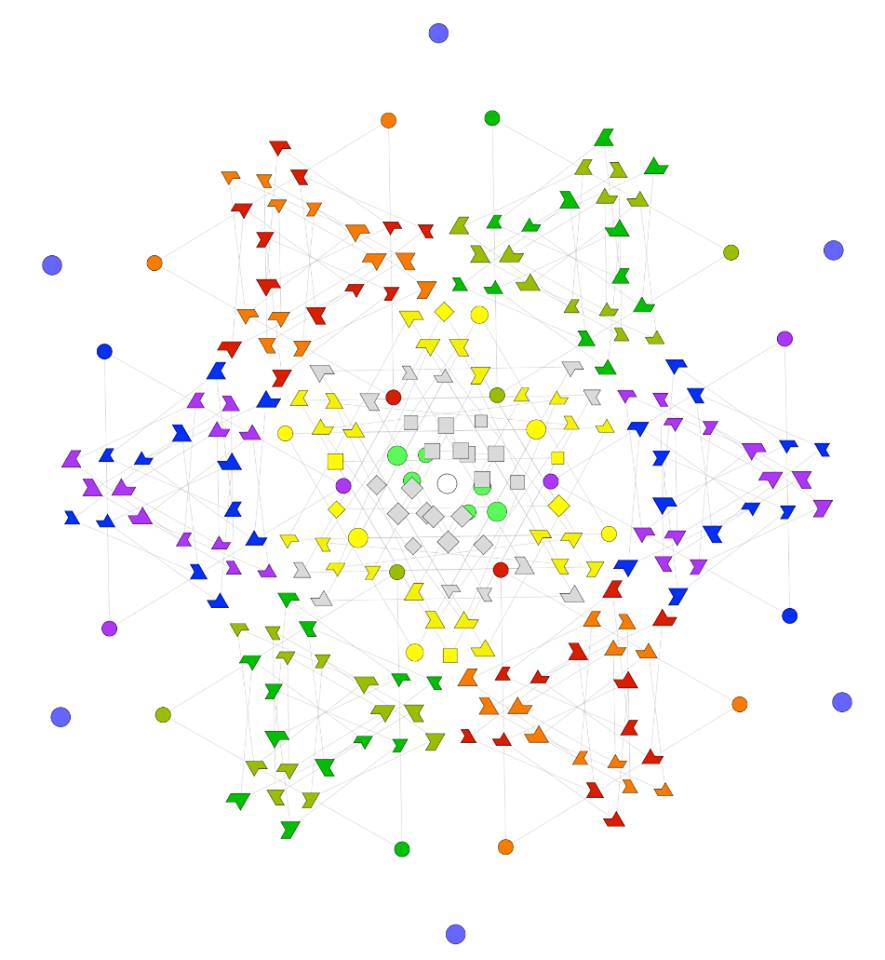
He uses the (H)orizontal and (V)ertical projection vectors of:
H = {.12, -.02, .02, .08, .33, -.49, -.49, .63};
V = {-.04, .03, .13, .05, .20, .83, -.45, .19};
Here it is rendered with H and V reordered to match in VisibLie_E8 tool:
H/V order is {2, 3, 4, 7, 1, 6, 5, 8};
Note: the particle assignments in my VisibLie_E8 tool (as in the Interactive visualizations on this website) are not the same and have different triality rotation matrices.
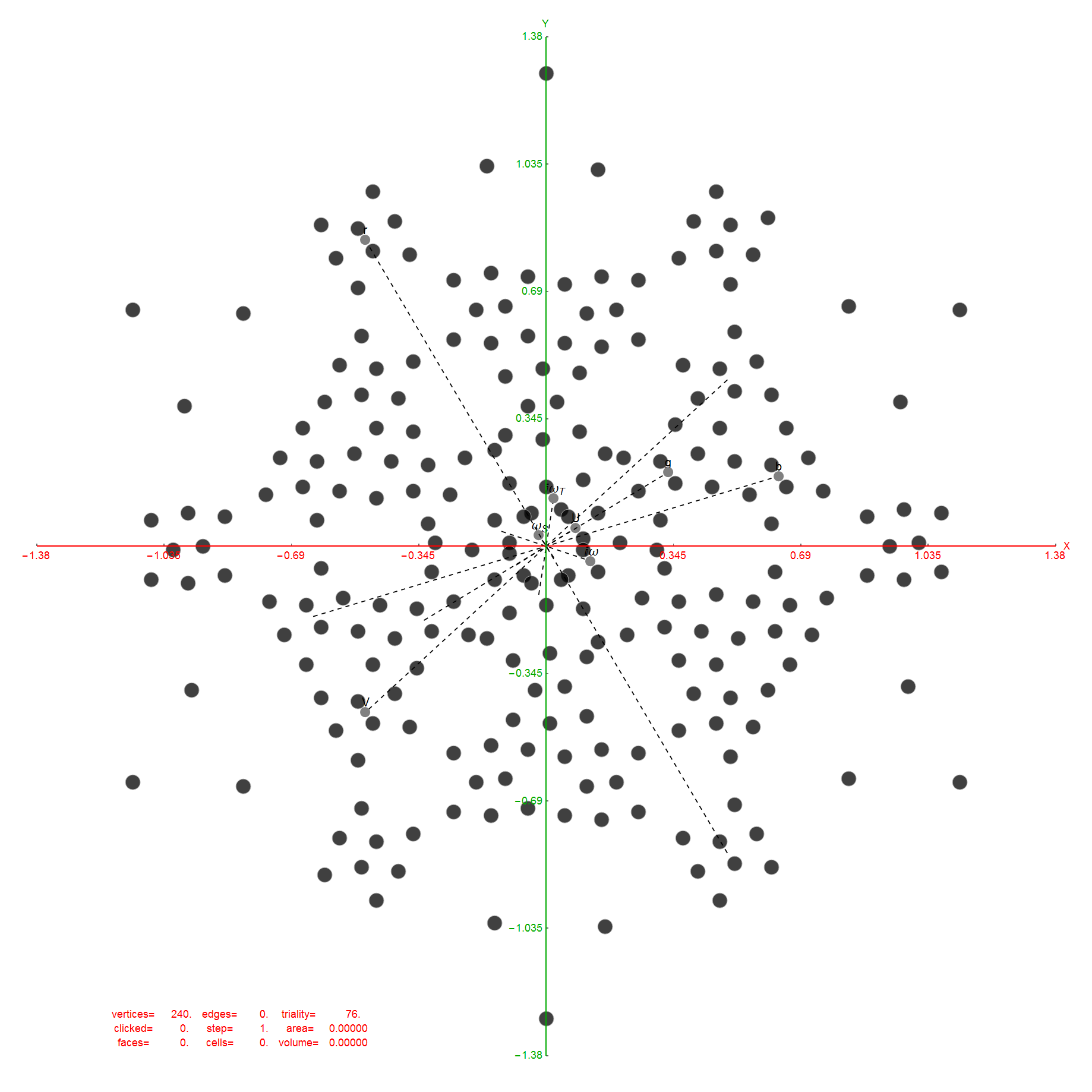
The pic below has a slightly altered projection that creates a bit more hexagonal symmetry and integer projections (without deviating more than .05 off his coordinates):
Note: vertex colors indicate the number of overlapping vertices.
This uses H/V projection vectors (reverse ordered back to his coordinate system).
Symbolic:
H={3 Sqrt[3]/40, 0, 0, 3 Sqrt[3]/40, 1/3, 1/2, 1/2, -2/3};
V={-3/40, 0, 3/20, 3/40, 3/20, -4/5, 1/2, -3/20}};
Numeric:
H={.13, 0., 0.,.13,.33,.5, .5,-.66`};
V={-.075, 0., .15, .075, .15,-.8, .5,-.15};
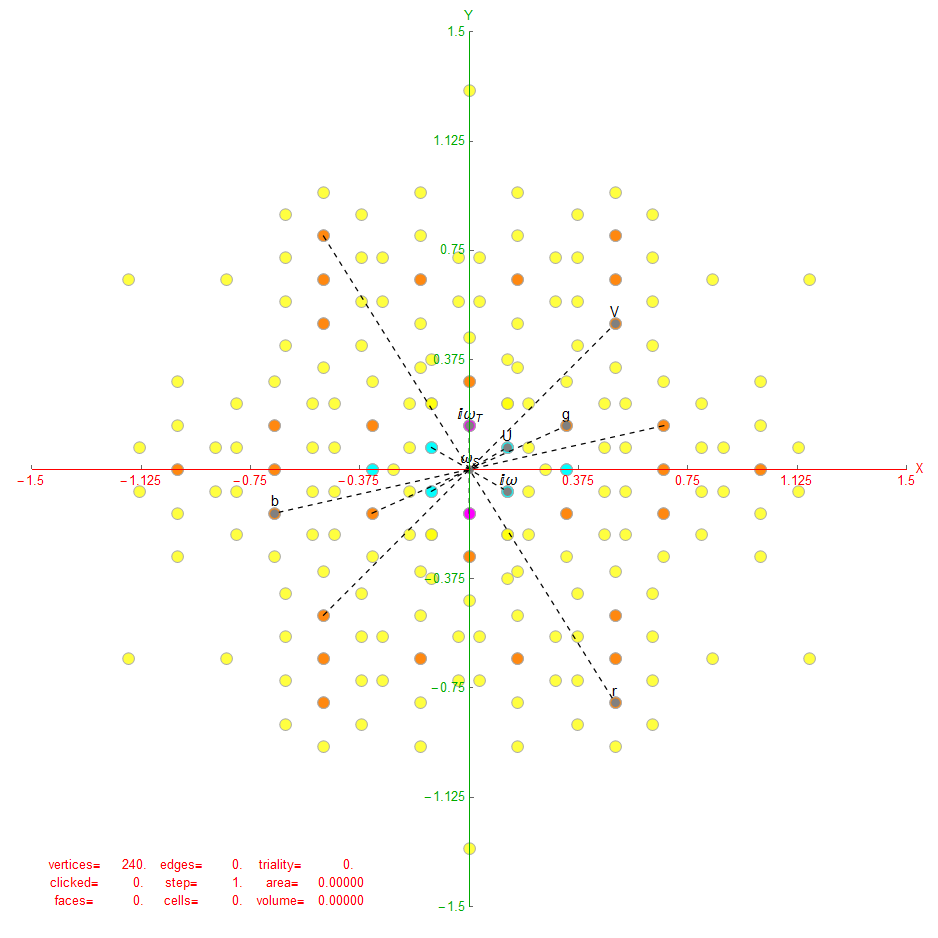
Here is Lisi’s version with my coordinates:
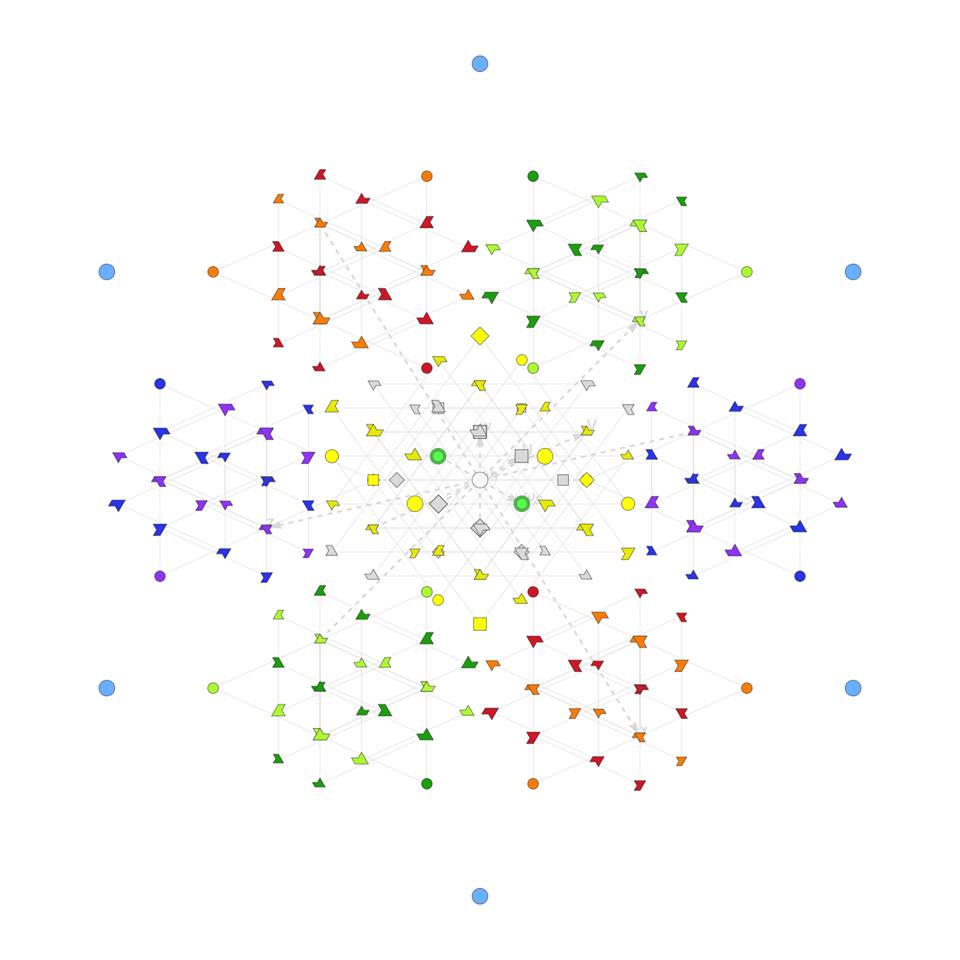
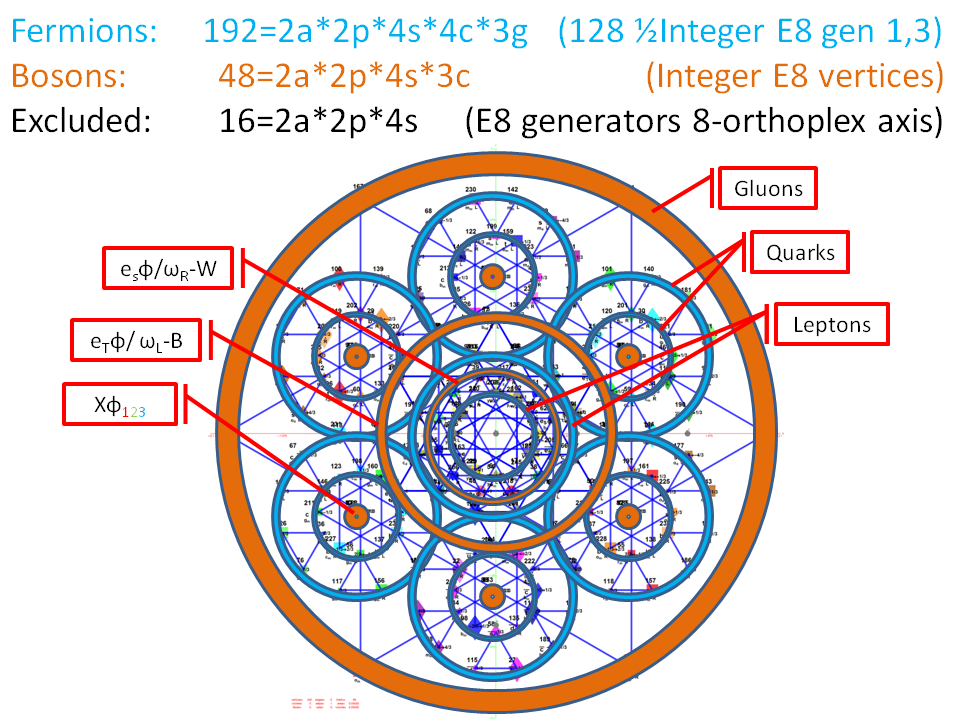
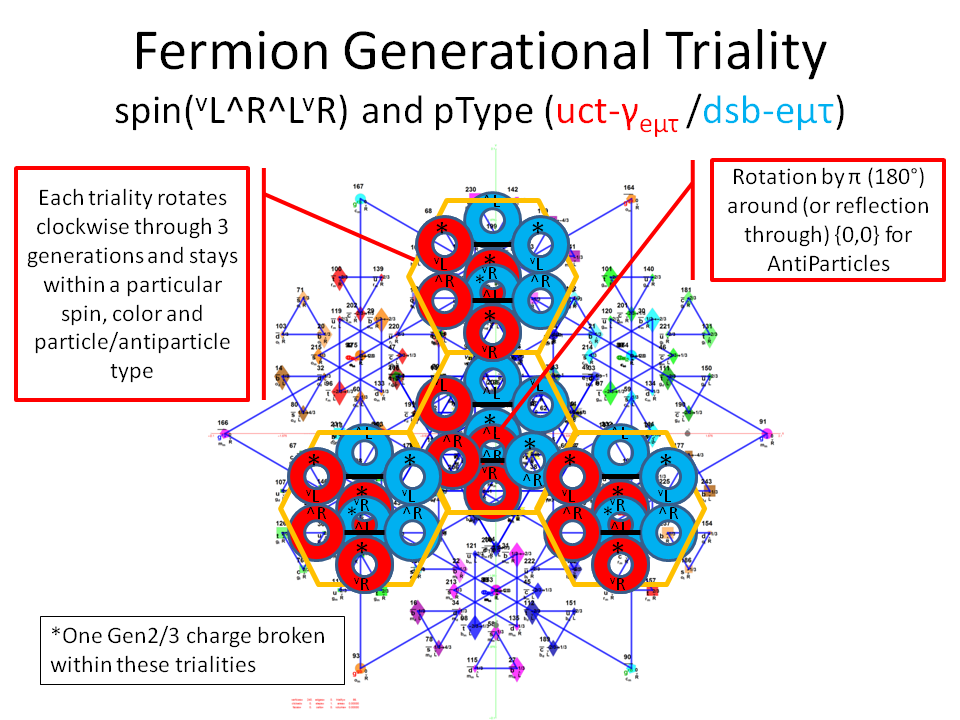
Here is a version of the full hexagonal (Star of David) triality representation using coordinates I found with the same process used above. Particle color, shape and size are based on the assigned particle quantum numbers (spin, color, generation). There are 86 trialities indicated by blue triangles.
Projection vectors (in my “physics” coordinate system) are:
H={2-4/Sqrt[3],0,0,-Sqrt[(2/3)]+Sqrt[2],0,0,Sqrt[2],0};
V={0,-2+4/Sqrt[3],Sqrt[2/3]-Sqrt[2],0,0,0,0,-Sqrt[2]};
See also a rectified version of this, where the particle overlaps show the inner beauty of E8!!
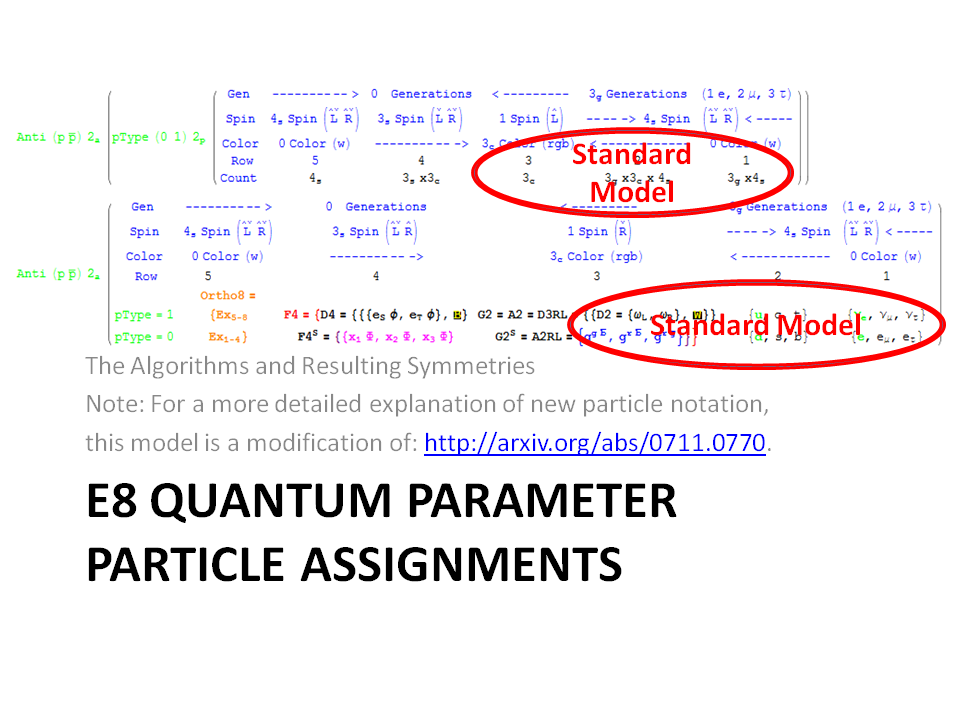
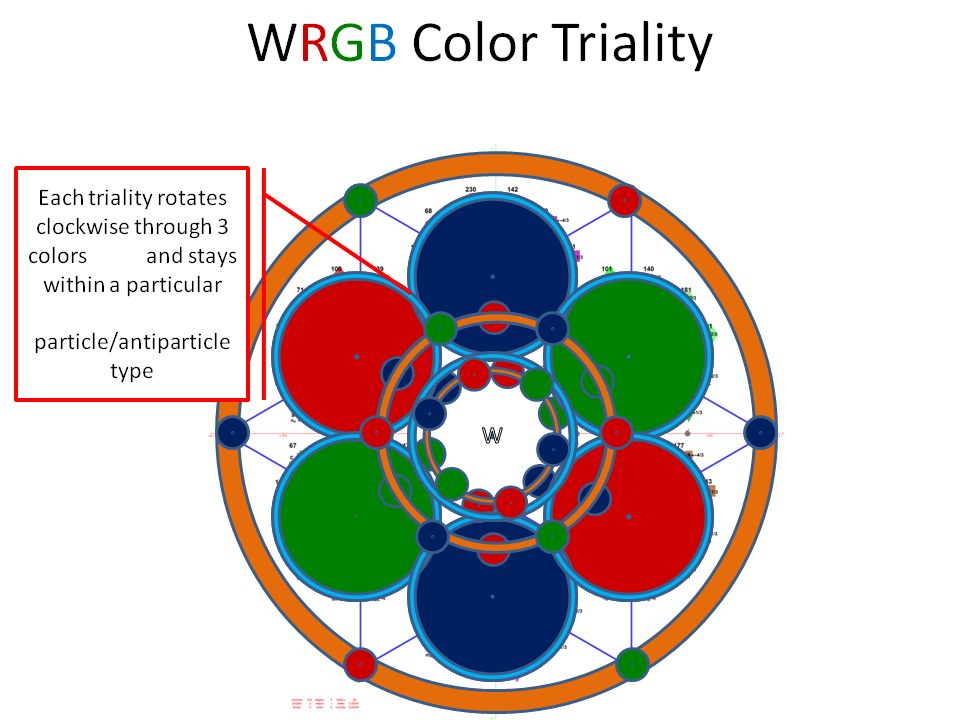
The underlying quantum symmetry patterns within this coordinate system are:
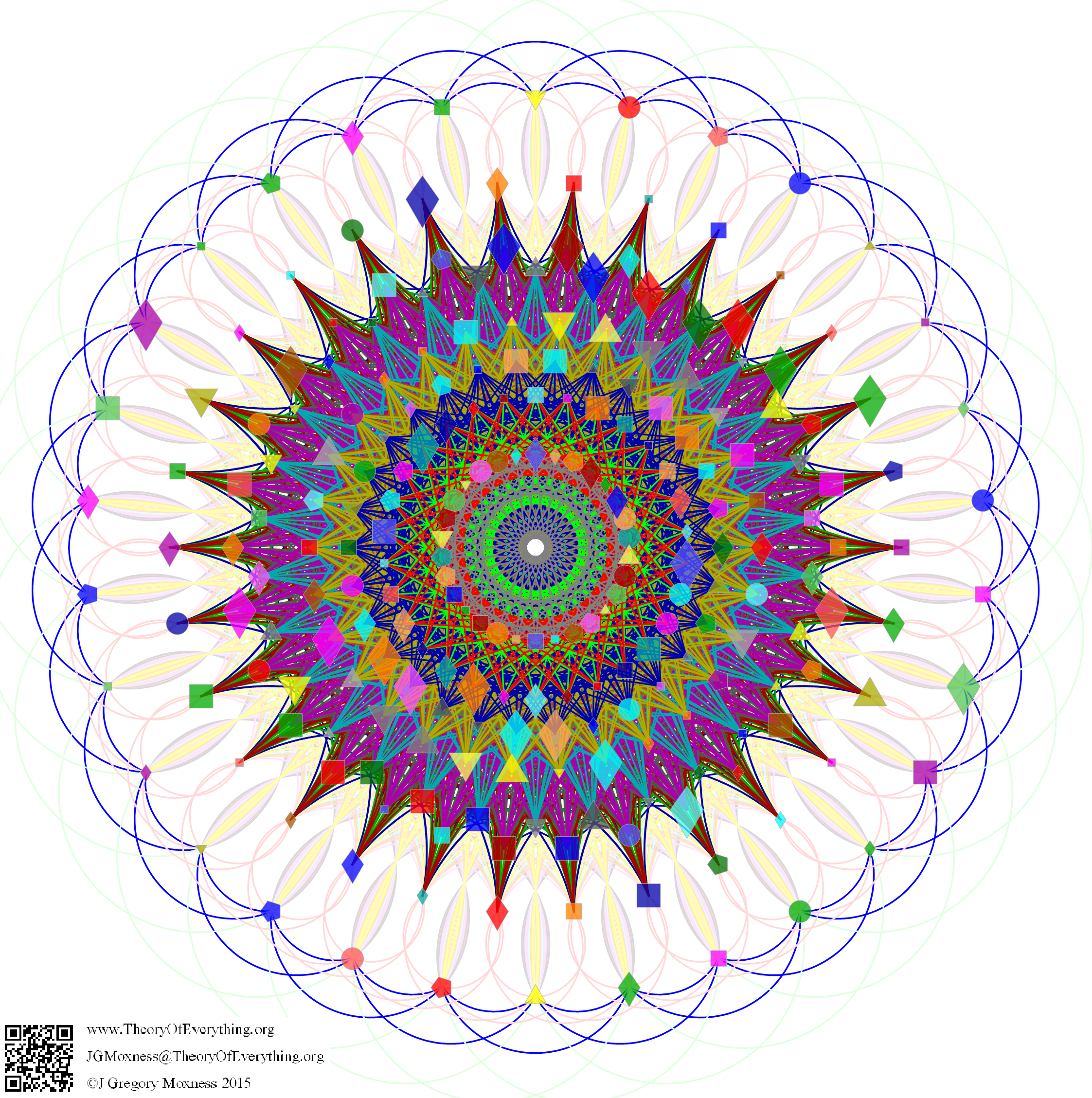
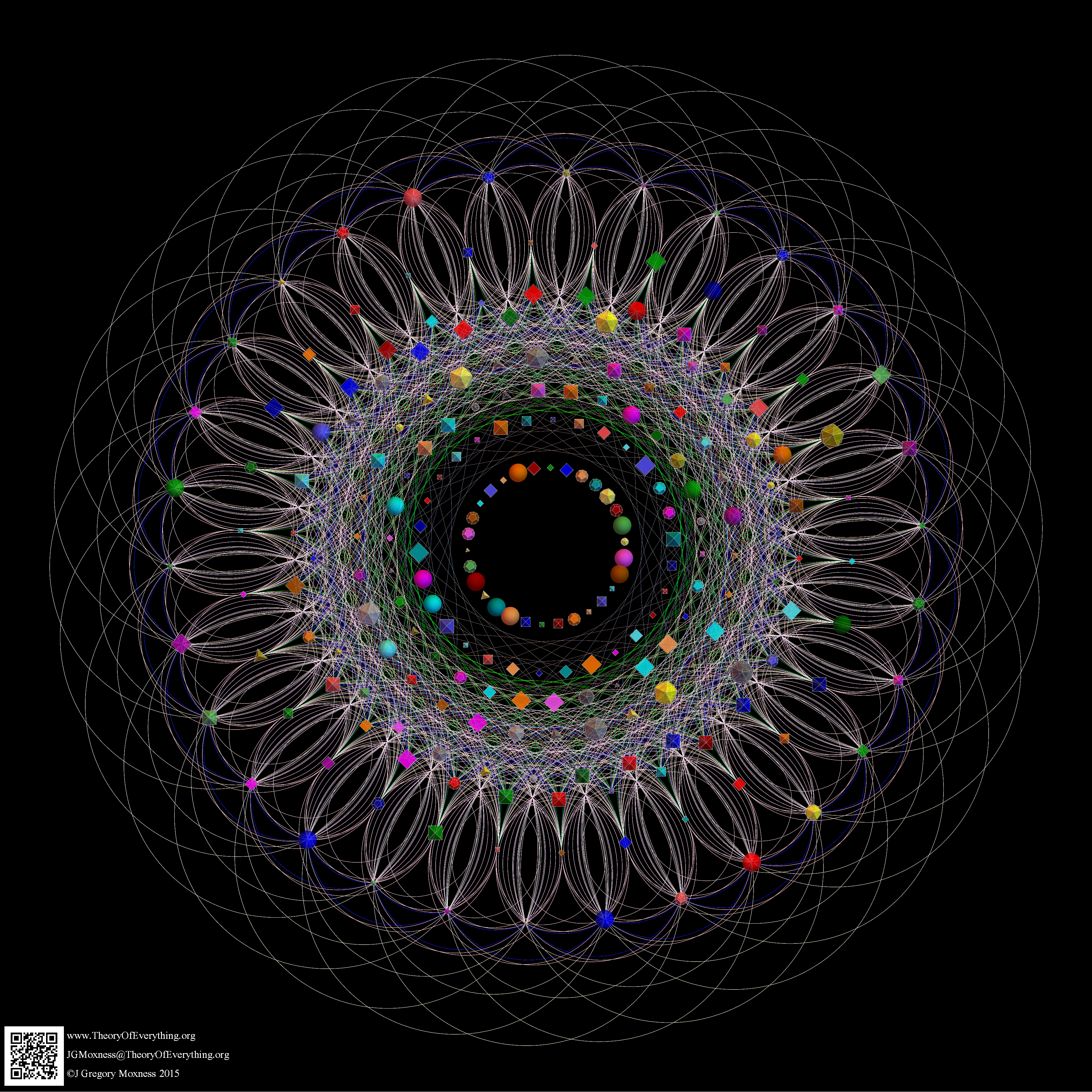
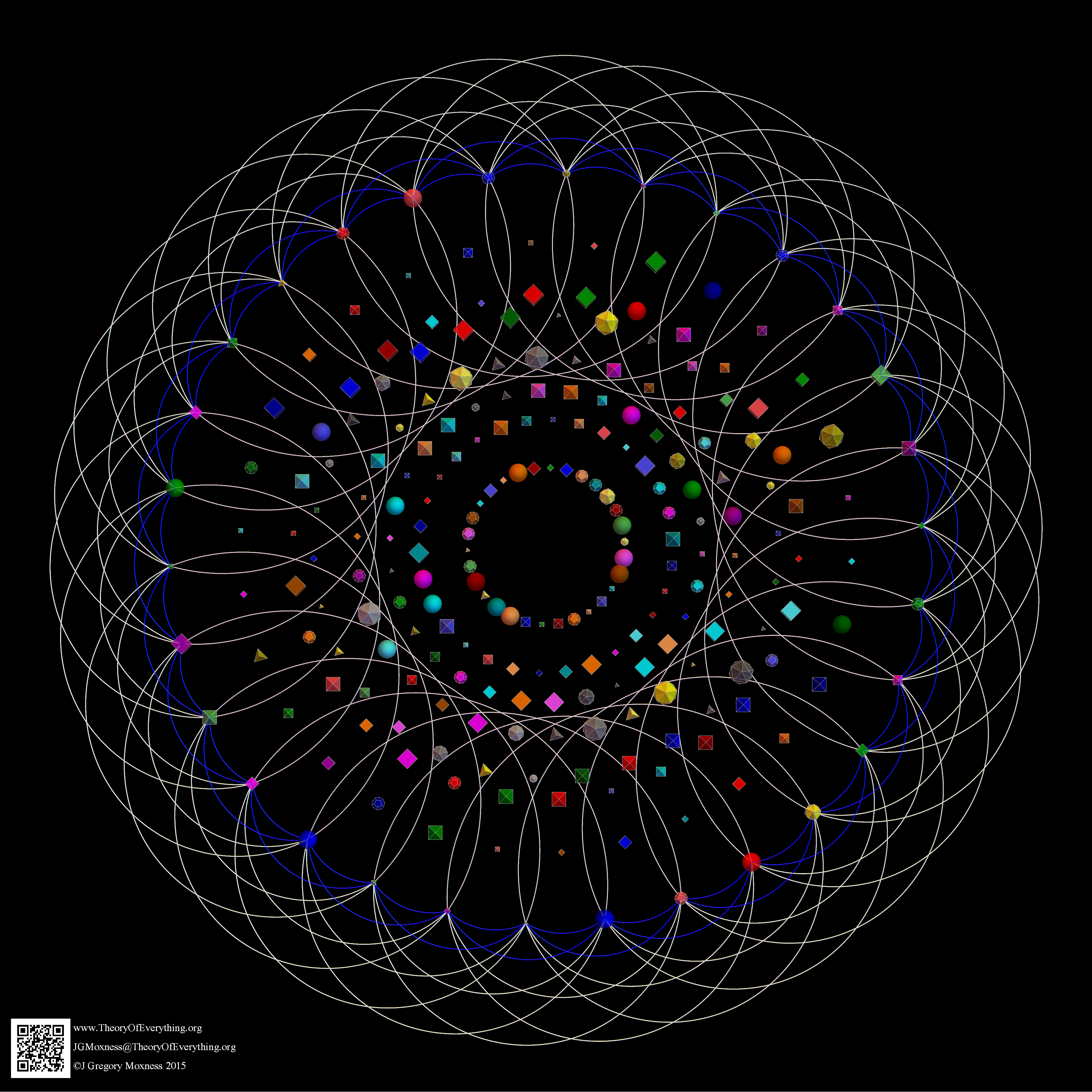
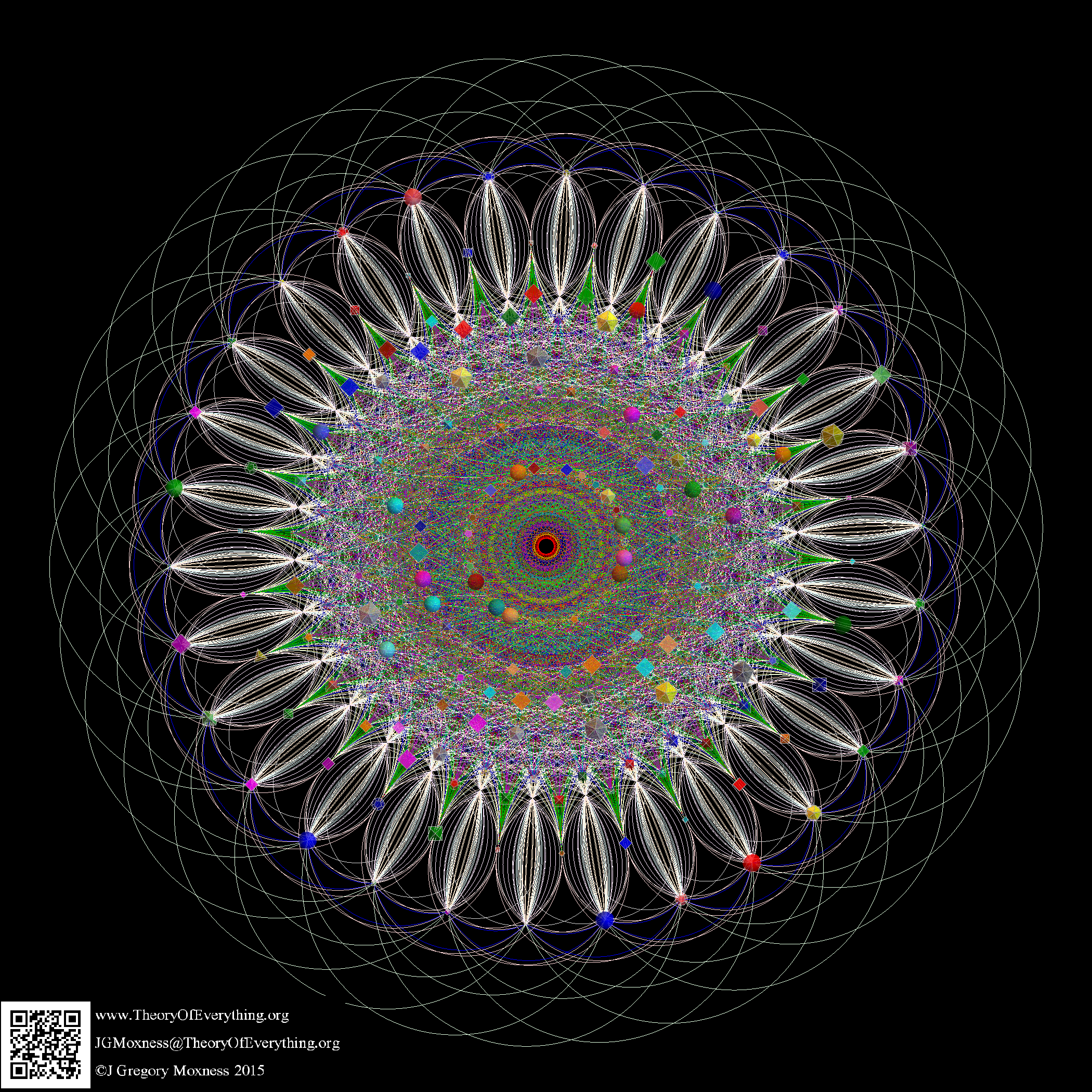
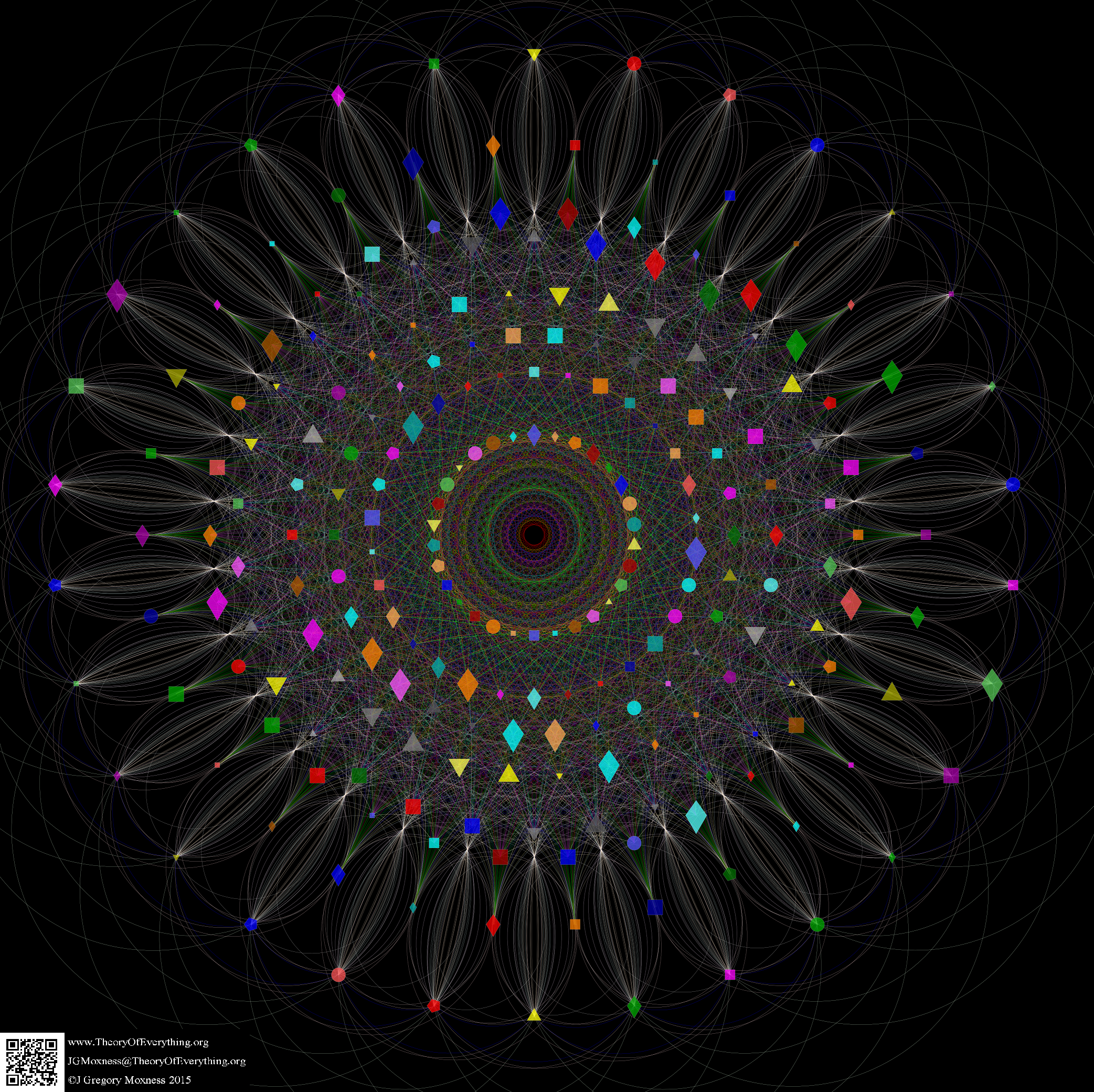
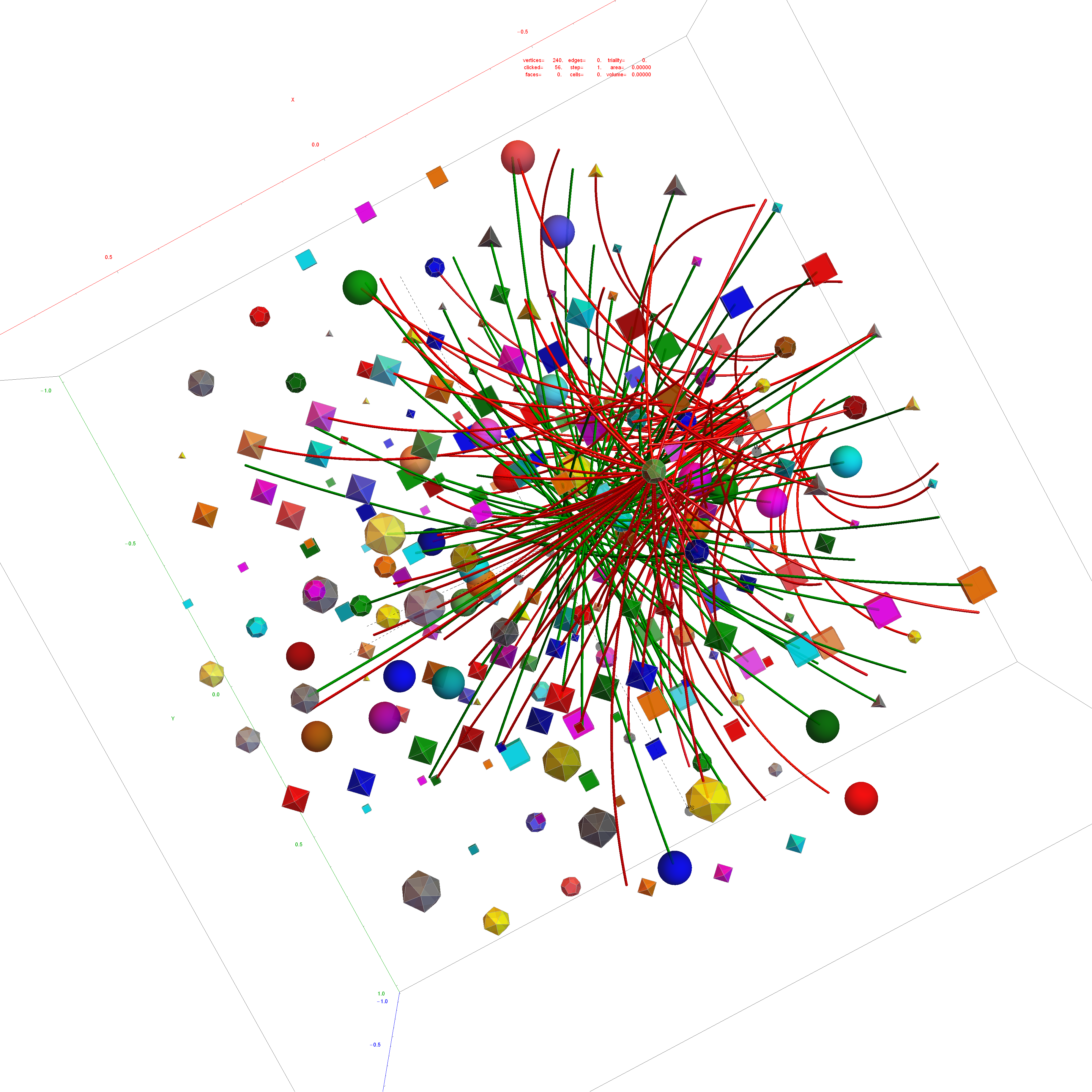
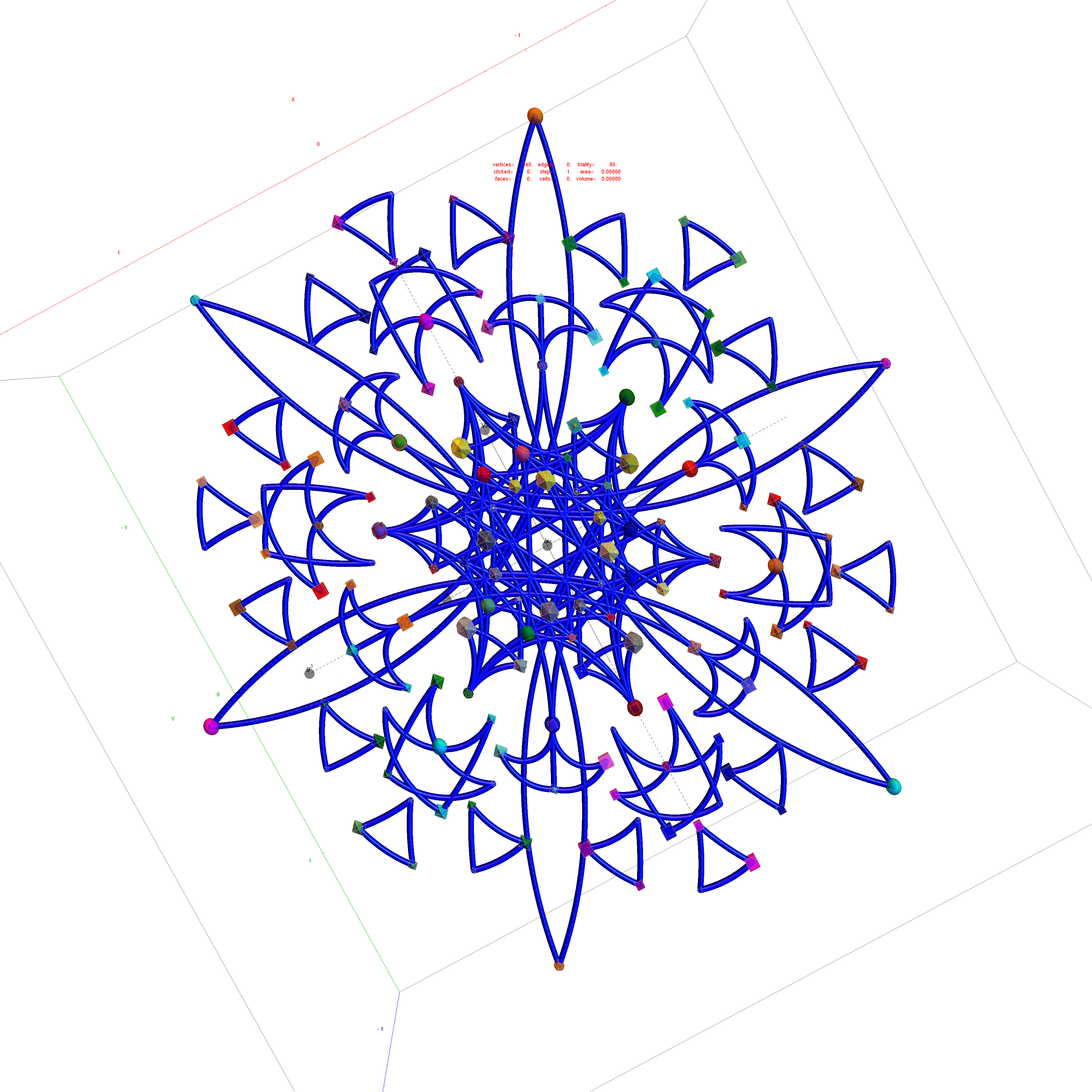
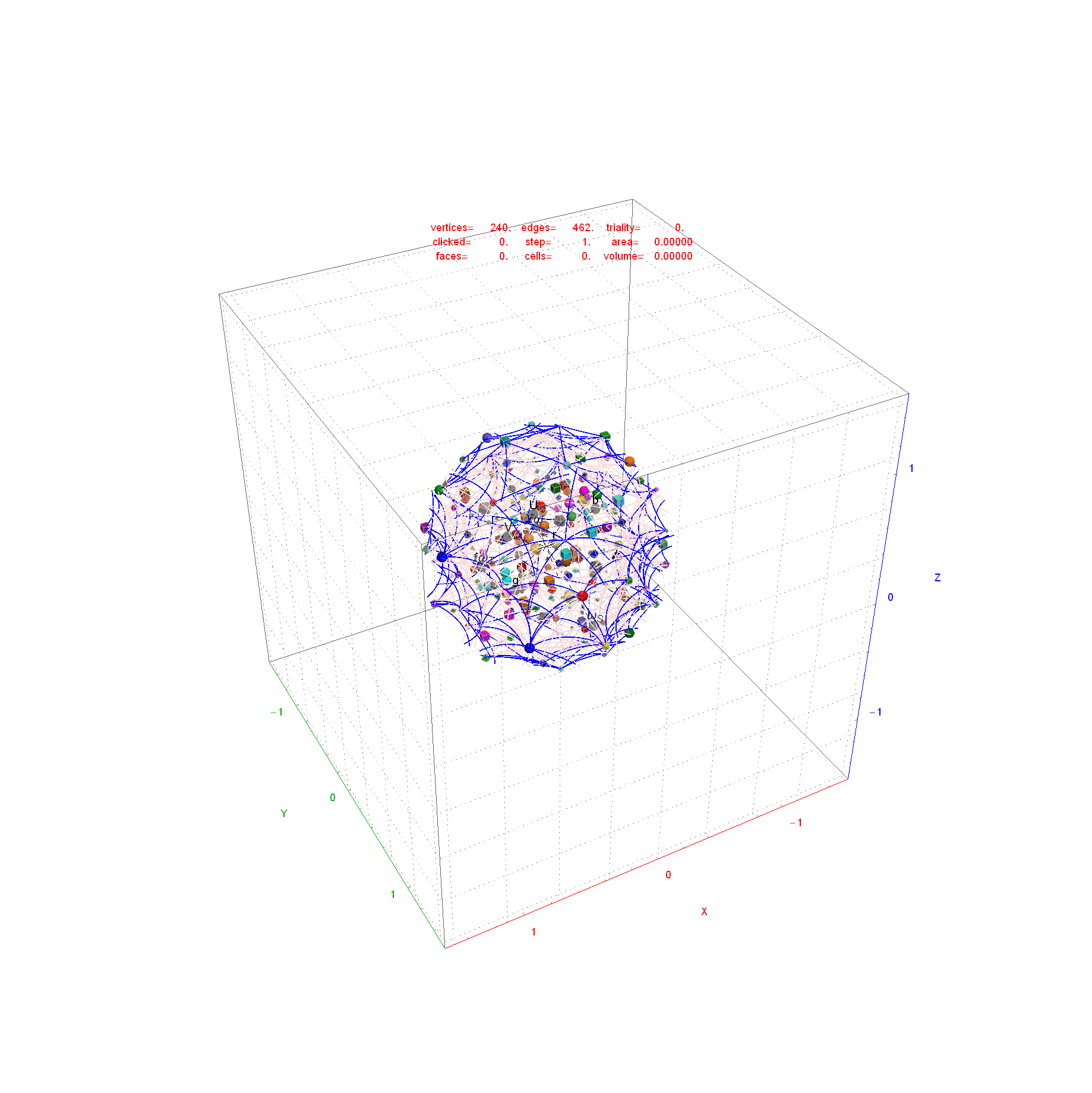
Beginning to play with visualizing E8 and subgroups using hyperbolic Poincare projections and tiling – in 2D/3D/nD
Copyright 2015 J Gregory Moxness