The newer version of the VisibLieE8-NewDemo-v13.nb (130 Mb) will work with those who have a full Mathematica v13 license. It is backward compatible to earlier versions. There are a few bug fixes from the older version of ToE_Demonstration.nb (130 Mb), which should work on v13 and older versions as well.
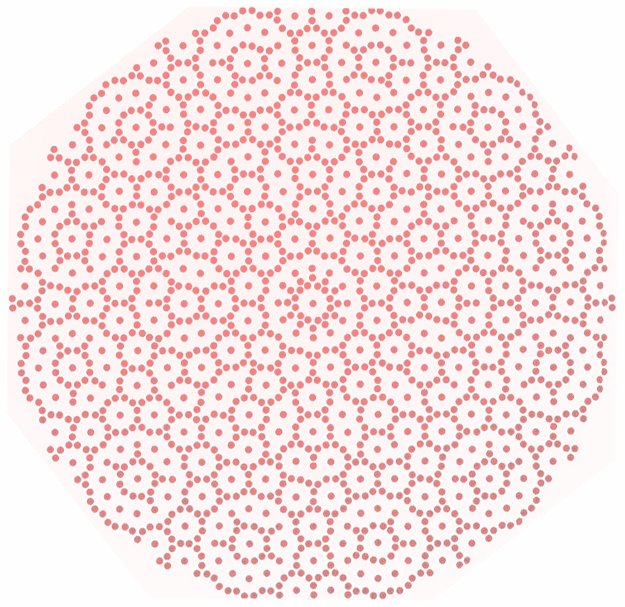
This post is an analysis of a June 2013 paper by Mehmet Koca, Nazife Koca, and Ramazan Koc. That paper contains various well-known Coxeter plane projections of hyper-dimensional polytopes as well as a new direct point distribution of the quasicrystallographic weight lattice for E6 (their Figure 3), as well as the quasicrystal lattices of B6 and F4.
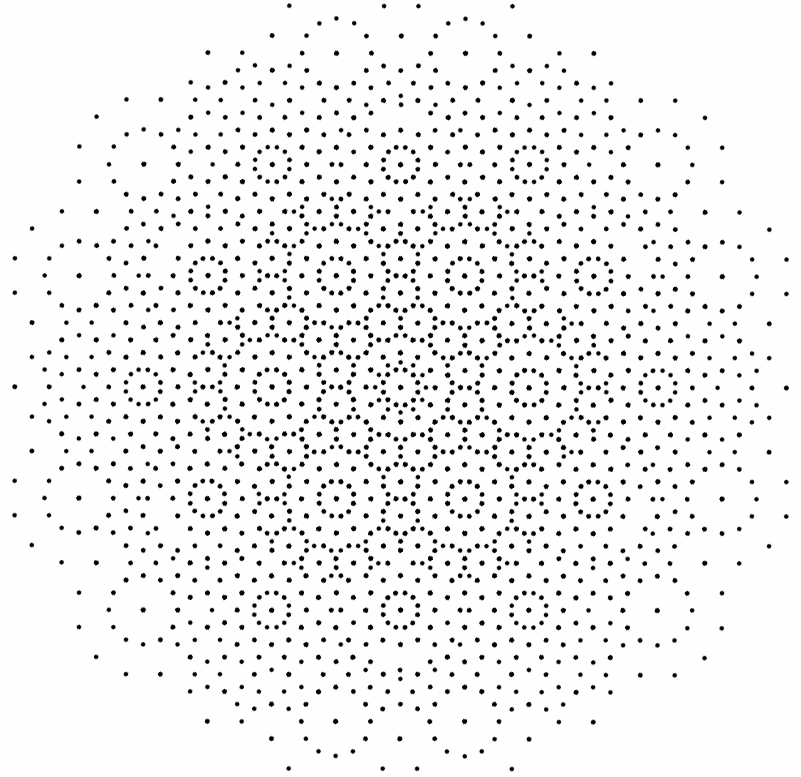
What is interesting about this projection is that it precisely matches the point distribution (to within a small number of vertices) from a rectified E8 projection using a set of basis vectors I discovered in December of 2009, published in Wikipedia (WP) in February of 2010 here.
Rectification of E8 is a process of replacing the 240 vertices of E8 with points that represent the midpoint of each of the 6720 edges. In this projection, there are overlaps which are indicated by different colors in the color-coded WP image linked above.
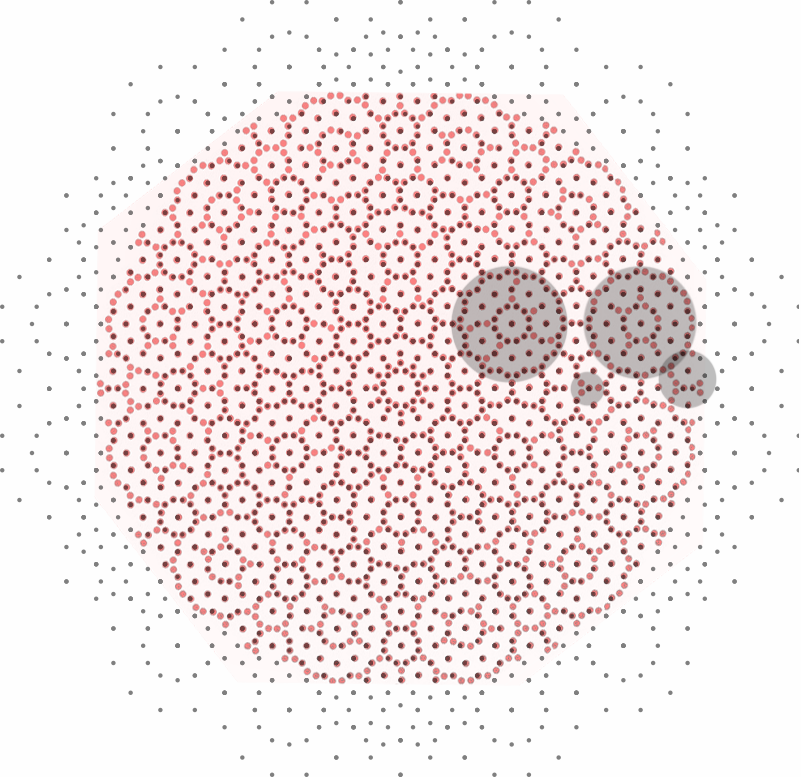
The image below is an overlay of the above images highlighting the 12*(9+3+26+7)=540 points that are not overlapping:
Given the paper’s explanation for the methods using E6 (720) with 6480 edges as a projection through a 4D 3-sphere window defined by q1 and q6, it may be insightful to study my projection basis for E8’s triality relationships with the Koca/Koc paper’s defined 4D 3-sphere.
For more information on why my projection basis is called the E8 Triality projection, see this post.
For the latest (as of 09/23/2024) on the topic see this post.
I’ve updated an analysis I did on the work of Cohl Furey’s papers from several years ago. Since then, she added another paper: https://arxiv.org/abs/1910.08395v1
The short pdf version of my analysis (with some detail cells collapsed) is here (34 pages), and a longer version is here (no collapsed cells and 51 pages). These pdf’s are a direct output from my Mathematica (MTM) Notebook. I will follow up with a LaTex paper on the topic soon.
This notebook has code built in to operate symbolically on native MTM reals, complexes, and quaternionic forms, as well as my custom code to handle the octonions, and now the bi-octonions (which doesn’t assign the octonion e1 to be equivalent to the complex imaginary (I)). That change also applies to the native quaternion assignments where of e1=I, e2=J, and e3=K in order to work with quater-octonions. This was a fairly trivial change to make since it simply involves removing the conversion of complex (and quaternion) operators from being involved in the octonionic multiplication.
Please note that my previous analysis here (from Feb. 2019) made the mistake of not commenting out these operations. As such, it was operating on octonions (not complexified bi-octonions), so some of my concerns were resolved based on correcting that error.
The bottom line is that I did validate much of the work presented in the referenced papers, with the exception of some 3 generation SM charge (Q) assignments in that latest paper (Oct. 2019).
I am very interested here in the suggestion at the very end of that paper [5] in the Addendum Section IX(B/C) on Multi-actions splitting spinor spaces, Lie algebras/groups, and Jordan algebras. I suspect having the ability to create a machine (i.e. a symbolic engine such as MTM) to operate on and visualize these structures as hyper-dimensional physical elements is critical to making progress in understanding our Universe more thoroughly.
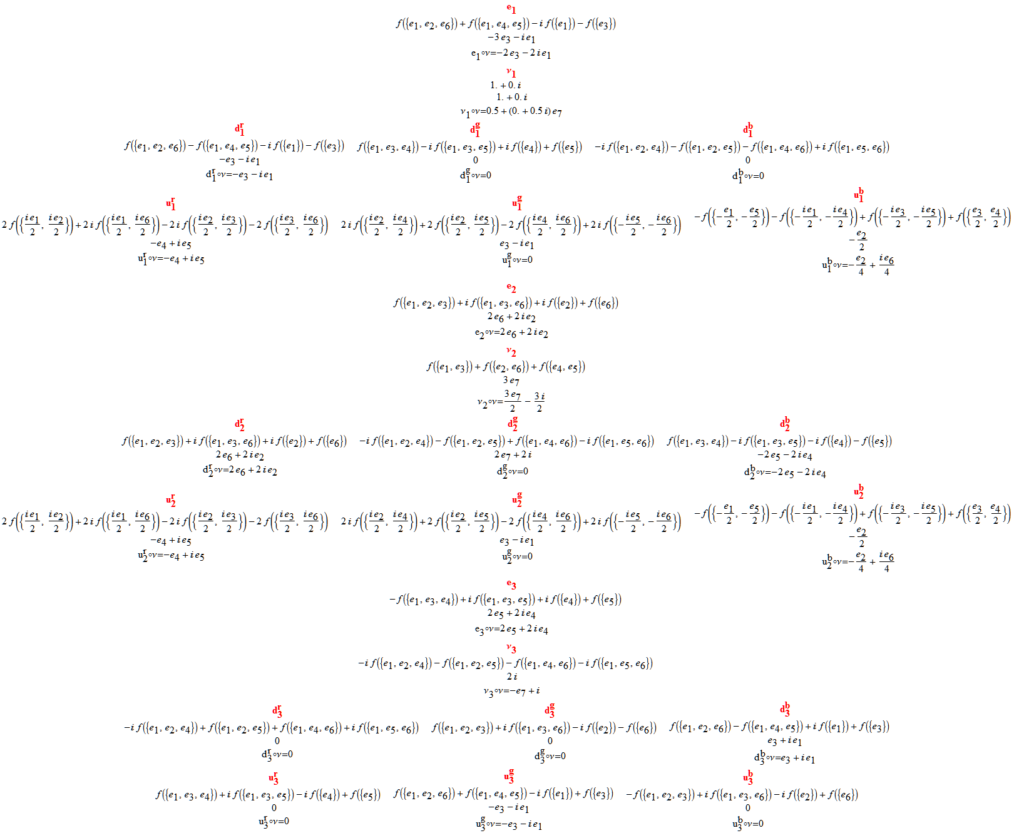
While I have had some success in replicating quark color exchange, as well as flavor changes (e.g. green u2 to d3 quark exchange using g13), there doesn’t seem to be a complete description of how to construct each of those color and flavor exchange actions from the examples given. So for reference I present all possible combinations of these actions across the particle/anti-particle definitions (see the image linked in the last paragraph of this post). This comment about limited examples also applies to replicating the 3 generation charge (Q) calculation using the sS constructs mentioned above.
I welcome any help or advice or additional examples.
Below is an example image of the 3 generation SM from the 2019 paper built from bi-octonions (with my octonion multiplication table reductions applied. The anti-particles (not shown) are simply the complex-conjugate of these. While I show in string form of Q, I am not showing the commutations based evaluations for them due to the questions / issues I have on how to get it to work.
The image below shows more detail of the 3 generation SM from 2014 with my code implementing the reductions. This leaves off the charge (Q) which was not defined as above in 2014 (AFAIK).
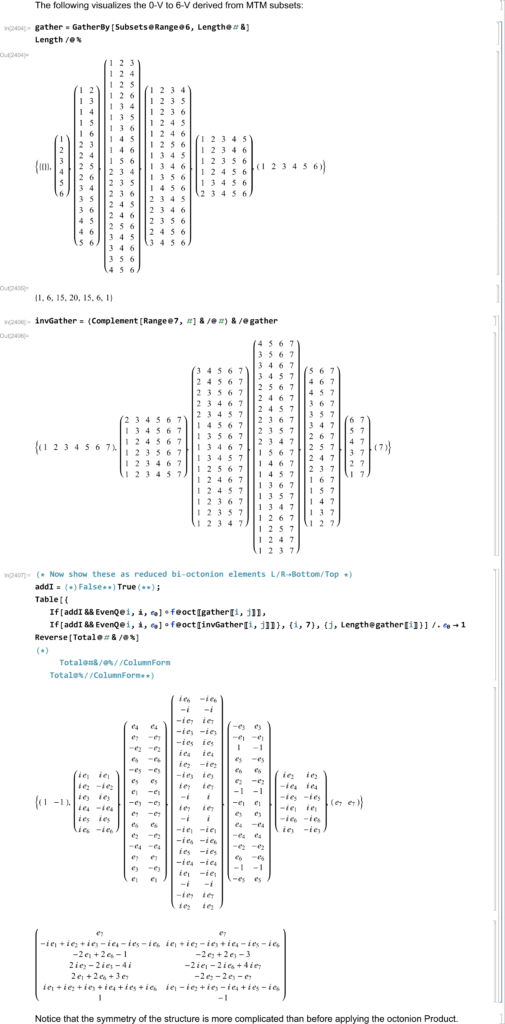
The image below shows a simple construction of the 0-V to 6-V splitting of the Mf Clifford algebraic structures, which I generated using MTM Subsets:
The rather large (long) image here checks all SM particle color and flavor changing actions and includes the anti-particles. The output is extensive and given my open questions on the formalism presented, the accuracy likely deviates from the intent of [5], but it is interesting to show how everything transforms. If no transform is found for a particular action, it outputs an * for that action. If a color or flavor changing transformation action is found, it identifies that action with the list of particles to which the transformation applies. Note: it only identifies a transformed particle if the source particle has a non-zero reduced value and the resulting match is exact (red) or a +/- integer factor of that particle (blue).