Tag Archives: Physics

My Latest paper published on Vixra – 3D Polytope Hulls of E8 4_21, 2_41, and 1_42

https://vixra.org/pdf/2005.0200v1.pdf

or also available directly from this website:

https://theoryofeverything.org/TOE/JGM/3D_Polytope_Hulls_of_E8-421-241-142.pdf

Using rows 2 through 4 of a unimodular 8x8 rotation matrix, the vertices of E8 421, 241, and 142 are projected to 3D and then gathered & tallied into groups by the norm of their projected locations. The resulting Platonic and Archimedean solid 3D structures are then used to study E8’s relationship to other research areas, such as sphere packings in Grassmannian spaces, using E8 Eisenstein Theta Series in recent proofs for optimal 8D and 24D sphere packings, nested lattices, and quantum basis critical parity proofs of the Bell-Kochen-Specker (BKS) theorem.

A few new Figures from the paper.

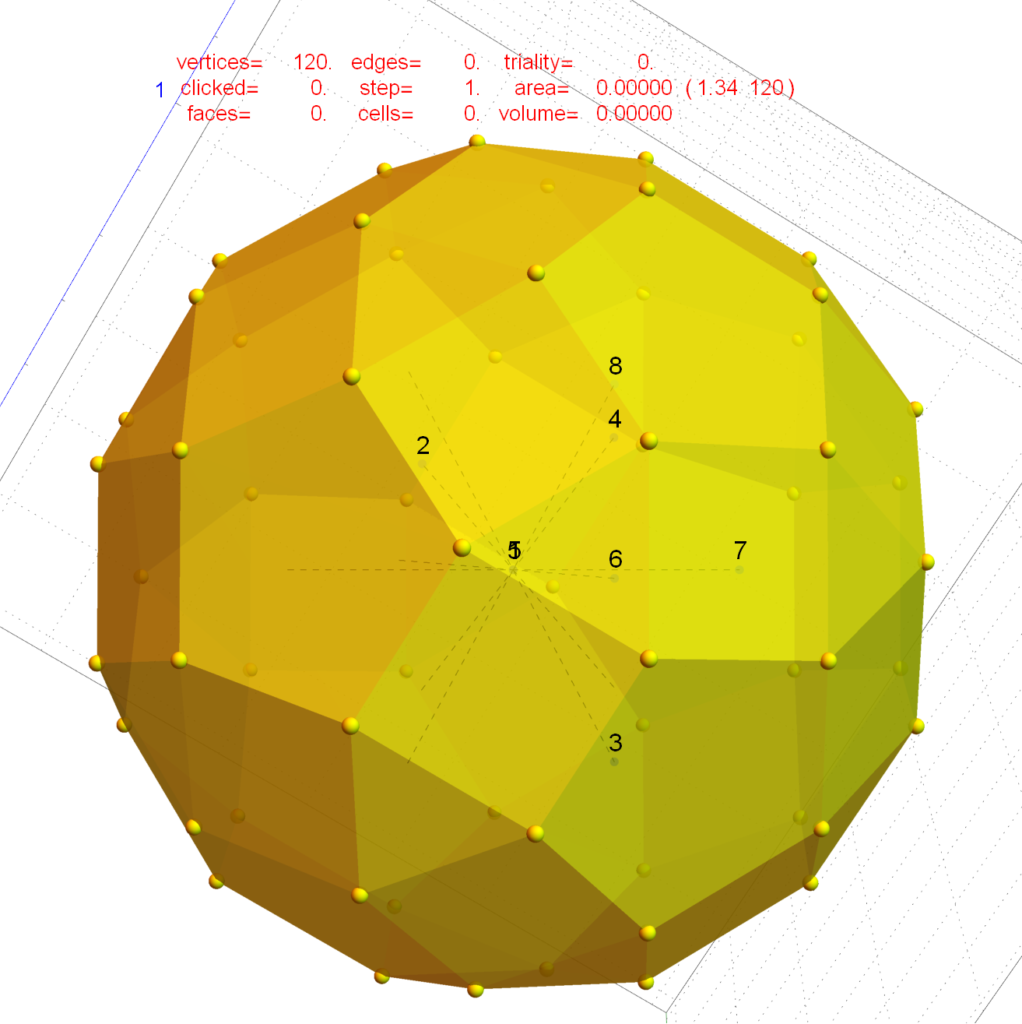
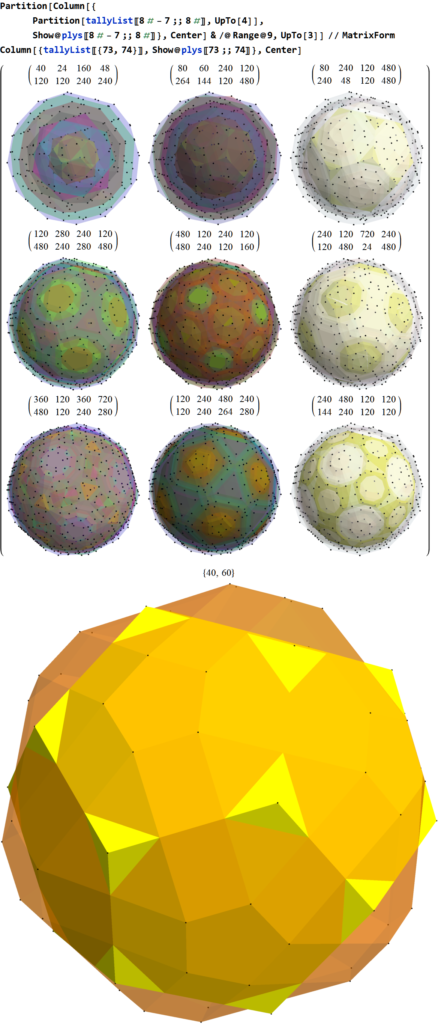
FIG. 6: Pair of overlapping rhombicosidodecahedrons from
3rd largest hull of the 74 hulls in 142
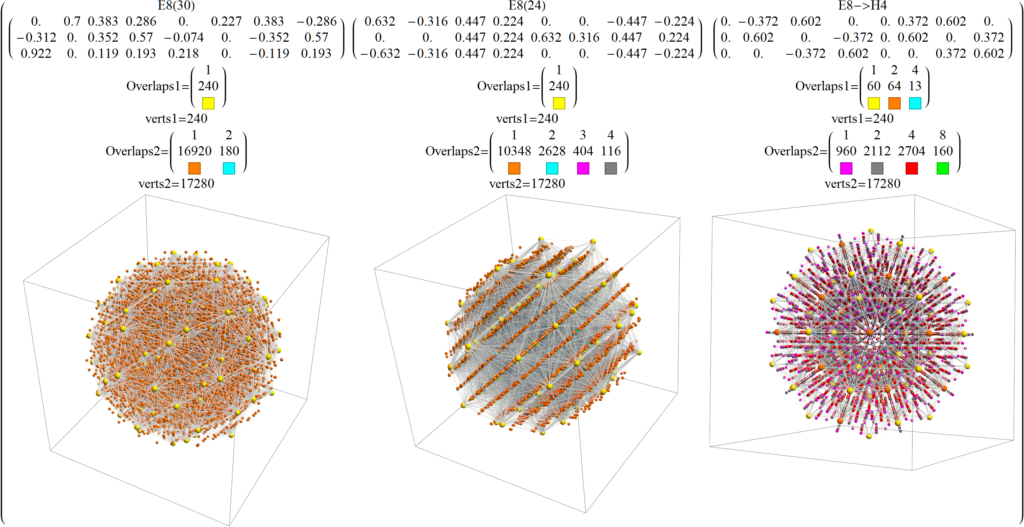

FIG. 13: 421 & Polytope projected to various 3D spaces
Each 3D projection shown lists the projection name, the nu-
meric basis vectors used, and the 421 & 142 overlap color coded
vertex groups, and the projection with vertices (larger) &
6720 edges and the 142 vertices (smaller)
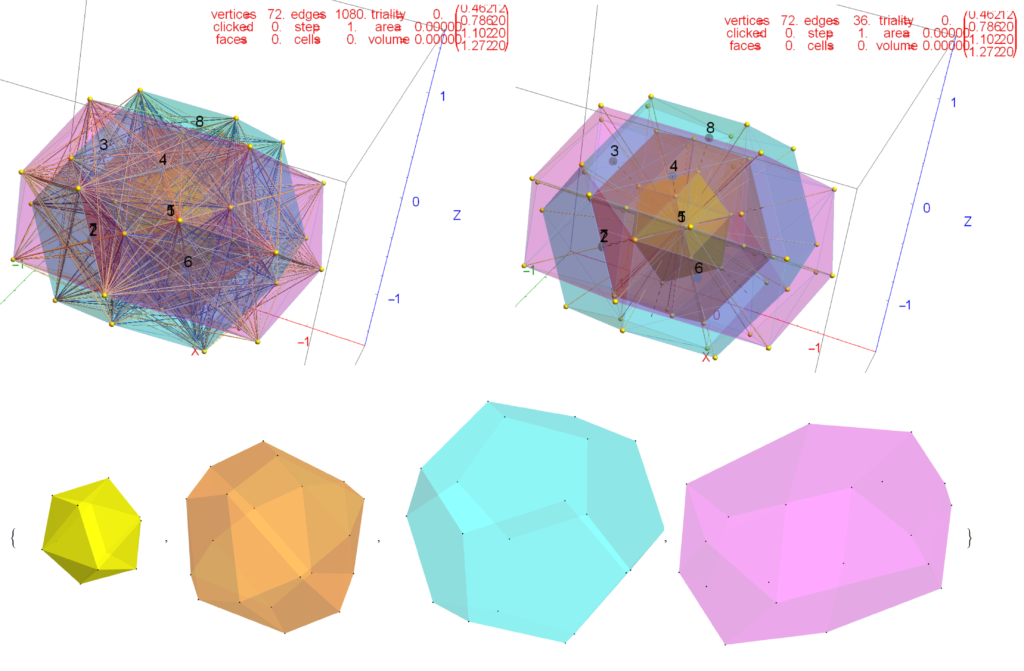
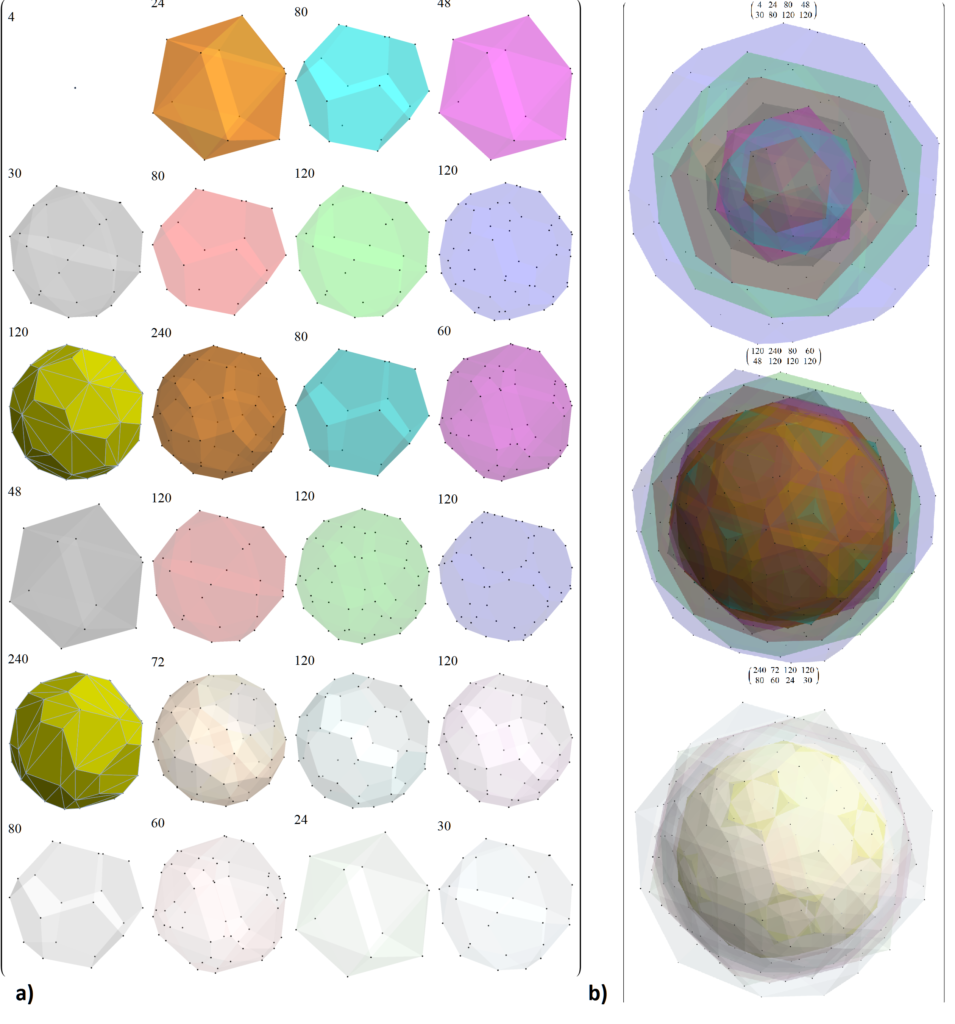
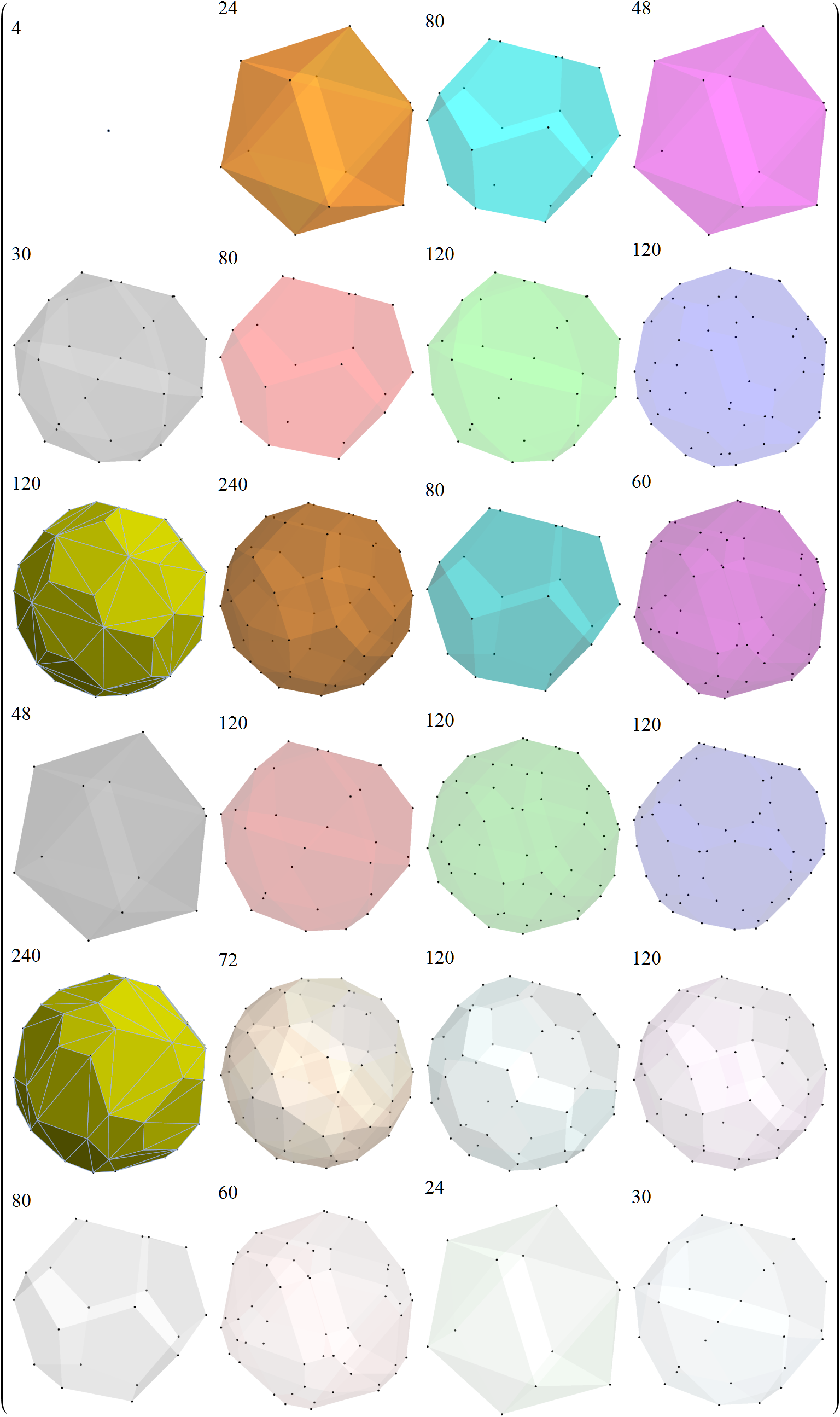
FIG. 14: Concentric hulls of 241 in Platonic 3D projection
with vertex count in each hull and increasing opacity and
varied surface colors.
a) 24 individual concentric hulls
b) In groups of 8 hulls
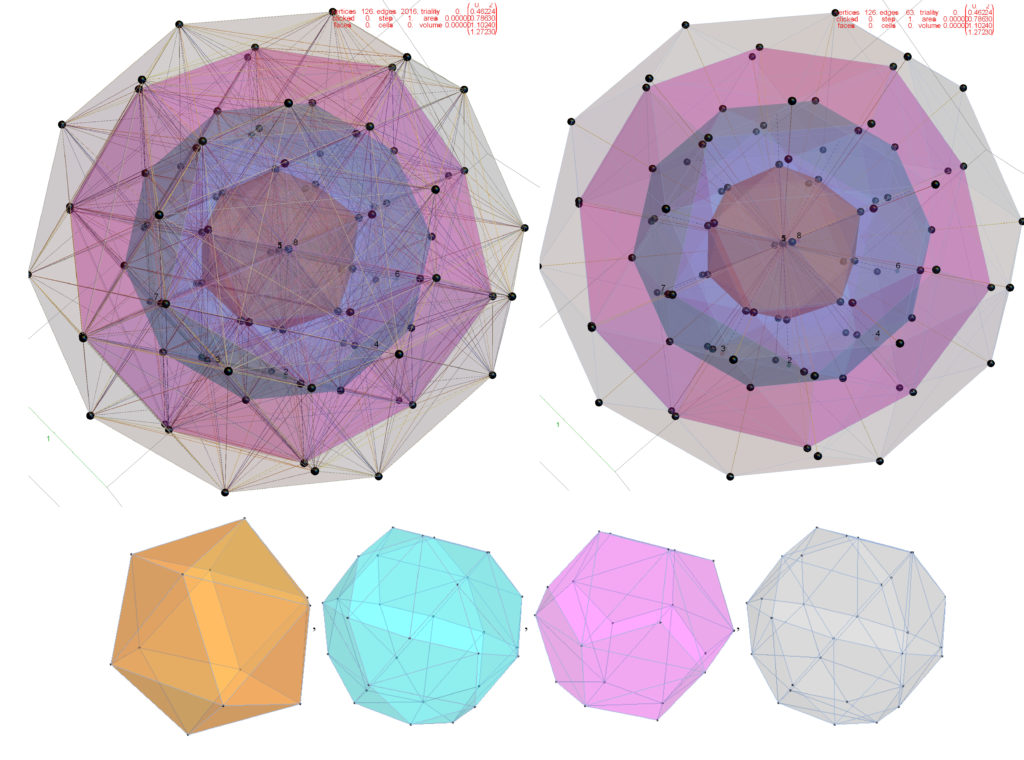
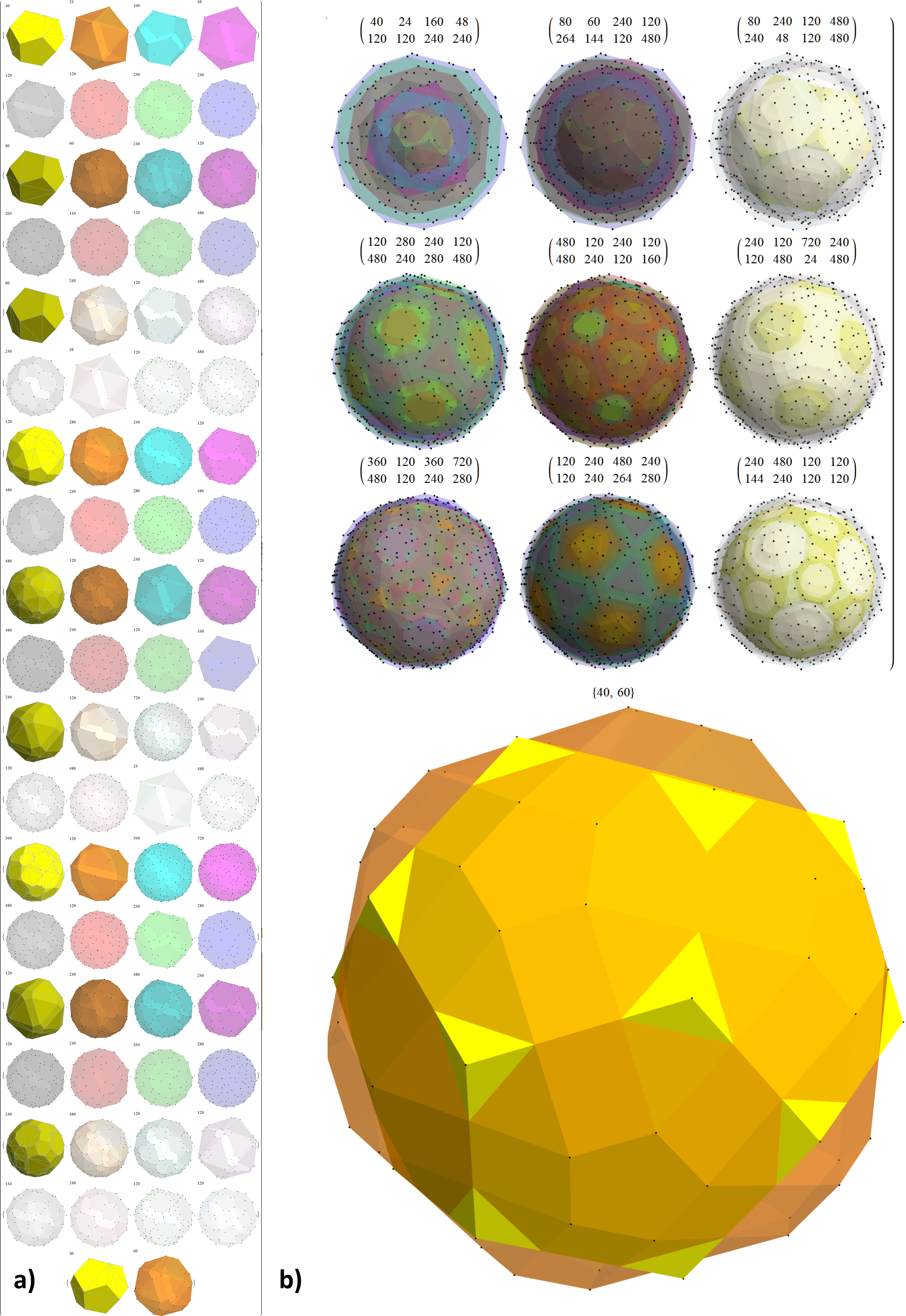
FIG. 15: Concentric hulls of 142 in Platonic 3D projection
with vertex count in each hull and increasing opacity and
varied surface colors.
a) 74 individual concentric hulls
b) In groups of 8 hulls
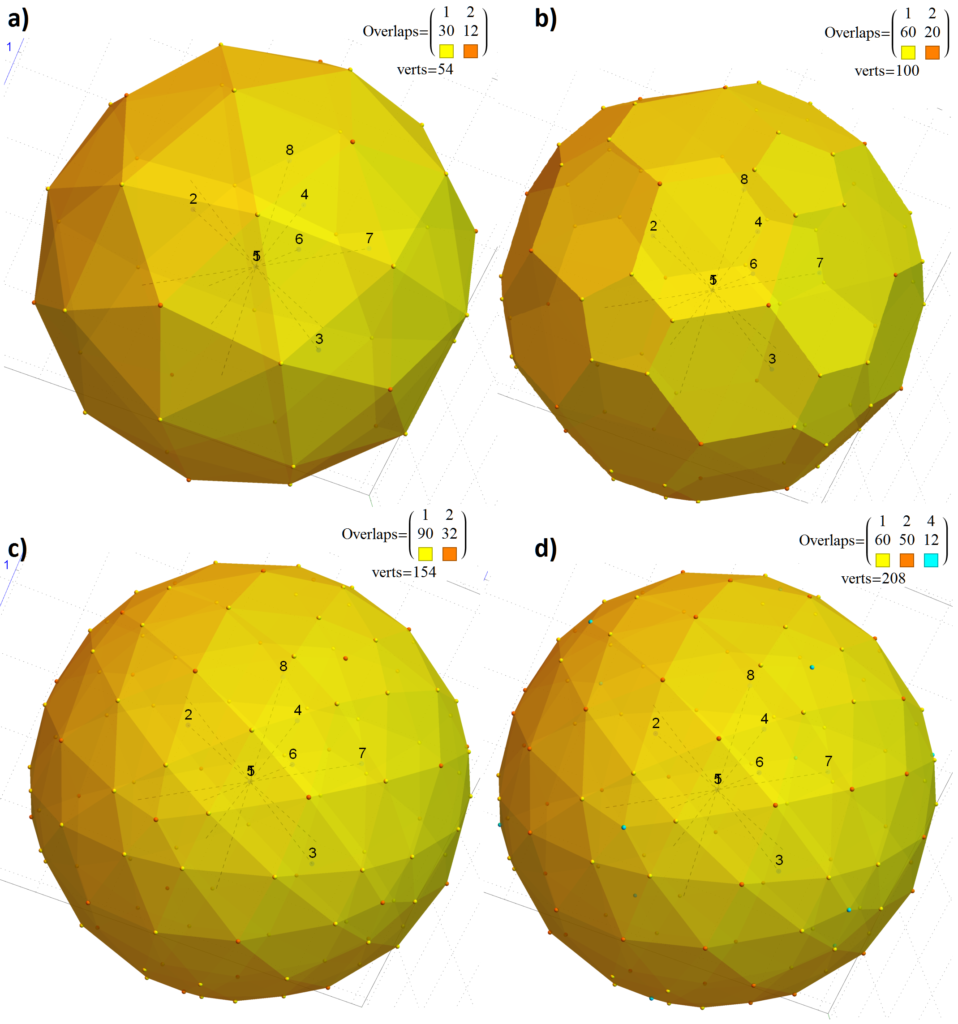
FIG. 18: E8’s outer two hulls scaled to unit norms in Platonic
3D projection with vertex counts color coded by overlaps
a) 54 vertex (42 unique) 421=241 icosidodecahedron (30 yel-
low) & two overlapping icosahedrons (12 red) scaled 1.051
b) 100 vertex (80 unique) 142 non-uniform rhombicosidodeca-
hedron (60 yellow) & two overlapping dodecahedrons (20 red)
scaled 1.0092
c) 154 vertex (122 unique) combination of a & b
d) 208 vertex (122 unique) combination same as c with color
coded vertex counts for both 421 & 241
Note: The internal numbers of the image are the 8 axis (pro-
jection basis vectors).

Now for a few new visualizations that are not in the paper…

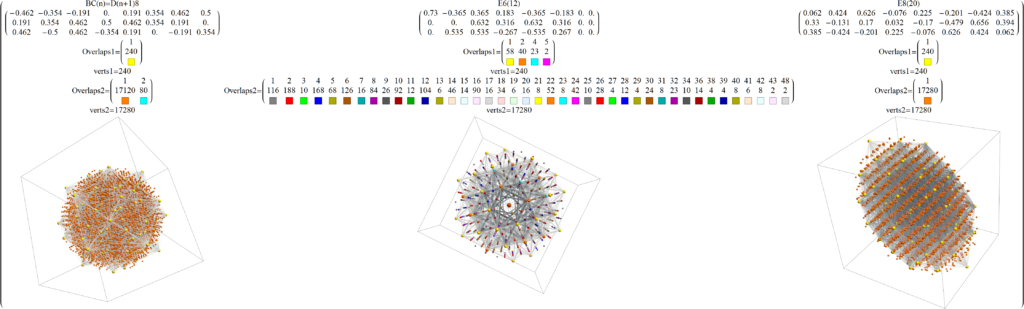
Various 3D projections of 2_41
Various 3D projections of 4_21

3D visualization of E8 1_42 polytope

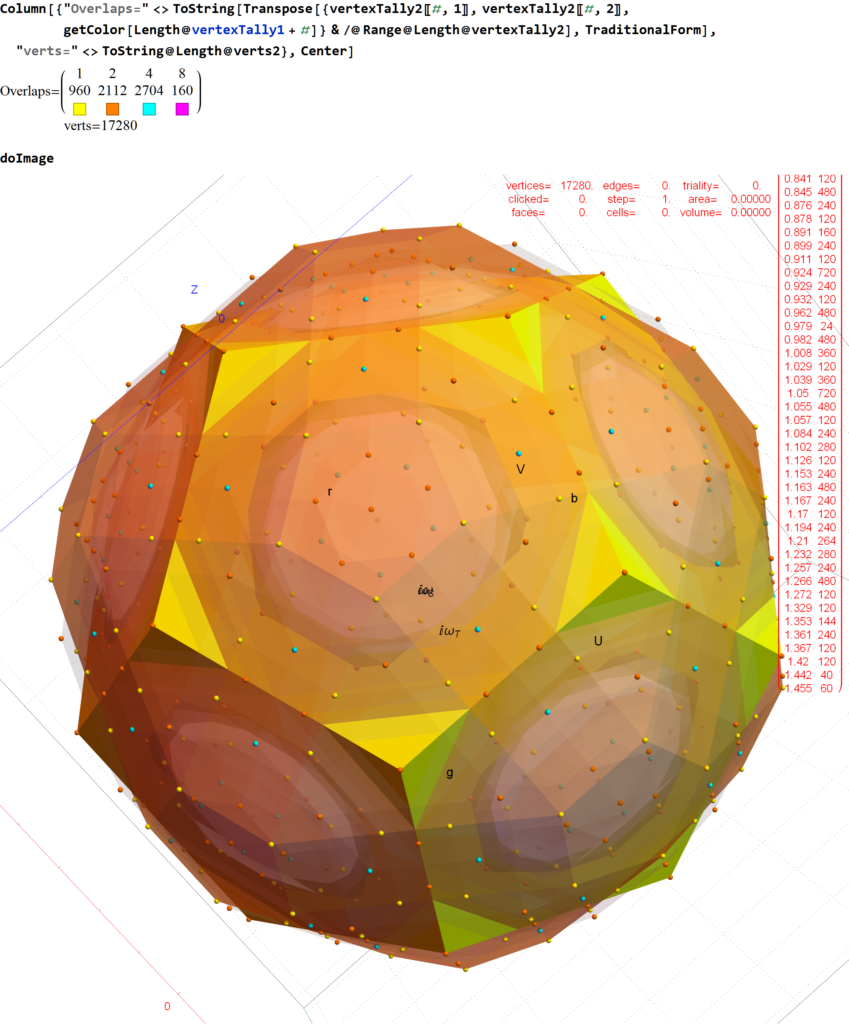
This is what I expect to be the first ever 3D visualization of the E8 1_42 polytope with 17280 vertices showing concentric hulls of Platonic solid related structures!

E8 1_42 polytope with 17280 vertices showing concentric hulls of Platonic solid related structures! Vertex colors represent the overlap counts.
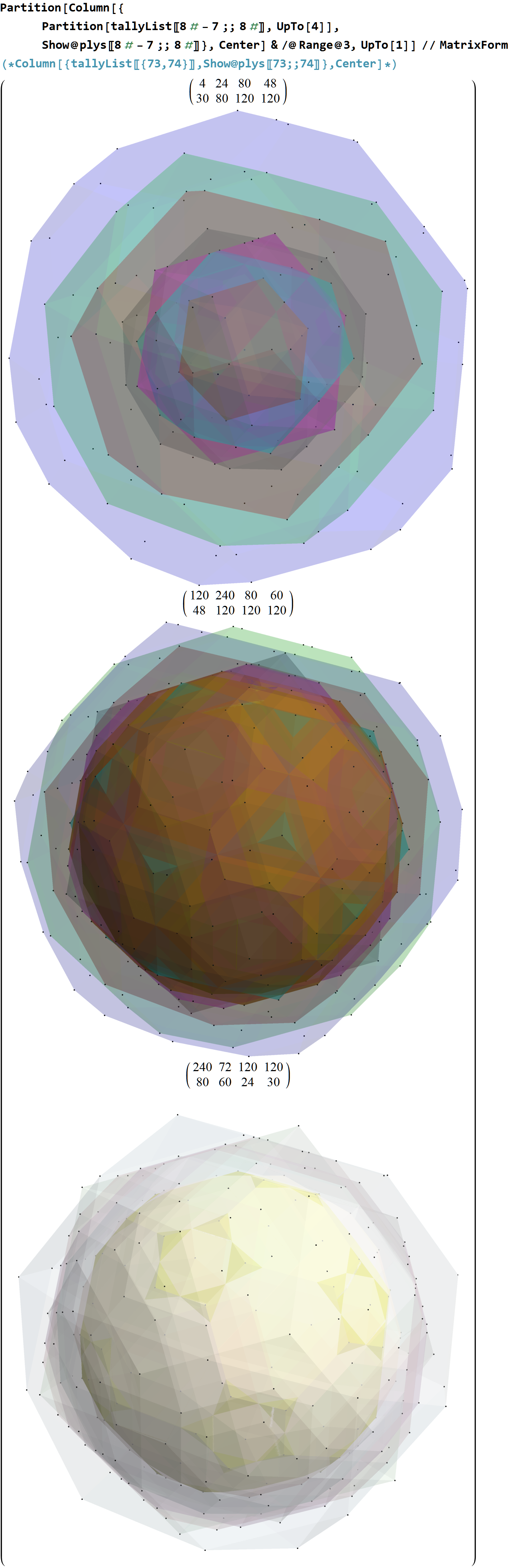
Each of 74 concentric hulls based on 3D Norm’d vertex positions (with varying opacity in sets of 8). Vertex counts in each hull listed above.
9 sets of 8 concentric hulls plus the last 2 outer hulls, Vertex counts in each
of 8 hull listed above. Notice this is a combination of two overlapped dodecahedrons (40) and a Nonuniform Rhombicosidodecahedron (60).

For the sake of completeness in visualization, see below for various projections to 2D. Click these links for a higher resolution PNG or the SVG version.

Nested Lattices of E8 in Complex Projective 4-Space

I read an interesting article about a pattern discovered by Warren D. Smith (discussed at length here):

“The sum of the first three terms in the Eisenstein E_4(q)  Series Integers of the Theta series of the E8 lattice is a perfect fourth power: 1 + 240 + 2160 = 2401 = 7^4”

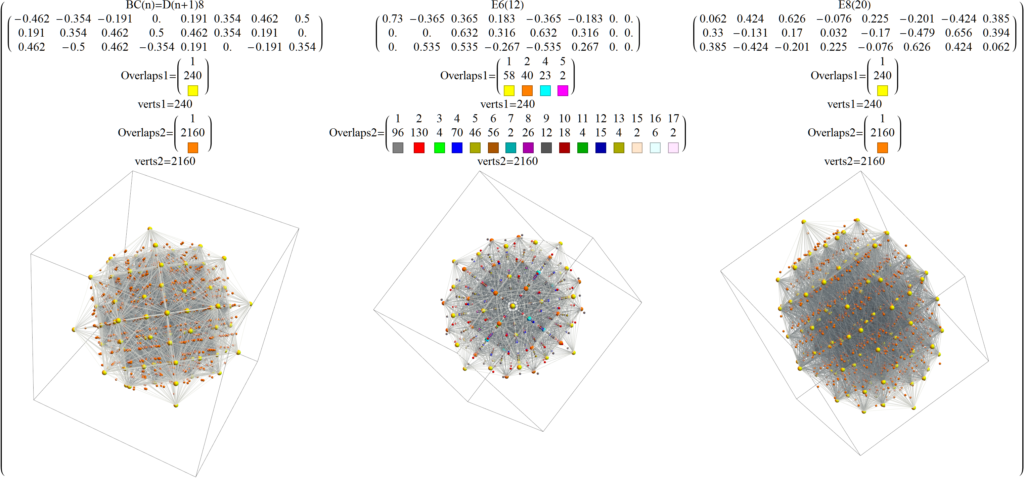
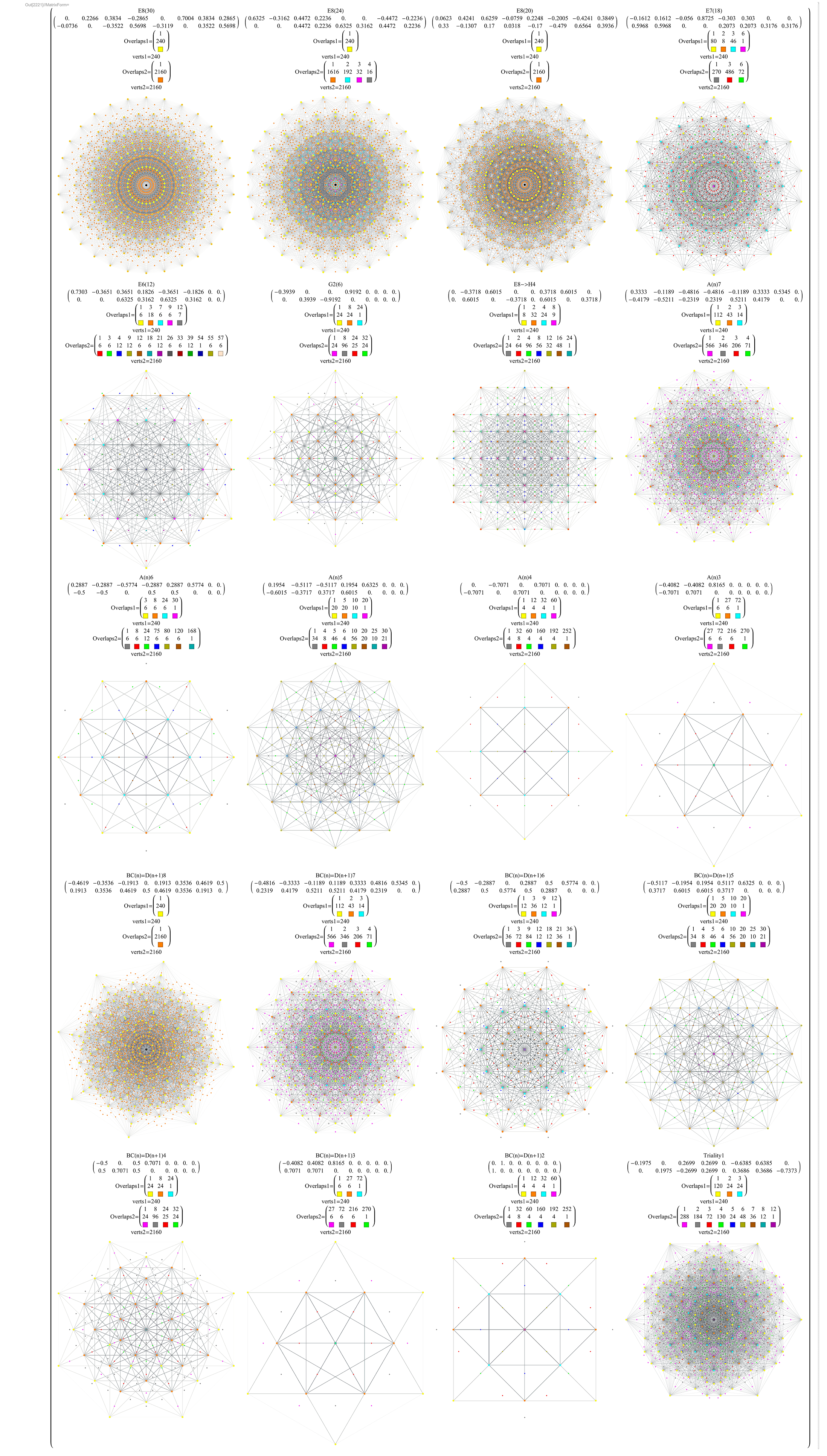
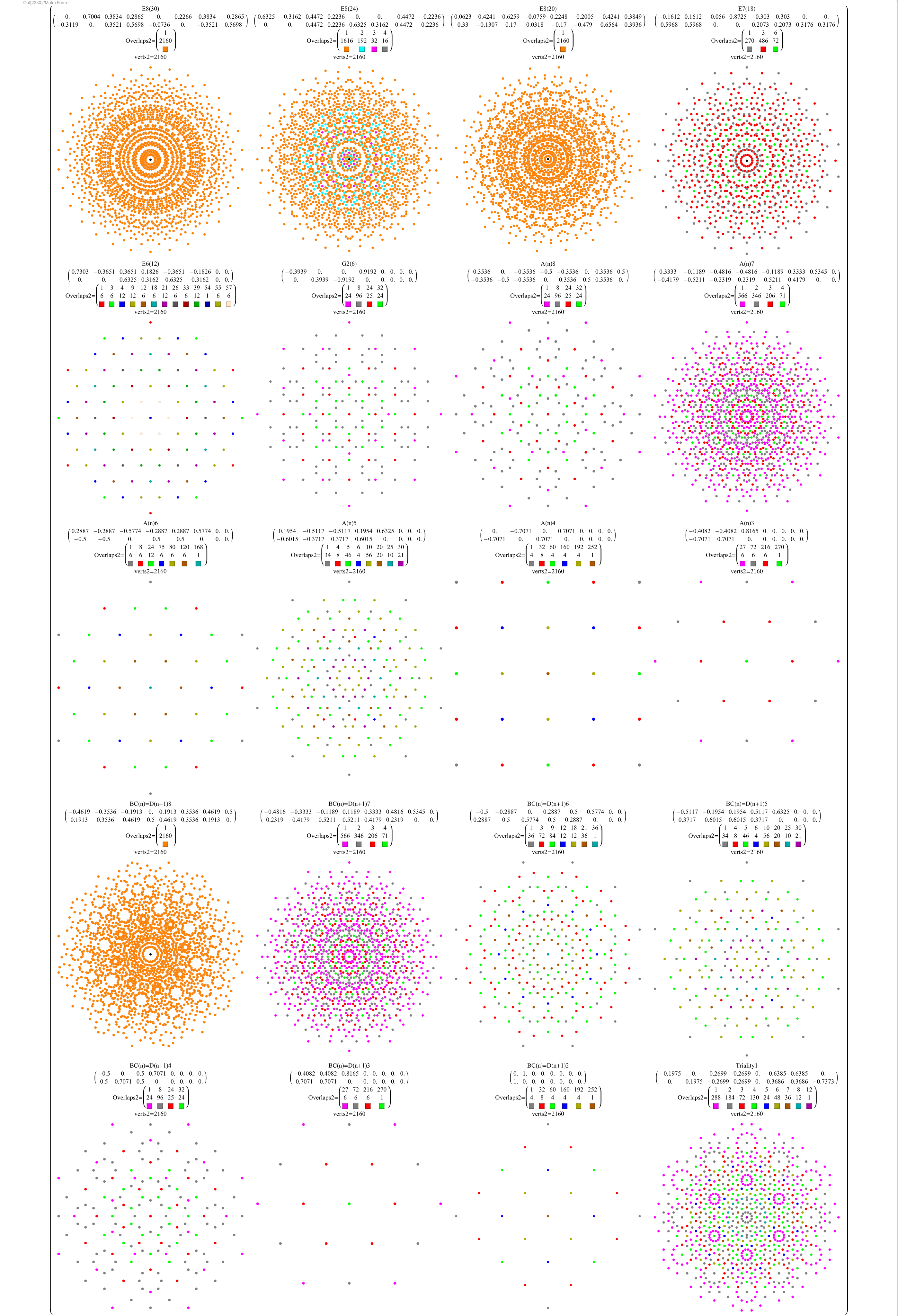
So I decided to visualize the 2401=1+240+2160 vertex patterns of E8 using my Mathematica codebased toolset based on some previous work I put on my Wikipedia talk page.

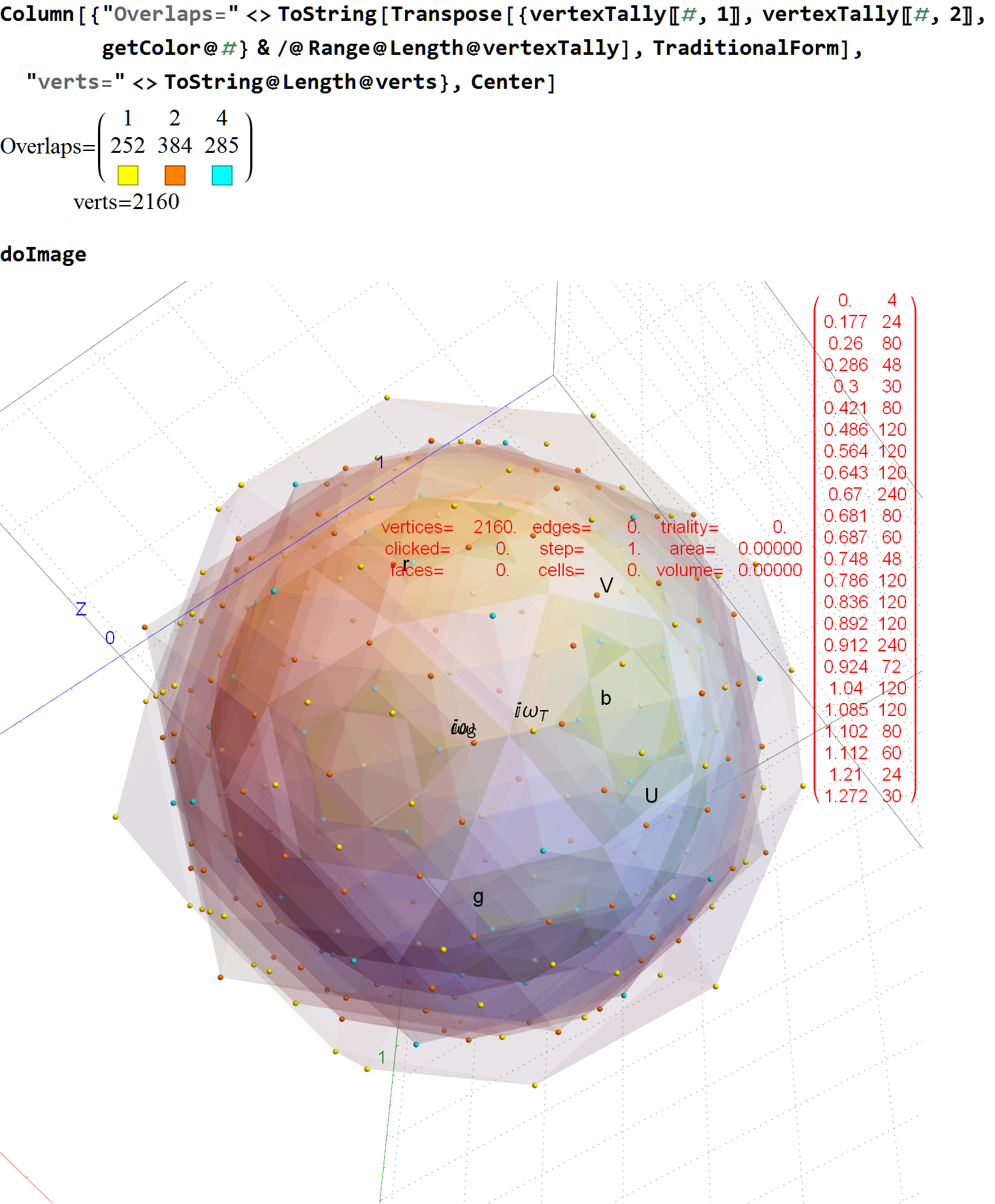
The image below represents various projections showing 6720 edges of the 240 E8 vertices, plus a black vertex at the origin, and the 2160 Witting Polytope E8 2 _ 41 vertices using the same projection basis (listed at the top of each image along with the color coded vertex overlaps). Click these links for a higher resolution PNG or the SVG version.

Some of the particular projections of the Witting Polytope may need 8D rotations applied to the basis vectors to find better symmetries with the Gosset, but this is a start using my standard set of projections.

The 240 vertices of the Gosset Polytope are generated using various permutations:

(* E8 4_21 vertices *)
e8421 = Union@Join[
Eperms8@{1, 1, 1, 1, 1, 1, 1, 1}/2,
perms8@{1, 1, 0, 0, 0, 0, 0, 0}];

The 2160 vertices of the Witting Polytope are generated using various permutations:

(* E8 2_41 vertices *)
e8241=Union@Join[
perms8[{1,0,0,0,0,0,0,0}4],
perms8[{1,1,1,1,0,0,0,0}2],
Eperms8[({2,0,0,0,0,0,0,0}+1)]]/4;

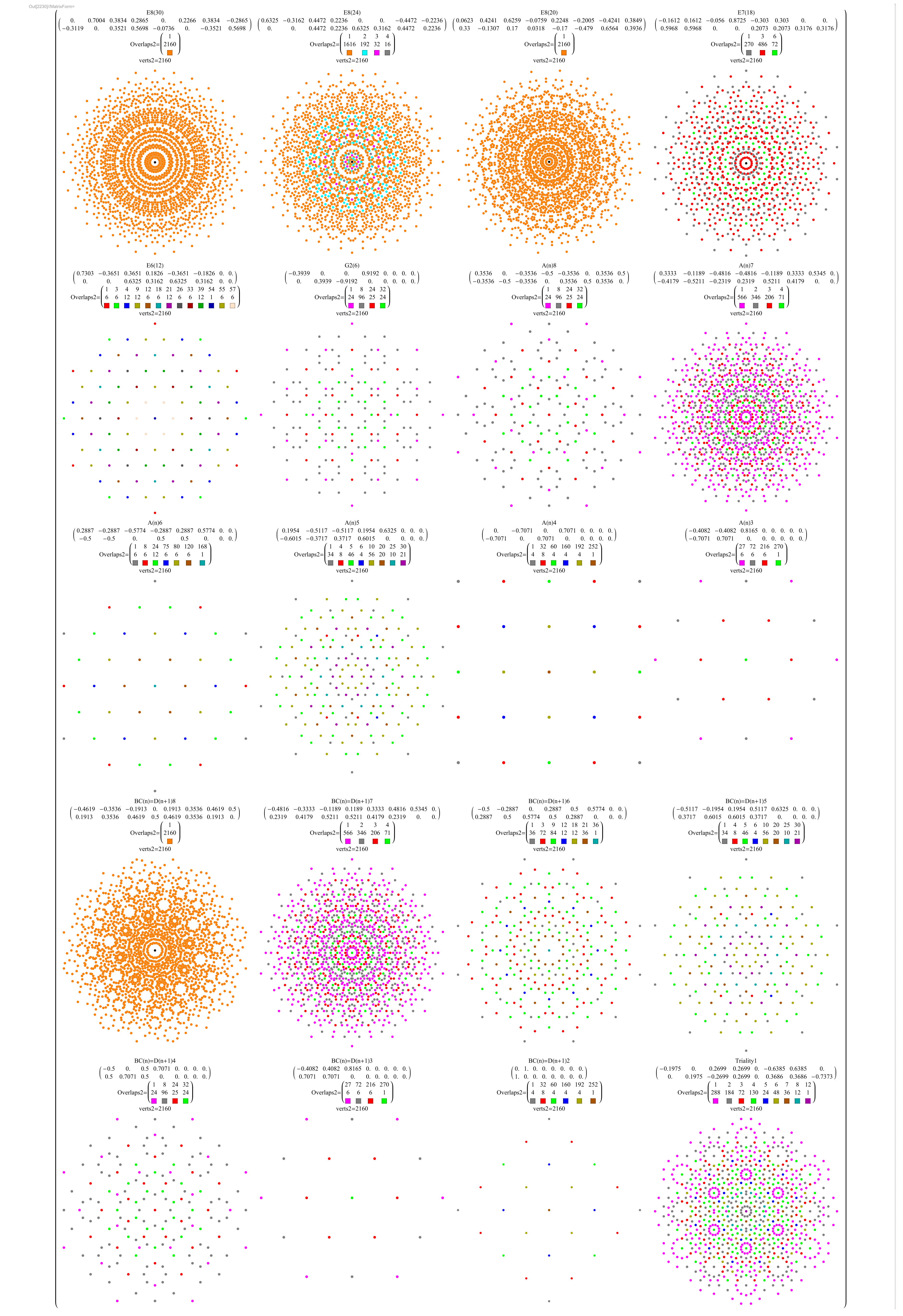
Another view shows just the 2160 Witting Polytope vertices. Click these links for a higher resolution PNG or the SVG version.

2160 Witting Polytope (vertices only)

Another great source of visualizations on E8 and this Witting Polytope is here.

Now visualizing in 3D the structure in 3D using rows 2-4 of the E8->H4 folding matrix, we get:

Witting Polytope with 2160 E8 2 _ 41 vertices sorted by Norm distance into 3D Platonic solid related concentric hull structures using rows 2-4 of the E8->H4 folding matrix. The last image shows overlap counts using colored vertices.
Sets of 8 concentric hulls with hull vertex counts above each.
Full set of concentric hulls with color coded vertices showing overlap counts. Norm’d vertex groups in red.

Latest Paper – Unimodular rotation of E8 to H4 600-cells

Please see my latest paper that describes some advances in understanding the E8 to H4 rotation matrix

https://theoryofeverything.org/TOE/JGM/Unimodular-Rotation-of-E8-to-H4.pdf

Abstract: We introduce a unimodular Determinant=1 8×8 rotation matrix to produce four 4 dimensional copies of H4 600-cells from the 240 vertices of the Split Real Even E8 Lie group. Unimodularity in the rotation matrix provides for the preservation of the 8 dimensional volume after rotation, which is useful in the application of the matrix in various fields, from theoretical particle physics to 3D visualization algorithm optimization.

Visualization of the Icosahedral points generated recursively…

Stereoscopic 3D Interactive Solar system simulation (shoemaker-Levy-9)

Please try: SolarSystem.cdf

It is a Mathematica 11/12 Computable Document Format (CDF) web interactive app that has been purpose built for visualizing Solar System Orbital Mechanics

It requires local installation of the free Mathematica CDF plugin.

This now includes the 1998 OR2 “Planet Killer” that will pass very near Earth in April 2020 (when selecting the Asteroid vs. Comet).

Now with improved UI, better planet scaling, and Anaglyph viz.

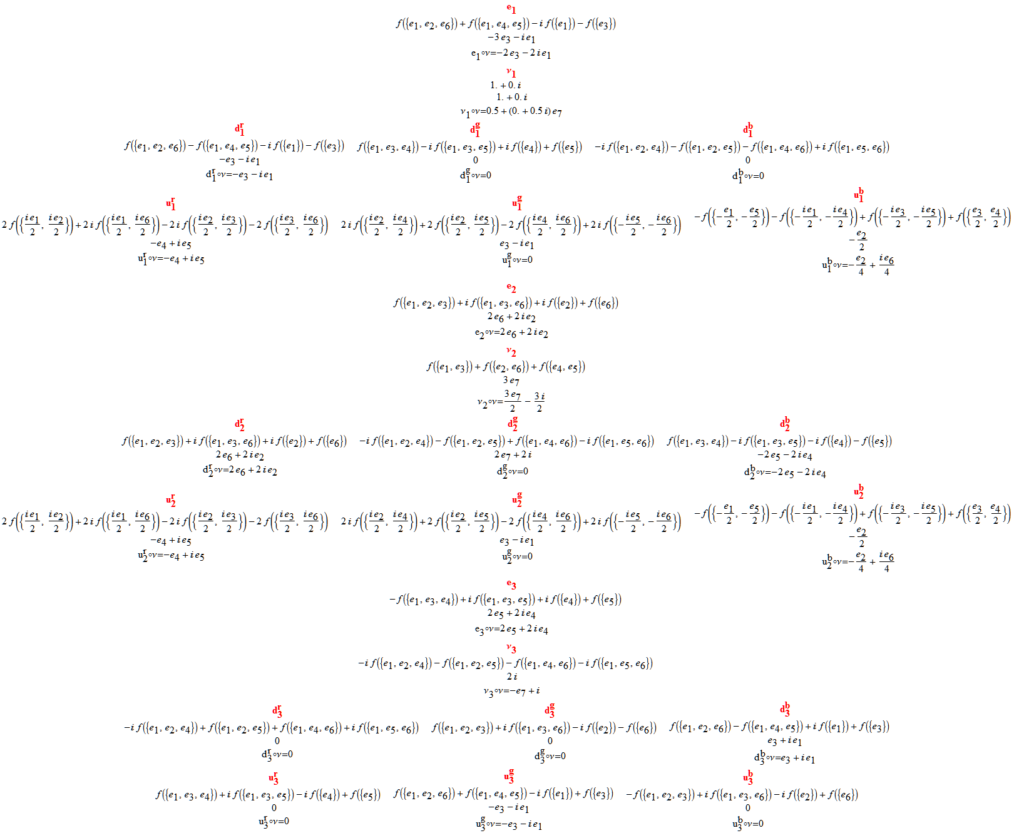
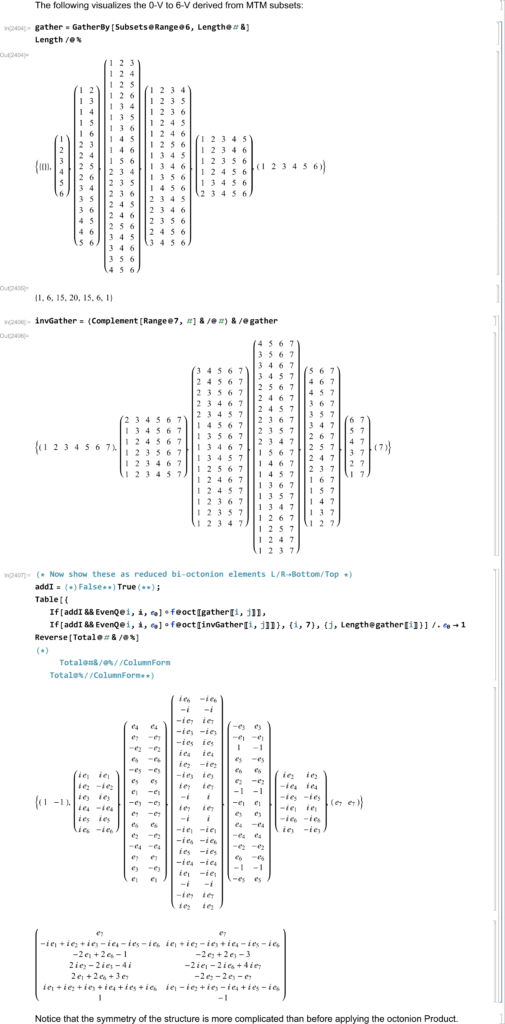
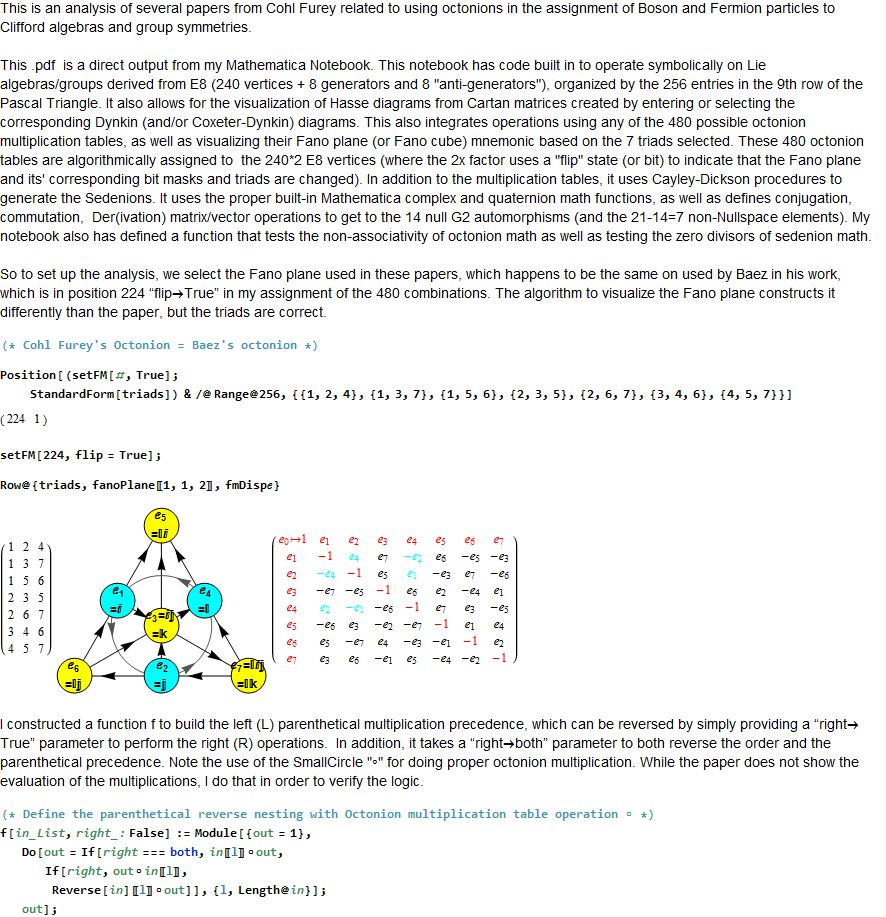
Mathematica Analysis of Cohl Furey’s octonion and Clifford group theoretic ℂ⊗O assignments to standard model particles

I’ve read some recent papers by Cohl Furey and was intrigued by the potential relationship between the octonion and Clifford group theoretic assignments to standard model particles. Since I have developed an extensive Mathematica notebook to perform symbolic analysis using these structures (derived primarily for E8 Lie group work), I decided to follow her suggestion… “The reader is encouraged to check that C⊗O forms the 64-complex-dimensional Clifford algebra Cl(6), generated by the set {i e1,…i e6} acting on f”.

So to that end, I created the this .pdf with some preliminary results of that analysis. I found a few minor issues, but so far the model seems to symbolically compute consistently. Very cool!

A new ‘more Natural’ ToE model with Covariant Emergent Gravity as a solution to the dark sector

Please take a look at my latest paper based on my original work circa 1997-2007.
JGM/010-MOND-CEG-TOE [pdf, cite]
Title: A new ‘more Natural’ ToE model with Covariant Emergent Gravity as a solution to the dark sector
Authors: J Gregory Moxness
Comments: Apr 4 2018, 4 pages.
Subjects: General Relativity and Quantum Cosmology (gr-qc); High Energy Physics – Theory (hep-th)

For citations, remove the LaTex href tag structure if you don’t use the hyperref package.

6 Demicubes Projected via H4 Folding Matrix

Taking the 32 vertex 6 Demicube with an even number of -1 elements and projecting with 3 of the 4 rows of the H4 folding matrix gives an dodecahedron hull with 12 vertices and 30 edges on the hull out of 240 edges of 6D length Sqrt[2]).

BTW – if you find this information useful, or provide any portion of it to others, PLEASE make sure you cite this post. If you feel a blog post citation would not be an acceptable form for academic research papers, I would be glad to clean it up and put it into LaTex format in order to provide it to arXiv (with your academic sponsorship) or Vixra. Just send me a note at:  jgmoxness@theoryofeverthing.org. 

While taking the 32 vertex 6 Demicube with odd number of -1 elements and projecting with 3 of the 4 rows of the H4 folding matrix gives the icosahedron with 20 vertices and 30 edges on the hull out of 240 edges of 6D length Sqrt[2]).

The Rhombic Triacontahedron and E8 to H4+H4Φ folding

I was asked to clarify a particular projection of the Rhombic Triacontahedron from the 6-Cube subgroup of E8, which had I created for WikiPedia (WP) back in 2011 based on an E8 to H4+H4Φ rotation matrix I discovered in 2010.

The edge coloring on the projection above is defined by which of the 6 dimensional axis the edge aligns with.

BTW – if you find this information useful, or provide any portion of it to others, PLEASE make sure you cite this post. If you feel a blog post citation would not be an acceptable form for academic research papers, I would be glad to clean it up and put it into LaTex format in order to provide it to arXiv (with your academic sponsorship) or Vixra. Just send me a note at:  jgmoxness@theoryofeverthing.org. 

The following projection (basis) vectors take the 6-Cube as a subset of E8 and projects it into 3D using the following basis vectors:

Notice the last two dimensions in each vector are 0, which effectively takes the 128 8D 1/2 integer vertices of the E8 BC8 DemiCube into the 6D 6-Cube.

For the following data analysis, it is useful to reference the full list of E8 and H4+H4Φ data at the end of my blog post here.

The clarification desired was due to a conjecture that since E8 folds to H4+H4Φ (600 cells) and D6 folds to H3+H3Φ, that the 6-Cube should fold to an outer and inner rhombic triacontahedron scaled by Φ.

Below is a visualization of D6 folding into 2 concentric H3 icosadodecahedrons at a ratio of Φ using the same projection as described above. The edging displays the  480 Norm’d 6D Sqrt[2] length edges, clearly showing the outer and inner H3 polytopes.

Shown with exterior faces on edges (not a pure convex hull algorithm)…

The data below shows two sets of 30 vertices (outer on the left and inner on the right). They are sorted by the 3D Norm’d length of the vertex ray from {0,0,0}, followed by the vertex number in the E8 to H4+H4Φ list at the end of the post referenced above, along with the 6D E8 vertex that is a member of the D6 set, and the {x,y,z} projected vertex position

The last line of the data set shows that the first set of outer 30 projected vertex locations on the left is numerically equal to the second inner set after multiplication by Φ.

I did the same for the Rhombic Triacontahedron projected out of the 6-Cube.

I separated the outer and inner vertices used to make the WP projection at the top of the post. There are 64 vertices and 192 6D unit length edges forming pentagonal symmetry along specific axis (as well as hexagonal symmetries on other axis). It is clear that scaling the inner 32 vertex locations by Φ is not going to give the outer 32 vertex positions. Yet there is a similarity- they both have 12 vertices of one 3D Norm’d length and 20 of another.

Outer 32 vertices and 60 unit length Norm’d 6D edges.

The edge coloring on the projection above is defined by which of the 6 dimensional axis the edge aligns with.

Inner 32 vertices and 60 unit length Norm’d 6D edges.

The last line of the data set above shows that the outer data (left) is the same as the inner data set multiplied by a factor of Φ when the first 12 (shorter 3D Norm’d)  inner vertices (right) are multiplied by an additional factor of Φ.

This explains the lack of isomorphism, but why is it not like the D6 to H3+H3Φ and E8 to H4+H4Φ in the symmetry of Φ scaling?

The best explanation I can give involves the pattern of left vs. right 3 digits in the 6-Cube E8 vertices. This is due to the left right symmetry of the basis vectors applied to binary pattern of half integer vertices in the 6-Cube.

All vertices have a consistent pattern that differentiates the 20 longer Norm’d vertices from the 12 shorter ones. Specifically, the shorter 12 that have the inner ones needing the added factor of Φ always show that:

  • the right inner vertices all have an even number in 6 +/- elements but not always evenly split across the left and right
  • the left outer vertices all have an odd number of in 6 +/- elements  always unevenly split across the left and right

Whereas, the longer 20 that match the Φ scaling reverse the pattern where:

  • the right inner vertices all have an odd number in 6 of +/- elements  always unevenly split across the left and right
  • the left outer vertices all have an even number in 6 of +/- elements but not always evenly split across the left and right

Another related fact in the folding pattern of the 6-Cube emerges when we note that since E8 contains 128 1/2 integer BC8 (the 8 Demi-Cube). In addition, we note that the 6D complement of BC8 and the 6-Cube is the same set of vertices. This means we get the same projection using all 128 vertices of the 6D trimmed BC8 as we do with the 64 of the 6-Cube, except now there are 768 6D Norm’d unit length edges rather than 192. Interestingly, that means that similar to E8 containing simultaneous copies of 4 600-Cells (a left and right pair scaled at Φ), E8 contains 4 simultaneous copies of the rhombic triacontahedron after adding the Φ scaling on the two sets of 12 inner BC8 vertices).

Wow – that is nice! Remember, you heard it here first!

If we try this idea with the complement of the integer elements of E8, namely the 112  6D trimmed D8 vertices complemented with 60 D6 vertices, the 6D trimmed 52 vertex complement contains 4 identical copies of the excluded 16 generator vertices of E8 {+/-1,0,0,0,0,0,0,0} permutations (plus 4 {0,0,0,0,0,0,0,0} vertices).

As you can see, the folding of the integer elements of E8 do not fold the same as the 1/2 integer elements, and in retrospect, we probably should not expect them to.

It is because of the symmetric 4D left/right symmetry of E8=BC8+D8 that we get the wonderful folding of it into  H4+H4Φ !